
Beyond Voice: How LSTM-CNN & Texture Analysis are Revolutionizing Smart Home Monitoring
Ambient acoustic event assistive framework for identification, detection, and recognition of unknown acoustic events of a residence
This paper introduces the Ambient Acoustic Event Assistive Framework, a cost-effective smart home monitoring system designed to detect 22 "unknown" household acoustic events using low-cost microphone sensors. Leveraging a novel application of Local Binary Patterns (LBP) for audio texture analysis and a customized LSTM-CNN architecture, the framework achieves SOTA performance in residential sound classification and resource wastage detection.
TL;DR
Researchers have developed a novel Ambient Acoustic Event Assistive Framework that identifies 22 often-ignored household sounds (like a leaking tap or an open fridge) with 77% accuracy. By treating sound as a "texture" using Local Binary Patterns (LBP) and processing it through an LSTM-CNN, the system saves energy and enhances security without the need for invasive cameras or wearable sensors.
Background: The Invisible Energy Drain
In the rush of daily life, we often filter out "white noise"—the rhythmic drip of a faucet, the hum of a fan, or the soft click of a cupboard. However, these unattended events are often precursors to accidents or massive resource wastage. Previous solutions required residents to wear gadgets or install CCTVs, both of which face low adoption due to discomfort and privacy fears. This paper asks: Can we use low-cost microphones to "see" these events through sound alone?
The Core Innovation: Sound as Texture
The technical breakthrough lies in how the authors bridge the gap between Audio Signal Processing and Computer Vision.
1. Acoustic-to-Visual Transformation
Raw 1D audio signals are difficult to classify when they overlap or contain noise. The authors transform these into 2D grayscale images. Instead of simple spectrograms, they apply Local Binary Patterns (LBP)—a technique usually reserved for facial recognition or medical imaging.
Why LBP? LBP captures the local spatial structure of the sound's frequency distribution, making the model highly robust to variations in intensity and background noise.
2. The LSTM-CNN Hybrid Architecture
The system uses a tiered architecture (Physical, Fog, and Cloud layers) to process data. The heavy lifting is done by a customized LSTM-CNN:
- CNN Layers: Extract local spatial features (texture) from the LBP-processed audio image.
- LSTM Layers: Handle the temporal sequence, recognizing that a "door closing" has a specific time-order that a "fan humming" does not.
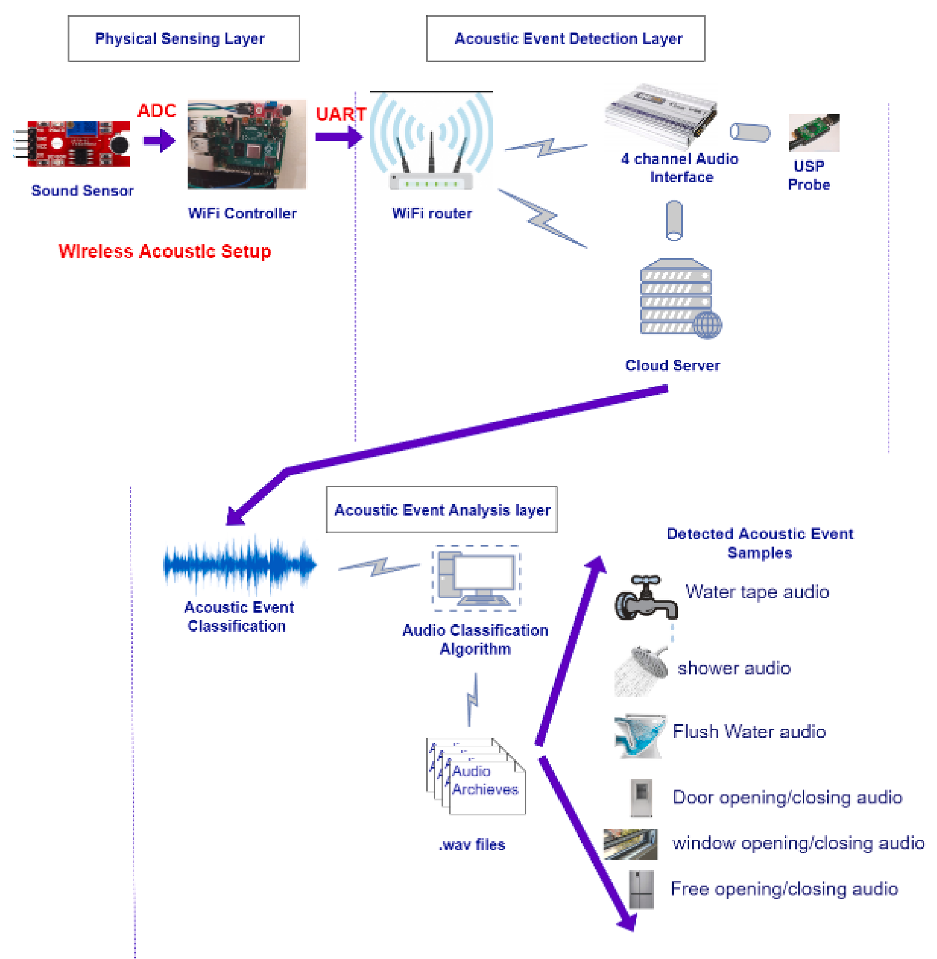 Fig 1: The phase-wise system Architecture of the proposed Ambient Acoustic Assistive Framework.
Experiments & Results
The model was tested against two datasets: the benchmark ESC-50 and a custom "unknown-2000" dataset containing over 2000 samples of residential sounds.
Quantitative Performance
The results were clear: the LSTM-CNN outperformed all classical machine learning models.
- LSTM-CNN: 77.0% Accuracy
- SVM: 72.6% Accuracy
- KNN: 68.3% Accuracy
- C4.5 Decision Tree: 65.3% Accuracy
Noise Robustness
A vital part of the study was the SNR (Signal-to-Noise Ratio) testing. The LBP+LSTM-CNN combination maintained high F1-scores even at SNR0 (extreme noise), proving that texture analysis effectively filters out ambient chaos.
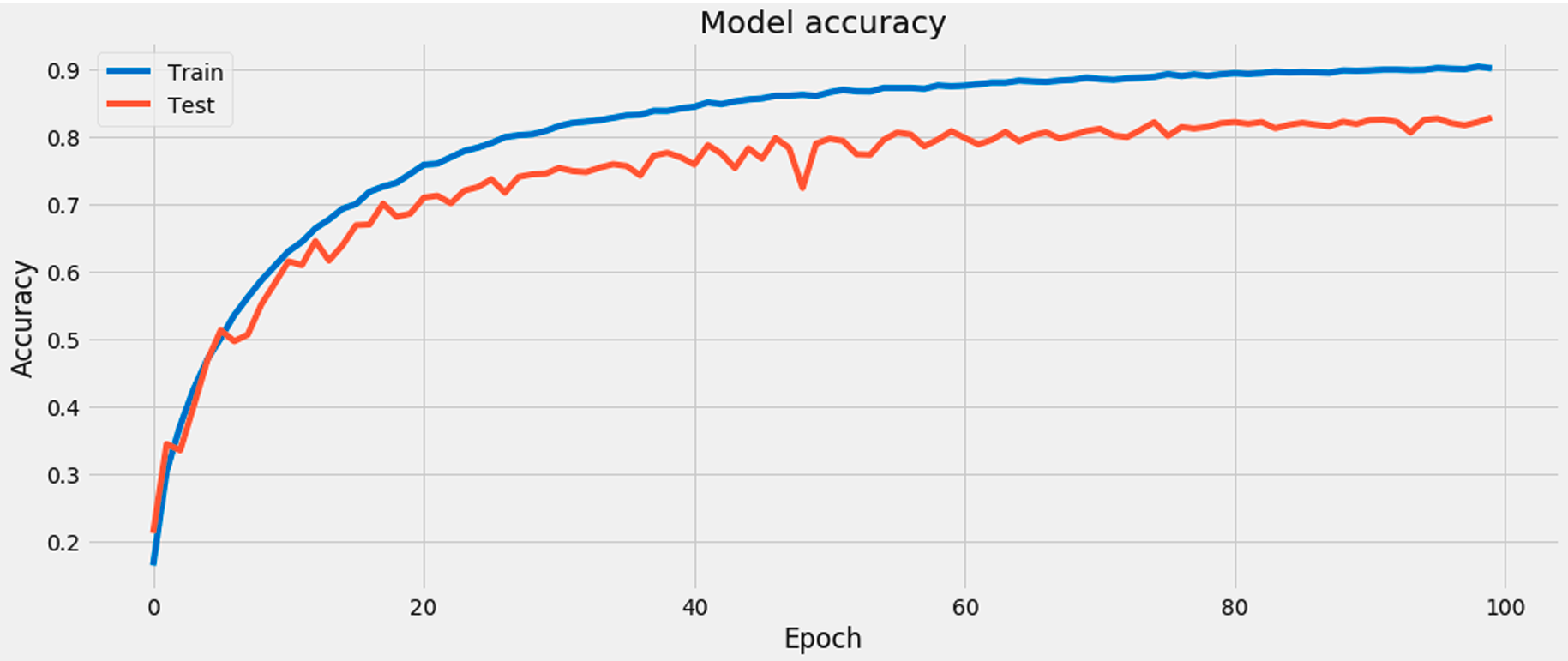 Fig 2: Training and testing accuracy performance, demonstrating the model's convergence and stability.
Critical Analysis: Why It Matters
The most impressive aspect of this work is its cost-effectiveness. By using low-cost microphone sensors and off-the-shelf ESP8266/Wi-Fi modules, the framework is accessible for mass-market smart home integration.
However, there are limitations:
- Complexity of Overlapping Sounds: The paper primarily focuses on discrete events. In a real home, a TV playing near a leaking tap might still confuse the model.
- Dataset Specificity: While "unknown-2000" is a great start, residential acoustics vary wildly by room size and building materials.
Conclusion
This framework moves us closer to a "virtual companion" that monitors our homes silently and respectfully. By proving that LBP-based texture analysis can be applied to audio, the authors have opened a new door for multi-modal AI research in Smart Living.
Final Takeaway: Tomorrow's smart homes won't just listen for your voice commands; they will intelligently monitor the "heartbeat" of your residence to keep you safe and your bills low.