
AMES-Cloud: Revolutionizing Mobile Video with Cloud-Assisted Adaptivity and Social Intelligence
AMES-Cloud: A Framework of Adaptive Mobile Video Streaming and Efficient Social Video Sharing in the Clouds
AMES-Cloud is an adaptive mobile video streaming framework that combines Scalable Video Coding (SVC) and cloud-based private agents to optimize Quality of Service (QoS). It introduces two core mechanisms: AMoV for link-adaptive bitrate adjustment and ESoV for social-network-aware video prefetching.
Executive Summary
TL;DR: AMES-Cloud is a comprehensive framework designed to eliminate the common frustrations of mobile video streaming—buffering and disruptions. By leveraging cloud-based private agents for each user and combining Scalable Video Coding (SVC) with Social Network Service (SNS) analysis, it achieves seamless playback and proactive content delivery.
Background Positioning: This work represents a significant shift from "server-centric" or "client-only" adaptation to a "cloud-agent" model. It effectively utilizes the elasticity of cloud computing to solve the scalability bottleneck of traditional adaptive streaming.
Problem & Motivation: The Gap in the Wireless Link
Despite the evolution from 3G to LTE, the gap between video traffic demand and wireless link capacity remains a critical pain point. The inherent volatility of mobile environments—caused by multi-path fading, user mobility, and cell congestion—makes stable video delivery nearly impossible with fixed-bitrate streams.
Current solutions often rely on the server to manage every user's adaptation, leading to a computational bottleneck. Furthermore, standard content delivery networks (CDNs) are reactive; they don't know what a user will watch until they click.
Methodology: The Core of AMES-Cloud
The framework is bifurcated into two synergistic components:
1. AMoV (Adaptive Mobile Video streaming)
Instead of maintaining multiple versions of a video (which wastes storage), AMES-Cloud uses SVC. SVC encodes a video into a Base Layer (BL) for essential quality and multiple Enhancement Layers (EL) for higher resolution or frame rates.
- Private Agents (subVC): Each user gets a virtual agent in the cloud that monitors their specific link quality (RTT, Packet Loss, SINR).
- Dynamic Matching: The agent predicts the next window's bandwidth and dynamically selects the number of ELs to transmit, ensuring "non-terminating" playback.
2. ESoV (Efficient Social Video sharing)
ESoV moves from reactive streaming to proactive prefetching. It analyzes the "Social Strength" of interactions:
- Direct Recommendations: High probability—prefetches the entire video.
- Subscriptions: Medium probability—prefetches the first 10%.
- Public Sharing: Low probability—prefetches the base layer only.
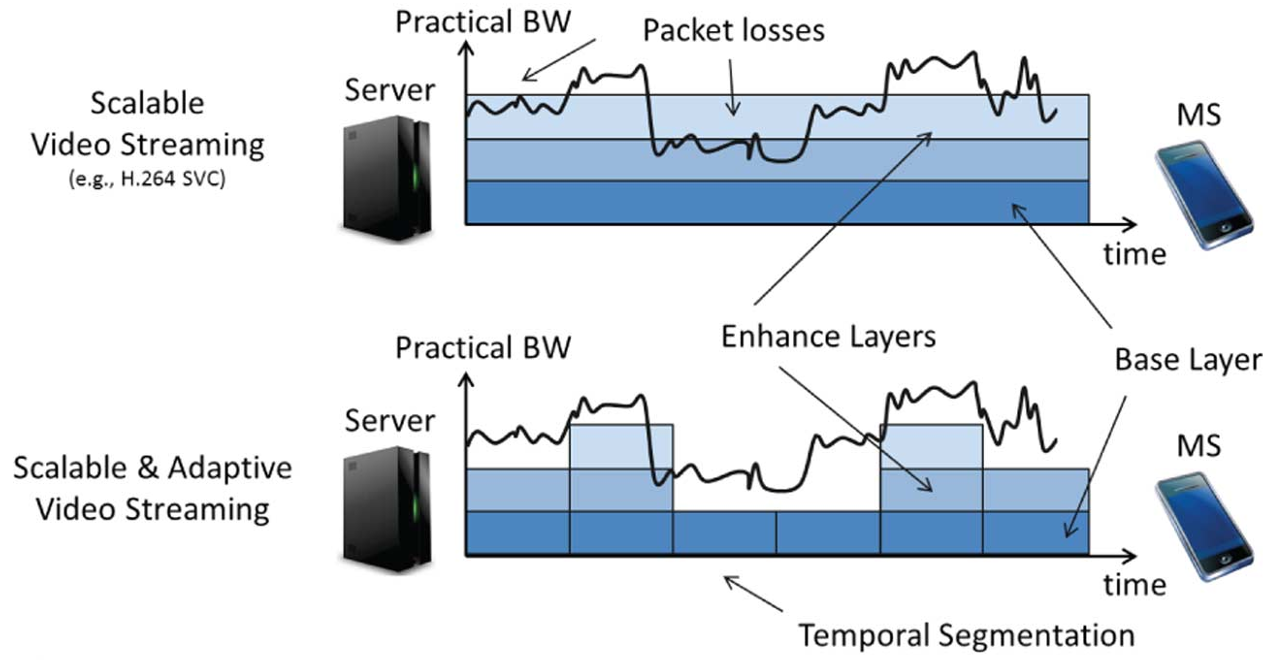 Fig 1: A comparison of traditional streaming vs. the AMES-Cloud SVC approach.
Experiments & Results
The researchers implemented a prototype using KT's U-cloud and Android clients on LTE/3G networks.
- Prediction Accuracy: For short time windows (1-2 seconds), the measurement-based bandwidth prediction achieved a relative error of only ~10%, proving it robust enough for real-time adaptation.
- Cloud Efficiency: Cloud-based SVC encoding was proven viable for real-time applications, with delays staying well below 1 second for standard resolutions.
- Zero-Delay Playback: When social prefetching (ESoV) was active, the "click-to-play" delay was virtually eliminated, providing a superior UX compared to standard HTTP streaming.
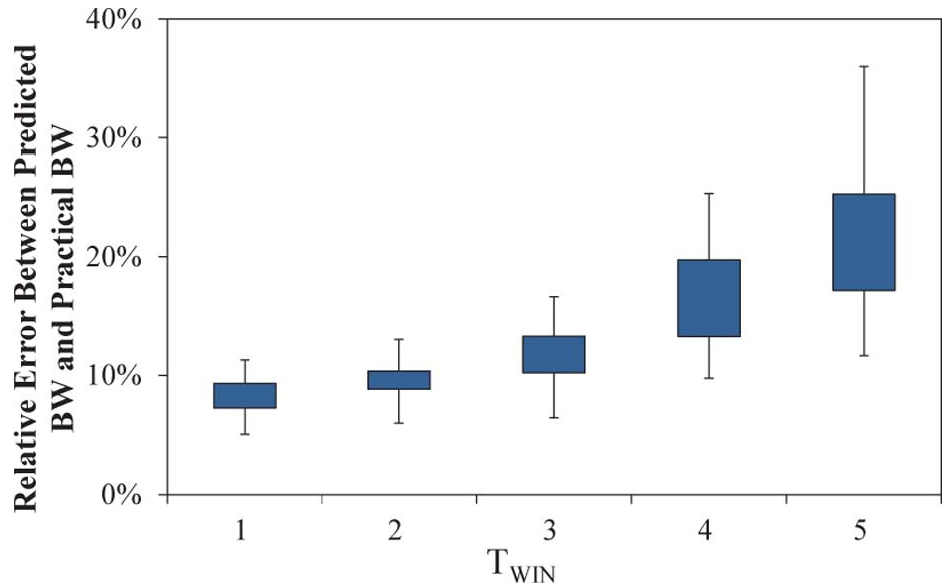 Fig 2: Reliability of bandwidth prediction at different time intervals ().
Critical Analysis & Conclusion
Takeaway
The genius of AMES-Cloud lies in its personalized cloud virtualization. By giving every user a dedicated "brain" in the cloud, the system can perform complex SVC adjustments and social-based prefetching that would be too heavy for a central server or a resource-constrained mobile device.
Limitations
- Cost: Maintaining individual agents and performing real-time SVC encoding for thousands of concurrent users presents a significant financial and energy cost for providers.
- Privacy: Prefetching based on social analysis requires access to user social graphs, raising potential privacy concerns.
Future Outlook
As we move toward 6G and increasingly integrated social-media-video platforms (like TikTok or Reels), the proactive "push" model suggested by AMES-Cloud will likely become the industry standard, potentially enhanced by AI-driven user behavior modeling.