
Beyond Polarity: How Amplifiers, Downtoners, and Negations Shape the Geometry of Emotions
An Empirical Analysis of the Role of Amplifiers, Downtoners, and Negations in Emotion Classification in Microblogs
The paper presents an empirical study on how linguistic modifiers—amplifiers, downtoners, and negations—affect discrete emotion classification in microblogs. The authors introduce a modifier scope detection method and a weighted lexical model to decode the semantic shifts from prior emotions to predicted classes.
TL;DR
While we know "very happy" is more intense than "happy," what happens to the underlying emotion when we say "not happy" or "slightly afraid"? This paper moves beyond simple sentiment (positive/negative) to analyze how modifiers transform discrete emotions (Joy, Anger, Fear, etc.). By using a weighted lexical model, the authors prove that modifiers act as semantic "shifters" that can navigate the complex space between different emotional states.
Context: Why "Not" is Not Enough
In sentiment analysis, a negation is usually a simple bit-flip: "good" (+1) becomes "not good" (-1). However, in the world of discrete emotions, the logic breaks down. If you are "not sad," are you happy? Or are you just indifferent? The authors argue that existing models, especially simple Bag-of-Words (BoW) approaches, miss the vital nuances provided by:
- Amplifiers: Words like "extremely" or "totally."
- Downtoners: Words like "hardly" or "slightly."
- Negations: Words like "never" or "not."
Methodology: Mapping the Emotional Shift
The researchers developed a two-step framework to track these modifiers.
1. Scope Detection
Before you can analyze a modifier, you must know what it modifies. The authors compared three methods: a "Next-n" heuristic, Dependency Tree parsing, and a Binary SVM. Surprisingly, the simplest method—a Next-2 heuristic (assuming the modifier affects the following two tokens)—outperformed complex dependency parsing in the noisy environment of Twitter.
2. The Weighted Matrix Model
The core innovation is the use of four 6x6 matrices (). Each cell represents how a word with an initial "prior" emotion contributes to a "final" emotion vote.
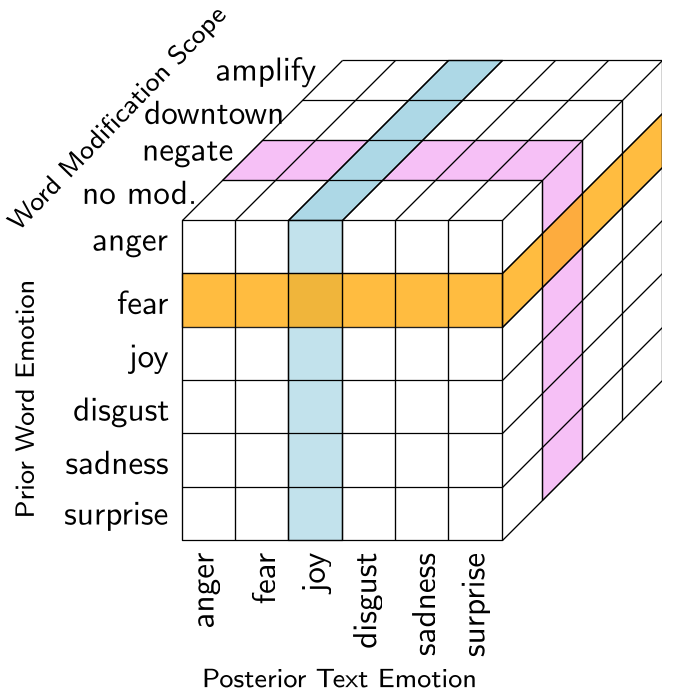
Fig. 1: The tensor structure used to optimize the weights of emotional transitions across different modifiers.
Key Insights: What the Data Tells Us
The results of the weight optimization (via hill-climbing) revealed fascinating linguistic patterns that align with psychological models like Plutchik’s:
- Amplifiers Clarify: Amplifiers (e.g., "very") don't just add volume; they "purify" the emotion by suppressing secondary connotations. For example, "very joy" strongly negates "anger," more so than "joy" alone.
- Downtoners Blur: Downtoners (e.g., "slightly") act as the opposite of amplifiers. They often push an emotion toward a related but different state. Interestingly, the authors found that fear in the scope of a downtoner often expresses surprise.
- The Negation Flip: "Not happy" was found to be statistically closer to sadness than to anger or fear.
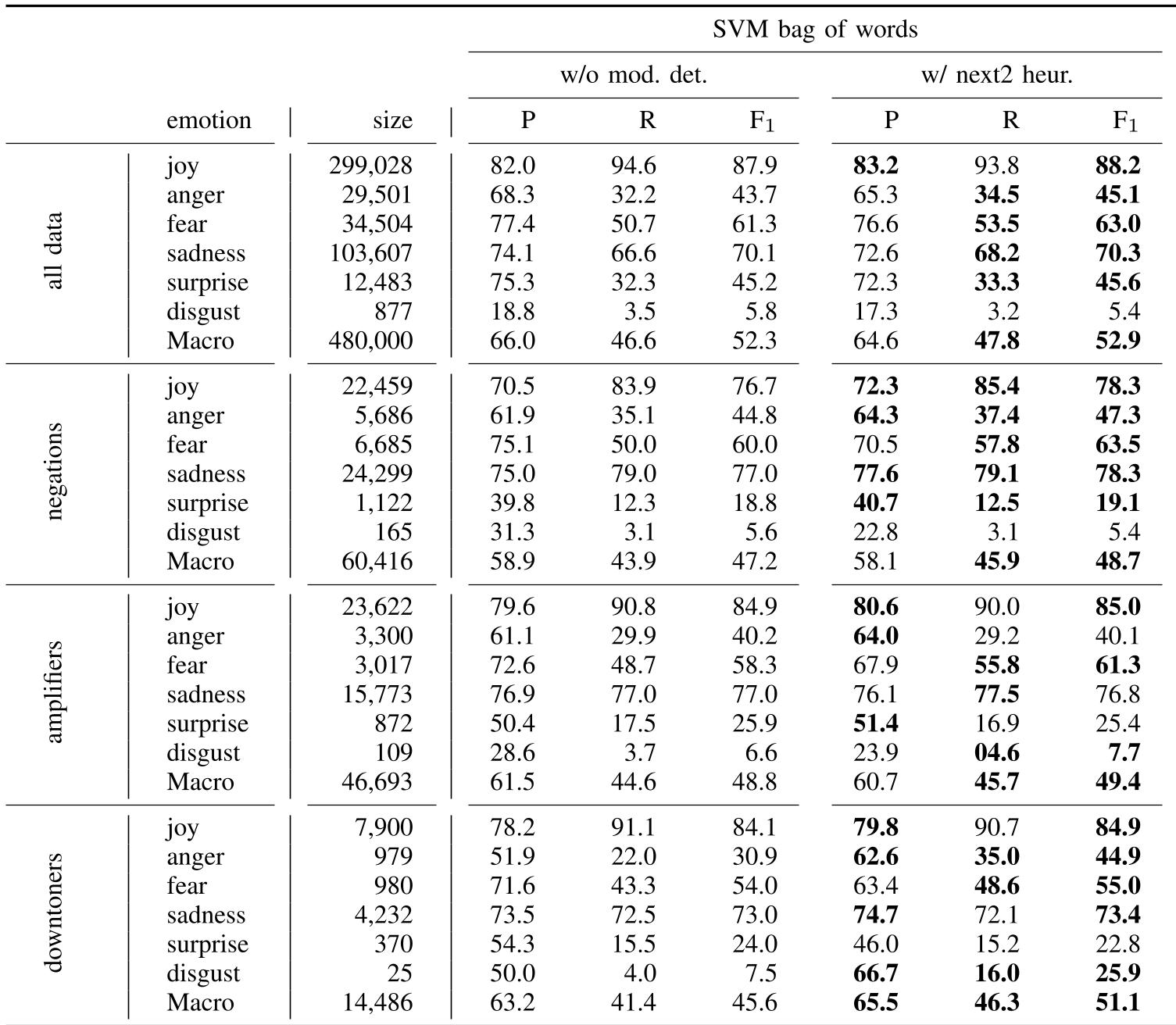
Fig 2: Performance comparison showing that including modifier detection (Next-2) consistently boosts F1 scores across various emotion categories.
Deep Dive: The "Geometry" of Negation
The most striking takeaway is the visualization of the weight matrices. The "No Modifier" matrix is largely diagonal (meaning "joy" words predict "joy"). However, the "Negation" matrix shows significant off-diagonal activity.
- Joy Sadness: Negated joy contributes heavily to the sadness score.
- The Surprise Factor: Surprise is a "double-edged" emotion. The study found it can be divided into positive and negative realizations, where modifiers help disambiguate the intent.
Critical Analysis & Future Work
The study proves that even simple BoW models can be significantly improved by adding a "linguistically aware" layer. However, the reliance on a Next-2 heuristic, while effective for Twitter, might fail in more complex literature where modifiers have longer-range dependencies.
Future Outlook: The authors suggest that integrating these "weight matrices" into Neural Network attention heads could lead to "Explainable AI" that doesn't just predict an emotion but can explain how a specific adverb shifted the sentiment of the entire sentence.
Summary
By treating linguistic modifiers as mathematical operators on an emotional vector space, this paper provides a roadmap for more sophisticated, nuanced social media mining. It settles the debate: "not happy" isn't just "less happy"—it's a calculated step toward sadness.