
Cognition over Heuristics: Bridging Ontology Alignment and Analogical Reasoning via LISA
The role of analogy in ontology alignment: A study on LISA
This paper explores the application of the LISA (Learning and Inference with Schemas and Analogies) cognitive model to the task of ontology alignment. By treating alignment as a form of human-like analogical reasoning, the authors demonstrate that a symbolic-connectionist architecture can achieve performance comparable to state-of-the-art (SOTA) engineering heuristics, ranking 4th in the OAEI benchmark.
TL;DR
Is ontology alignment—the process of finding correspondences between different knowledge schemas—actually a subset of human analogical reasoning? This paper investigates this by applying LISA (Learning and Inference with Schemas and Analogies), a cognitively-validated model, to the Semantic Web. The results prove that a system designed to simulate human brain activity can match, and sometimes beat, sophisticated engineering algorithms in aligning complex ontologies.
The Missing Theoretical Foundation
Ontology alignment is essential for the Semantic Web to function, allowing independently developed systems to "speak" to one another. Despite decades of research into lexical similarities and graph-based matching, the field remains a "toolbox" of heuristics.
The authors argue that since humans provide the "ground truth" for alignment quality, the systems themselves should perhaps emulate human cognition. They look toward Analogical Reasoning—the process of mapping knowledge from a base domain to a target domain based on structural relationships rather than just surface traits (e.g., "an electric battery is like a reservoir").
Methodology: How LISA Thinks
LISA is a symbolic-connectionist model. It represents knowledge as propositions but processes them through neural activation.
1. Symbolic Knowledge Representation
Ontologies are decomposed into LISA-compatible structures:
- Objects: OWL classes or properties (e.g.,
Paper). - Roles: Predicates defining relationships (e.g.,
isSubClassOf). - Semantic Units: The "meaning" nodes derived from comments and labels (e.g., terms like "conference" or "published").
2. Connectionist Dynamics (The Co-activation Mystery)
LISA doesn't just "calculate" a similarity score. It operates by simulating attention:
- When a proposition in the "driver" ontology is activated, it fires its constituent roles and objects.
- This activation flows through shared semantic units to the "recipient" ontology.
- If a concept in the recipient ontology "wakes up" at the same time as the driver concept, a mapping connection is formed.
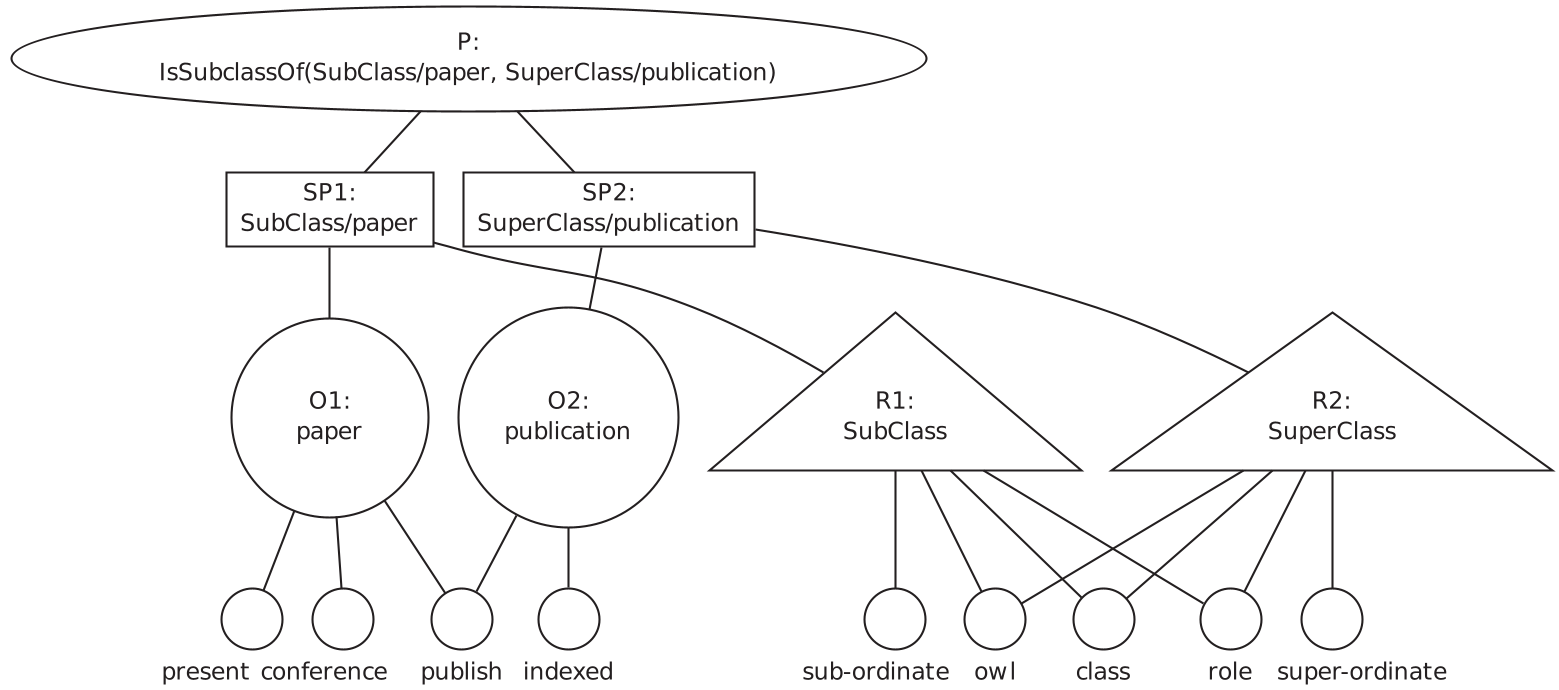 Figure 1: The hierarchical structure of a LISA proposition, showing how objects and roles connect to underlying semantic units.
Experiments: Tuning the "Human" Brain
The researchers tested 48 different configurations of LISA against the OAEI (Ontology Alignment Evaluation Initiative) benchmarks.
Key Insights from Data Analysis:
- Activation Order Matters: Just like humans can't process everything at once, the order in which LISA "thinks" about concepts (Classes -> Subclasses -> Properties) significantly impacts its success.
- Relational vs. Non-Relational: Representing relationships as higher-order propositions (Relational Encoding) allows LISA to exploit deeper structural patterns, leading to a mean F-score improvement.
- Robustness: LISA's performance (Mean F-score ~0.71) ranked it 4th among 20 specialized alignment systems, proving that a general-purpose cognitive model is competitive with highly specialized software.
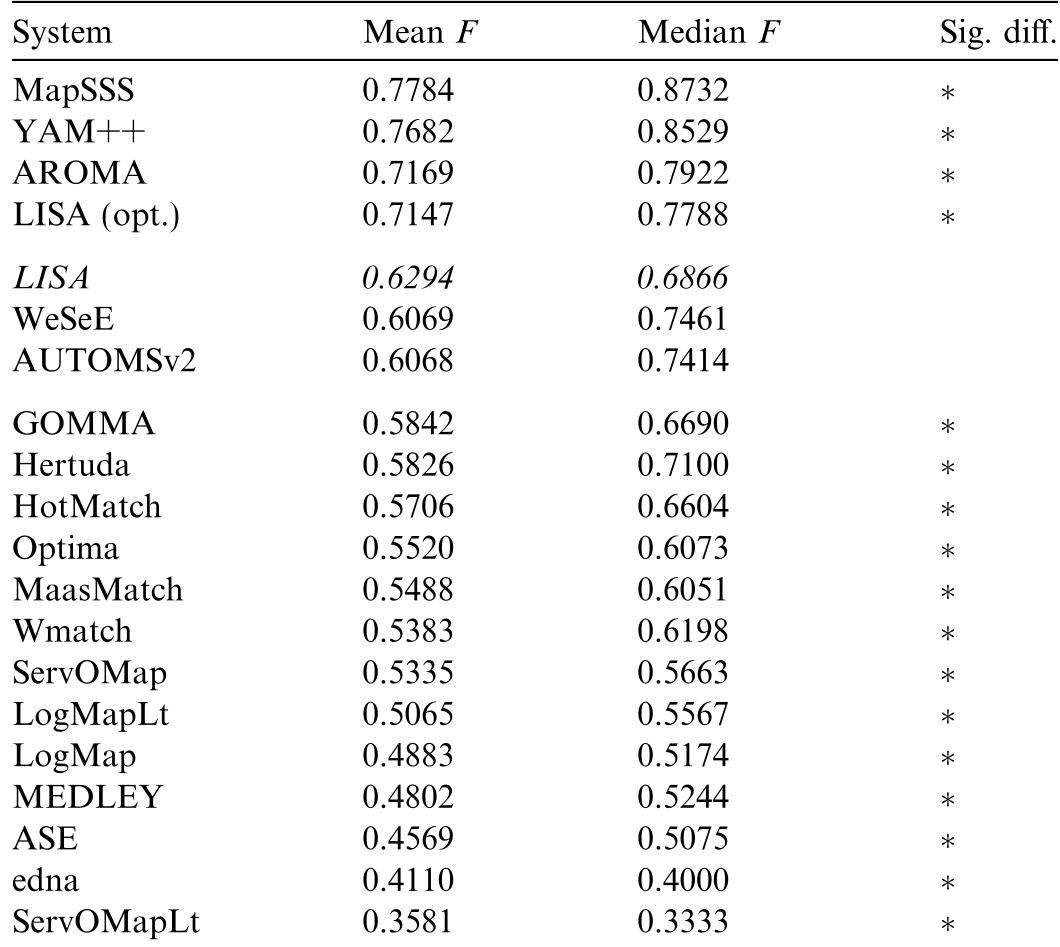 Table 1: LISA (opt.) compared against other systems in the 2012 OAEI competition.
Critical Analysis: The Strengths and Limits
Why it works: LISA excels at Systematicity. It doesn't just look for words that look alike; it looks for clusters of relationships that "feel" identical between two domains. This mimics the human ability to understand that a "Professor" in one ontology and a "FacultyMember" in another serve the same structural role.
The Catch:
- Language Sensitivity: LISA relies heavily on "semantic units" parsed from labels. If the ontologies are in different languages (English vs. French) without pre-translation, the neural activation won't bridge the gap.
- Scalability: Cognition is expensive. Simulating the temporal firing of neurons for thousands of classes is computationally more taxing than a simple string-match algorithm.
Conclusion: Toward a Cognitive Semantic Web
This paper is a successful proof-of-concept for the Cognitive Semantic Web. It proves that the "black box" of human intuition for data mapping can be modeled and automated. For future AI researchers, the takeaway is clear: when solving logical interoperability problems, sometimes the best architecture is the one already inside our heads.
Future Directions
The authors suggest that future work should focus on textual coherence—grouping propositions so that "attention" moves through the ontology in a way that mimics a human expert reading a document.