
Strategic Incentives: Optimizing Participation in Dynamic Crowdsourcing Systems
Analysing Incentive Strategies to Promote Participation in Crowdsourcing Systems
2016-01-01
Summary
Problem
Method
Results
Takeaways
Abstract
This paper introduces two adaptive monetary incentive strategies, Adaptive System-Oriented (ASO) and Adaptive User-Oriented (AUO), designed for crowdsourcing systems with temporal constraints. These methods aim to maximize system utility by reaching a target number of contributions at a cost near the theoretical optimum, specifically accounting for dynamic user reward expectations over multiple rounds.
## Executive Summary
**TL;DR**: This paper tackles the challenge of recruiting a specific number of participants for crowdsourcing tasks under budget and time constraints. By introducing **Adaptive System-Oriented (ASO)** and **Adaptive User-Oriented (AUO)** strategies, the authors demonstrate how systems can adjust monetary rewards round-by-round to match the shifting price expectations of the crowd, significantly improving cost-efficiency.
**Background**: Positioned at the intersection of Multi-Agent Systems (MAS) and Behavioral Economics, this work moves beyond static "take-it-or-leave-it" offers toward a dynamic, feedback-driven recruitment model that accounts for the "irrational" patterns of human participants.
## Problem & Motivation: The Cost of Fixed Incentives
Most crowdsourcing platforms (like Amazon Mechanical Turk or traffic monitoring apps) face a fundamental trade-off: pay too little and you miss your deadline; pay too much and the budget vanishes.
The authors identify a critical gap in prior work: **Dynamic Reward Expectations**. Users don't just want $X$; their "price" changes based on the urgency of the task and their previous interactions. Prior SOTA methods often treat the market as a static distribution. The authors argue that because the system's deadline ($T$) and budget ($B$) are private, agents treat every round as potentially the last, necessitating a Game Theoretic approach to ensure a Nash Equilibrium where participation remains profitable for both parties.
## Methodology: Learning the Market on the Fly
The core innovation lies in how the system estimates the reward "market":
### 1. Adaptive System-Oriented (ASO)
This strategy is "blind" to individual user profiles, respecting privacy. It treats the population as a black box and tries to estimate the **Cumulative Distribution Function (CDF)** of rewards:
* **Short-Term Memory (STM)**: Uses only the last two rounds to draw a linear estimation of the price-to-sample ratio.
* **Long-Term Memory (LTM)**: Uses a Least Squares method to find the best fit across all historical rounds.
### 2. Adaptive User-Oriented (AUO)
This strategy involves a "Call for Participation" (cfp) where agents report an expected reward ($ ilde{r}_i$). The system then orders these reports to find the lowest cost for the required samples ($x_t$).
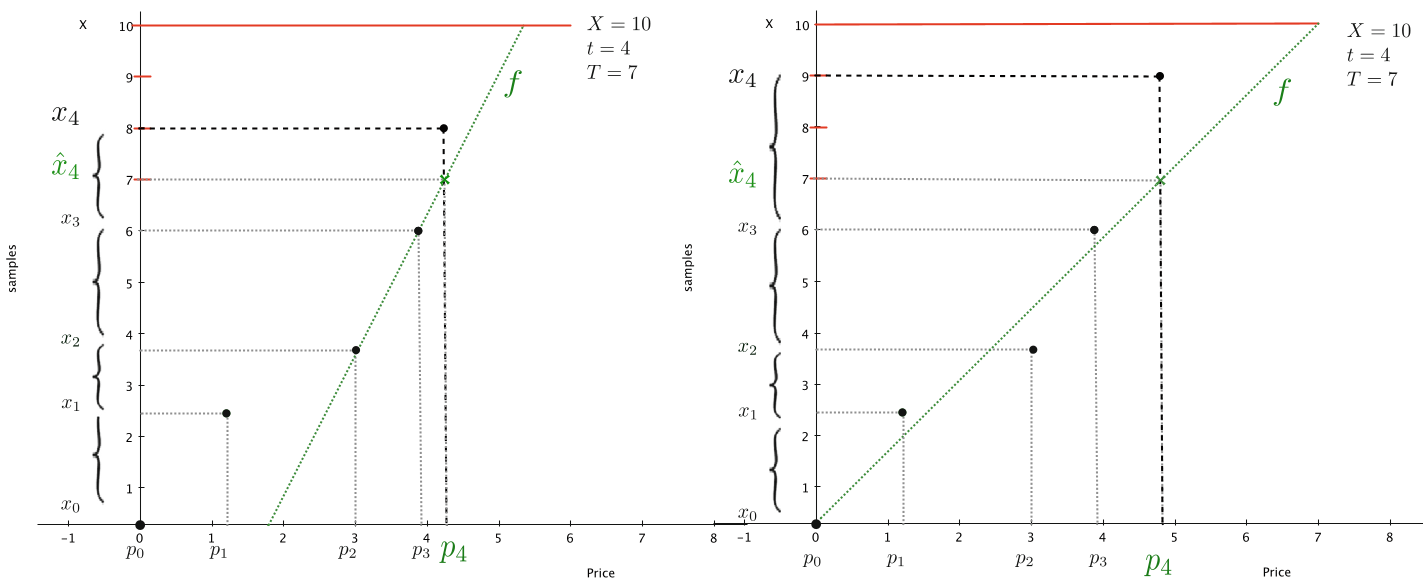
*Figure 1: Visualizing the linear estimation of the market CDF (f) based on price (p) and samples (x).*
## Experiments: Navigating Irrationality
The researchers tested their algorithms against two populations:
1. **Population 1**: 75% "Irrational" users (high variance in expectations).
2. **Population 2**: 75% "Rational" users.
### Key Findings:
* **Recency Bias Wins**: In highly irrational populations, the **STM** method (Short-term) actually outperformed the more complex LTM method. This suggests that in volatile markets, distant history is "noise" that degrades the system's ability to predict current needs.
* **Information has a Price**: While the **AUO (Informed)** strategy resulted in the lowest expenses (as seen in Table 1), it occasionally failed to reach the required sample goal ($G=800$) when users were irrational, because the reports provided by the agents were unreliable.

*Table 1: Performance comparison. Note that in Population 1, "Informed" (AUO) had lower samples (797) than our target (800).*
## Critical Analysis & Conclusion
**Takeaway**: The study proves that "perfect information" (asking users what they want) isn't always the silver bullet in crowdsourcing, especially when users act irrationally. A robust system must balance between asking for user input and observing actual market behavior.
**Limitations**: The model assumes user contributions are homogeneous (same quality). In real-world tasks (like data labeling), the system would also need to weigh the *quality* of the sample against its *cost*, a multi-objective optimization problem not covered here.
**Future Prospect**: Integrating these adaptive strategies into decentralized Autonomous Organizations (DAOs) where budget and deadlines could be managed by smart contracts, potentially using these ASO-STM algorithms to stabilize localized "gig economy" markets.