
"I Like" Therefore I Trust: Decoding Social Interactions for Automated Trust Graphing
"I Like" - Analysing Interactions within Social Networks to Assert the Trustworthiness of Users, Sources and Content
This paper presents a comprehensive user study (n=178) analyzing how trust can be algorithmically inferred from implicit social interactions rather than explicit ratings. It maps common actions like "Liking," "Retweeting," and "Commenting" on platforms like Facebook and Twitter to the perceived trustworthiness of users, content, and information sources.
TL;DR
In the digital age, we "Like," "Share," and "Retweet" hundreds of times a week, but these actions are more than just engagement metrics. Researchers Owen Sacco and John G. Breslin propose that these implicit interactions are the keys to solving the scalability problem of online trust. By analyzing user behavior across Facebook, Twitter, and LinkedIn, they have developed a framework to calculate the trustworthiness of users, sources, and content without requiring a single manual rating.
The Problem: The Static Trust Fallacy
Most Social Networks operate on a "one-size-fits-all" privacy model. If you are a "friend," you see everything. However, human trust is granular and dynamic. You might trust a colleague for professional news but not for personal health advice.
Previous academic attempts to solve this involved Explicit Trust Ratings—asking users to rate their friends on a scale of 1 to 10. This failed because:
- Labor Intensity: It’s too much work for the user.
- Temporal Decay: Trust changes, but ratings stay static.
- Context Blindness: A single number cannot capture trust across different topics.
Methodology: Mapping Actions to Trust
The authors conducted a survey of 178 participants to see how they perceive their own daily interactions. They found that different buttons carry different "trust weights."
1. The Interaction-Trust Matrix
The core of the methodology is the mapping of interactions to three trust entities:
- The Source: Influenced by Sharing and Re-sharing.
- The Content: Influenced by Sharing, Re-sharing, and Liking.
- The Requester (User): Influenced by Liking, Commenting, and Tagging.
2. Mathematical Modeling
To turn a "Like" into a trust score, the authors propose a subjective trust value () calculated as a weighted average. This account for social graph transitivity—meaning if your trusted friends trust a source, your subjective trust in that source increases.
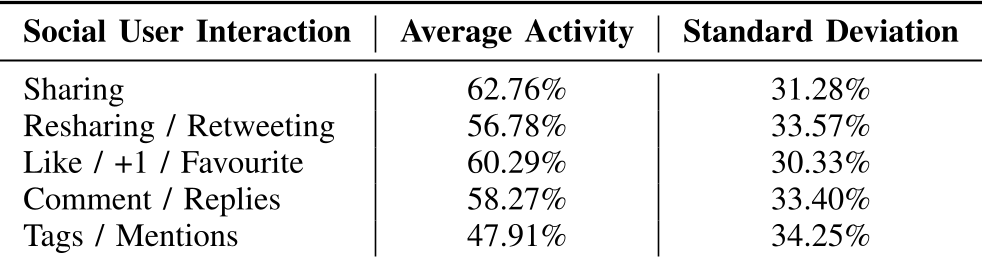 Figure: Average activity levels for different social interactions across platforms.
Key Insights and Results
The study highlights a major discrepancy between platform popularity and trust utility:
- Platform Dominance: Facebook and Twitter remain the primary hubs for trust-building interactions. LinkedIn, despite being "professional," had the highest "Never Use" rates for sharing (64%) and commenting (67%).
- The Power of the Retweet: Re-sharing/Retweeting (53.33%) and Tagging (45.67%) were perceived as the highest indicators of trust in the other person.
- Source over User: Surprisingly, users are more concerned with the reliability of the Original Source (65%) than the reliability of the person who shared it with them.
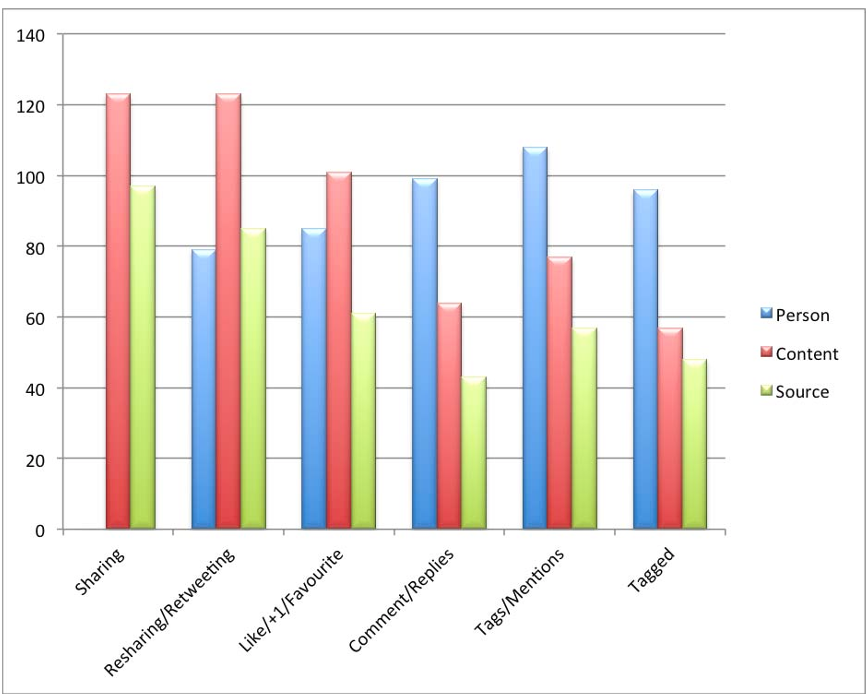 Figure: Overall participant perception of trust across various interaction types.
Critical Analysis & Future Outlook
While the paper provides a solid foundation for Implicit Trust Assertion, it leaves some stones unturned:
- Semantic Sentiment: Current formulas treat all comments as equal. However, a "Reply" could be a scathing correction rather than an endorsement. The authors acknowledge that future work must use Natural Language Processing (NLP) to analyze the semantics of replies.
- The "Zero-Interaction" Cold Start: What happens when a new user joins? The model currently results in zero trust, requiring reliance on external identity providers or "Social Web" history.
Final Takeaway
This research moves us closer to a "Semantic Privacy" model where SNS platforms can automatically suggest: "You haven't interacted with Alice's posts in two years; should we restrict her access to your private photos?" By leveraging the data we already generate through "Likes" and "Shares," we can create a safer, more intuitive Social Web.