
Beyond Mental States: Redefining Agent Speech Acts as Institutional Actions
An analysis of agent speech acts as institutional actions
This paper presents a formal analysis of Agent Communication Languages (ACLs) by redefining speech acts as "institutional actions" rather than simple physical or mental events. The authors propose a social commitment-based framework that distinguishes between natural actions (governed by physical causation) and institutional actions (governed by the "counts as" relationship).
TL;DR
Communication in multi-agent systems (MAS) is often treated as a sequence of mental state updates (FIPA-ACL style). This paper argues that this "cognitive" view is flawed. Instead, it proposes that Speech Acts should be viewed as Institutional Actions that create Social Commitments. This allows us to track what an agent is obligated to do, regardless of what it "thinks" or "believes."
The Core Tension: Natural vs. Institutional
In traditional AI, an action (like moving a block) is simple: an intention causes a physical change in the world. However, when an agent says, "I will pay you 10 dollars," no physical change occurs. The change is Institutional.
The authors argue that the AI community has conflated these two. They propose a fundamental distinction:
- Natural Actions: Driven by physical Causation.
- Institutional Actions: Driven by the "Counts As" relationship. (e.g., Sending a specific bit-string "counts as" a legal assertion in a digital marketplace).
Methodology: The Logic of "Counts As"
The paper builds a bridge between Speech Act Theory (Austin/Searle) and Distributed AI. The central mechanism is the promotion of an event type via an institution.
The Realization Chain:
- Primary Action: The agent sends a message (physical/digital event).
- Utterance: This activity counts as a linguistic act.
- Illocutionary Act: This utterance counts as a social commitment (e.g., an assertion or a promise).
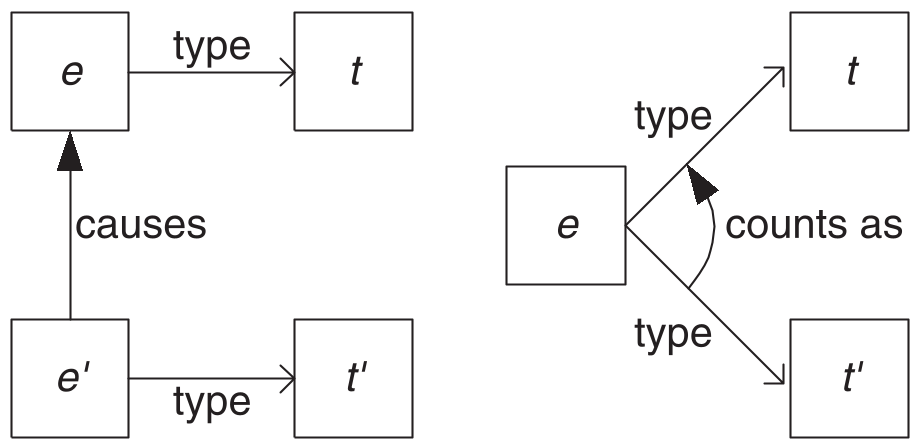 Figure 1: Distinguishing between the physical "Causes" and the social "Counts As" relationships.
The Problem with FIPA-ACL
The authors take a critical look at the FIPA standard. FIPA defines an inform act based on "Feasibility Preconditions" (FP), such as "The sender must believe P."
The Critique: How can a message-sending event "count as" a belief? A belief is an internal state, not a social fact. By forcing communication into a mental-state mold, current standards make it impossible to handle insincerity or normative violations effectively.
The Breakthrough: Social Commitment
Instead of checking if an agent really believes , we should check if they are committed to relative to another agent.
In this formula, the assertion is successful the moment the commitment is created. If the agent later says , we don't say the speech act failed; we say the agent violated a commitment. This provides a robust basis for:
- Reputation Systems: Tracking how often agents break commitments.
- Sanctions: Penalizing agents in an electronic institution.
- Transparency: Removing the need to "read the mind" of a black-box agent.
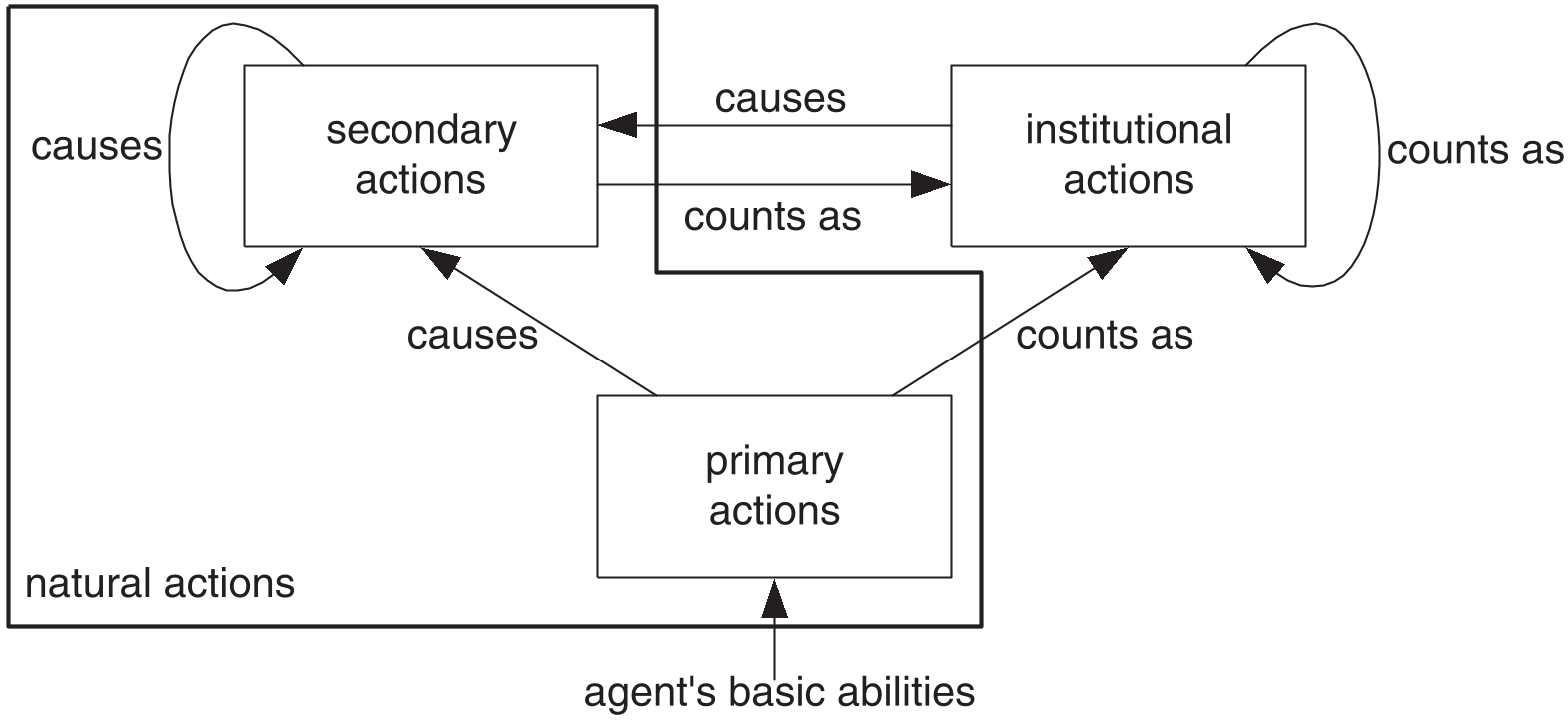 Figure 2: The spectrum of actions, from physical primary actions to complex institutional illocutionary acts.
Critical Insight & Conclusion
By treating speech acts as institutional facts, Colombetti and Verdicchio provide a pathway for building Open Systems. In an open system, you cannot trust the internal logic of every agent. You can, however, enforce a shared social logic.
Takeaway for the Industry: If you are building multi-agent protocols (e.g., for DeFi, supply chain, or autonomous fleets), don't model your agents' conversations based on what they "know." Model them based on what they "owe." The "Counts As" framework is the mathematical key to building digital societies that can handle deceit and complexity.