
Social Network vs. Social Media: Uncovering Interaction DNA in Renren and Sina Weibo
Analysis and Comparison of Interaction Patterns in Online Social Network and Social Media
This paper presents a comparative analysis of interaction patterns between Renren (Online Social Network) and Sina Weibo (Social Media) using unidirectional weighted graphs. By leveraging Hidden Markov Models (HMM) and Self-Organizing Maps (SOM), the study identifies that Sina Weibo exhibits higher popularity, greater user diversity, and superior information diffusion efficiency compared to the friendship-based Renren platform.
TL;DR
Not all social platforms are created equal. This study performs a deep dive into China's two giants of the early 2010s: Renren and Sina Weibo. By modeling user interactions as weighted directed graphs and applying machine learning (HMM & SOM), the research proves that Sina Weibo is a far more efficient "information engine" than Renren, largely because it transcends the traditional "weak ties" constraints that slow down friendship-based networks.
Problem & Motivation: Beyond the Friendship Link
Most early social network analysis focused on the social graph—who is friends with whom. However, a friend link is static; an interaction (a reply or a comment) is dynamic and reflects true influence. The authors argue that we must distinguish between Online Social Networks (OSN), which are reciprocal and friendship-oriented, and Social Media, which are interest-oriented. The goal was to quantify exactly why information travels faster and wider on platforms like Weibo compared to Facebook-clones like Renren.
Methodology: The Core of Interaction Modeling
The researchers used two massive datasets (3M+ users each) to build a unidirectional weighted graph.
1. The Physics of Cascades (Stretched Exponential)
Instead of a simple power-law, the authors found that node strength follows a Stretched Exponential (SE) distribution.
- The Intuition: This model views interaction as a multi-stage cascade.
- The Result: The "stretched factor" (c) reveals the depth of the conversation. In Renren, (1-2 hops), while in Weibo, (4-5 hops). Weibo's structure allows content to "leap" across the network much further.
2. Temporal Behavior (HMM & SOM)
A user isn't always active. The authors used a Hidden Markov Model (HMM) to capture two states: Active and Inactive.
- By training an HMM for each user, they extracted transition probabilities: .
- These parameters were fed into a Self-Organizing Map (SOM) to cluster users without prior labels.
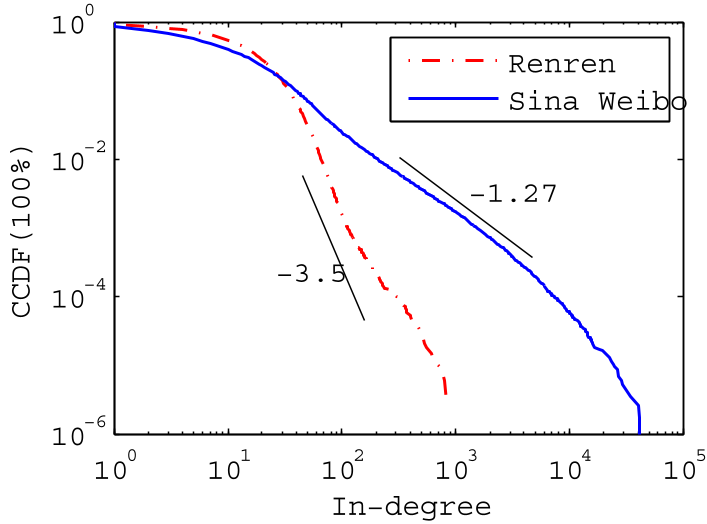 Above: Figure 1 & 2 showing the distribution of popularity and the fitting of the Stretched Exponential model.
Experiments & Results: Why Weibo Wins for Diffusion
The Weak Ties Paradox
In Renren, the "Weak Ties Hypothesis" holds: your strongest interactions are with people in your immediate circle. In Sina Weibo, the hypothesis fails for high-strength edges. This means on Weibo, users often interact intensely with people outside their local cluster—celebrities, news outlets, or interest leaders—creating high-speed "highways" for information.
User Diversity
Using SOM clustering, the authors identified distinct "User Personas":
- Content Producers: High activity leading to popularity.
- Celebrities: Can be inactive but still receive massive interaction (the "passive influence" effect).
- Ordinary Users: Low-intensity, reciprocal interactions.
The SOM results showed that Sina Weibo's population is significantly more diverse and holds a much higher percentage of "Top Popular" users compared to Renren.
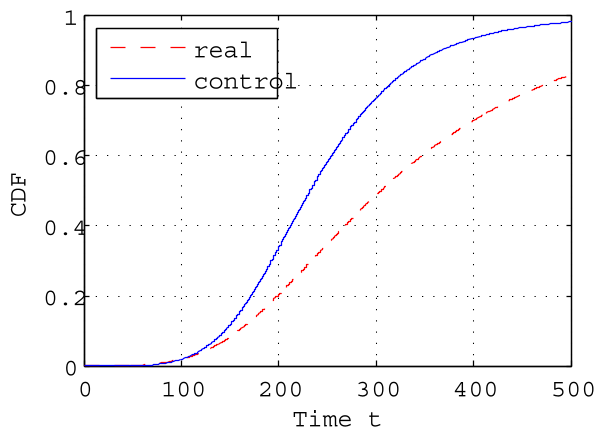 Figure 5: Simulation results demonstrating that real-world interaction patterns in Weibo facilitate faster and broader information spreading than a random control.
Critical Analysis & Conclusion
Takeaway
The study highlights that Social Media (Weibo) functions as a broadcast and interest-matching system, whereas Social Networks (Renren) function as digital living rooms. For developers and marketers, this implies that "virality" is a structural property of the platform's interaction rules, not just the content itself.
Limitations
- Context of Content: The study treats all replies as equal weight, but a "like" vs. a long "comment" vs. a "flame war" reply represents different social values.
- Era Specificity: The data is from 2010-2011. While the mathematical foundations (SE, HMM) remain valid, the rise of algorithmic feeds (like TikTok/Douyin) further evolves these patterns by making "social links" almost irrelevant.
Future Work
The authors suggest looking at how external attributes like age, gender, and social events trigger shifts in these HMM states—essentially moving from "how" people interact to "why."