
WSM: Bridging the Gap Between Social Theory and Wireless Mobility
Analysis and design of mobile Wireless Social Model q
The paper proposes the Wireless Social Model (WSM), a novel mobility framework for Delay Tolerant Networks (DTNs). By utilizing the -Model to generate social structures, WSM accurately replicates the power-law distributions of inter-contact times found in real-world traces, outperforming traditional random waypoint models.
TL;DR
The Wireless Social Model (WSM) is an advanced mobility framework designed for Delay Tolerant Networks (DTNs) that moves beyond simplistic random movements. It integrates social network theory—specifically the -Model and k-clique communities—to simulate human movement patterns. The result is a synthetic model that finally matches the "heavy-tail" inter-contact times seen in real-world datasets like the Dartmouth traces.
Context: Why Random Distribution Fails
In the world of opportunistic networking, the movement of a device depends entirely on the human carrying it. Most researchers traditionally relied on Random Waypoint (RWP) models. However, RWP assumes nodes are mindless particles. In reality, humans move towards social interests. This mismatch causes a massive gap in simulation accuracy: RWP predicts exponential inter-contact times, while real-world data consistently shows a power-law distribution (heavy tail).
The authors argue that the missing link is the Wireless Social Network (W-SN). Unlike a traditional Social Network (SN) based on kinship or friends, a W-SN includes "strangers" who encounter each other frequently due to shared spatial habits, effectively acting as "community friends" and potential message relays.
Methodology: The -Model and Goal Selection
The core of WSM lies in how it creates and maintains connections.
1. Connection Architecture
WSM uses a measure called (propensity to connect) based on shared neighbors () and a tunable parameter .
- When is high, the model approaches a random graph.
- When is low, it forms tight, isolated "caves." By setting , the authors maintain a balance that mirrors the Small World phenomenon—high clustering with short path lengths.
2. Node Initialization and Movement
Instead of random placement, nodes are organized into k-clique-communities. A node's movement is determined by a probability-based goal selection:
- Stay (40%): Reflecting stationary periods (offices, homes).
- Wander (10%): Random localized movement.
- Visit a Friend (50%): Moving toward the current location of a social contact.
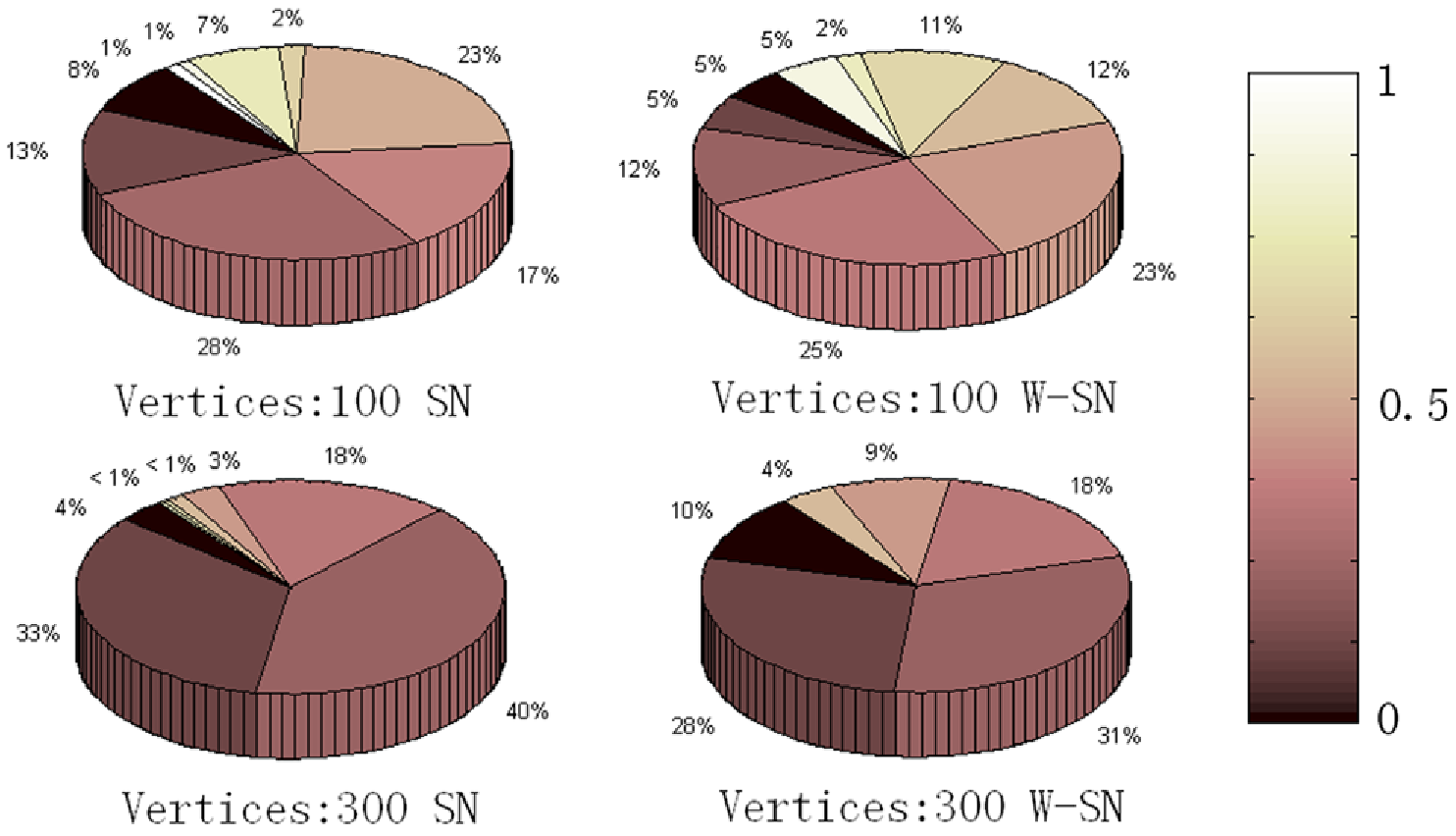 Figure: The visual difference between traditional Social Networks and the expanded Wireless Social Network.
Experiments: Validating Against Reality
The authors validated WSM against 20 days of wireless LAN traces from Dartmouth College.
Key Findings:
- Inter-contact Time: WSM perfectly captures the heavy tail in the distribution, whereas RWP drops off sharply (exponential decay).
- Community Statistics: As the community size increases, the membership number decreases rapidly—a characteristic found in real co-authorship and protein networks.
- Clustering: WSM yields a clustering coefficient of 0.472 for 100 nodes, significantly higher than random models, proving it captures the "clumpy" nature of human socialization.
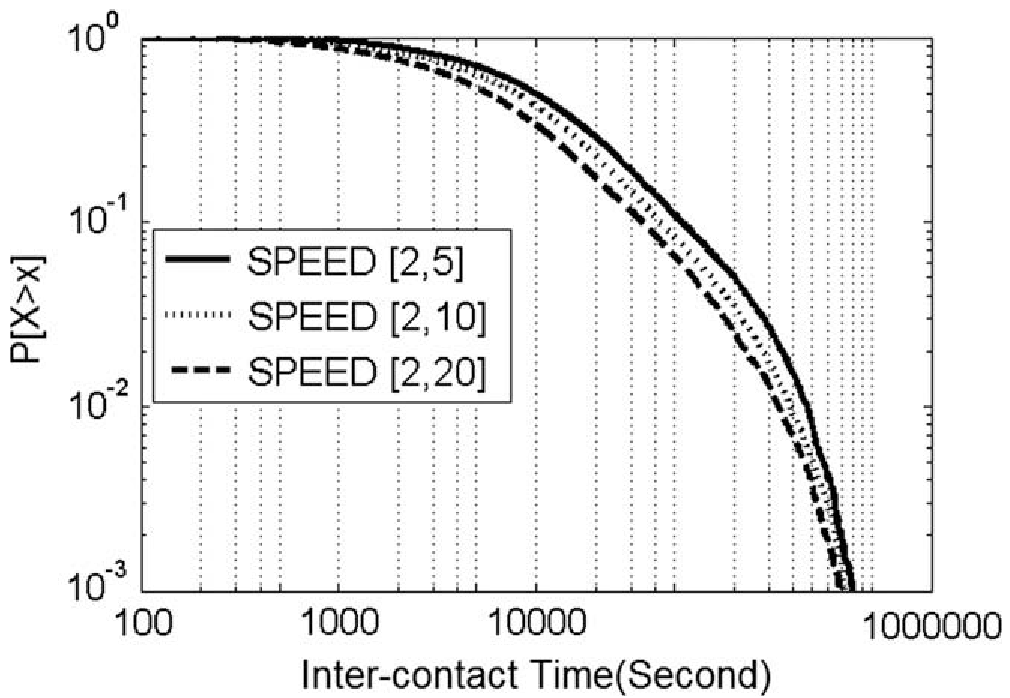 Figure: Comparison of inter-contact times. Note how WSM stays closer to the real Dartmouth traces than the Random models.
Critical Insight: The "Small World" Advantage
The study highlights that W-SNs exhibit even stronger small-world characteristics than typical social networks. In W-SNs, the characteristic path length decreases because wireless communication allows "shortcuts" between communities via strangers who happen to occupy the same physical space. This is a vital takeaway for protocol designers: opportunistic forwarding shouldn't just look for "friends," but for these "social bridges" created by wireless proximity.
Conclusion
The Wireless Social Model provides a much-needed tool for DTN researchers. By mathematically grounding mobility in the -Model and k-clique theory, it offers a simulation environment that is both computationally feasible and scientifically sound. Future work will likely see this model used to test more "socially aware" routing protocols that can predict meet-up events with higher precision.