
Unveiling the DNA of Mobile Social Networks: Evolution, Topology, and Small-World Dynamics
Analysis to reveal evolution and topological features of a real mobile social network
This paper presents a longitudinal study on the evolution and topological characteristics of Mobile Social Networks (MSNs) using real-world trace data from an XMPP-based chatting software. By analyzing network metrics over a one-month period, the study characterizes MSNs as scale-free networks with strong small-world properties.
Executive Summary
TL;DR: Leveraging a real-world dataset of 1,650 mobile users, this paper provides a deep dive into the structural evolution of Mobile Social Networks (MSNs). The study reveals that MSNs are not just random graphs; they are highly structured, scale-free entities exhibiting six-degree-of-separation features, where most users are connected via an average path length of only 3.
Context: Positioned as a foundational empirical analysis, this work bridges the gap between theoretical complex network modeling and practical mobile service optimization. It challenges the "static graph" status quo by analyzing how network complexity stabilizes over time.
The Dynamic Pulse: From Sparsity to Convergence
Most existing literature treats social networks as stationary snapshots. However, mobile user behavior is inherently fluid. The authors tackle the dynamic evolution problem—how does a network grow from a few isolated users into a robust, connected community?
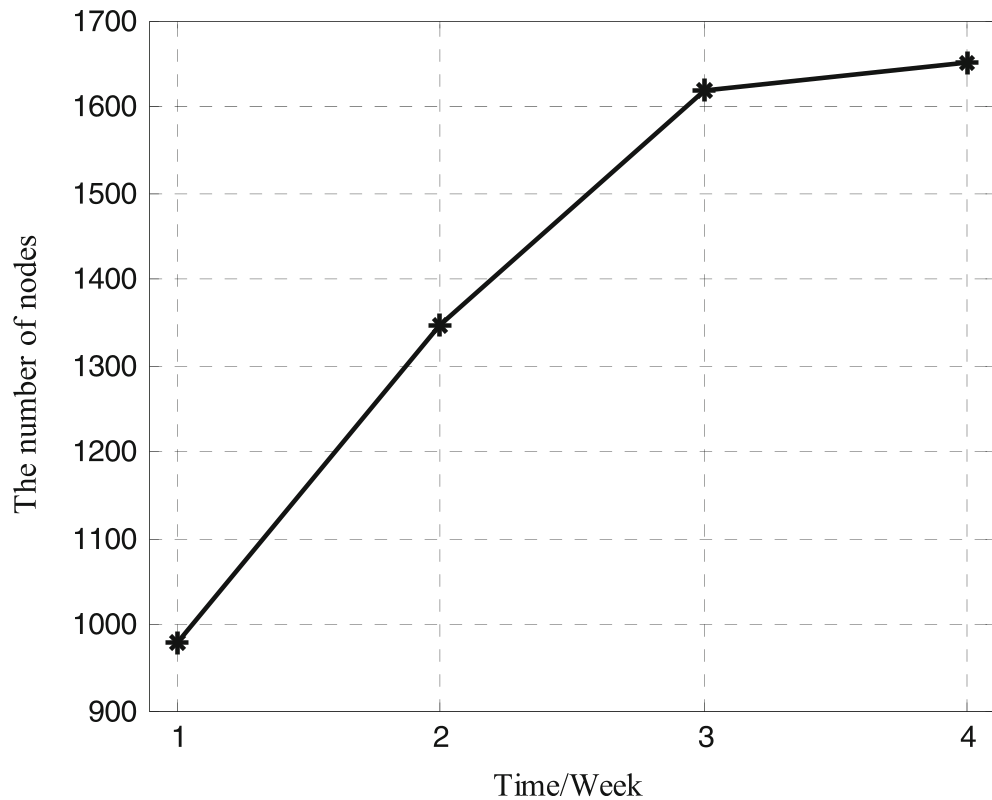
By analyzing 3,813 chat records partitioned into weekly intervals, the study shows a clear growth trajectory. Interestingly, while the nodes (users) and edges (friendships) increase, the rate of growth slows down, suggesting that MSNs eventually reach a topological equilibrium.
Methodology: The Four Pillars of MSN Topology
The paper employs a rigorous mathematical framework to dissect the MSN's "largest connected sub-graph" (which encompasses nearly 99.5% of active users).
1. Social Degree & Power-Law Distribution
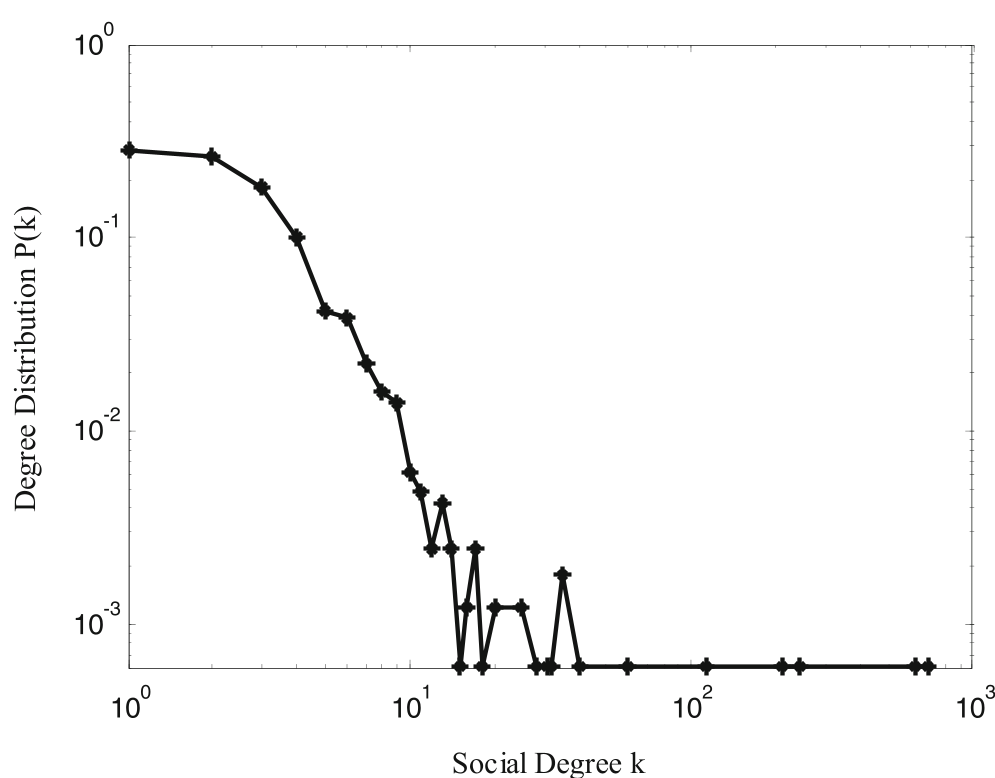
The authors find that the social degree follows a Power-law distribution: .
- Insight: Most users have very few connections, while a handful of "super-connectors" (hubs) maintain massive neighbor lists. These hubs are critical for network stability and information viralization.
2. The Small-World Effect (Node Distance)
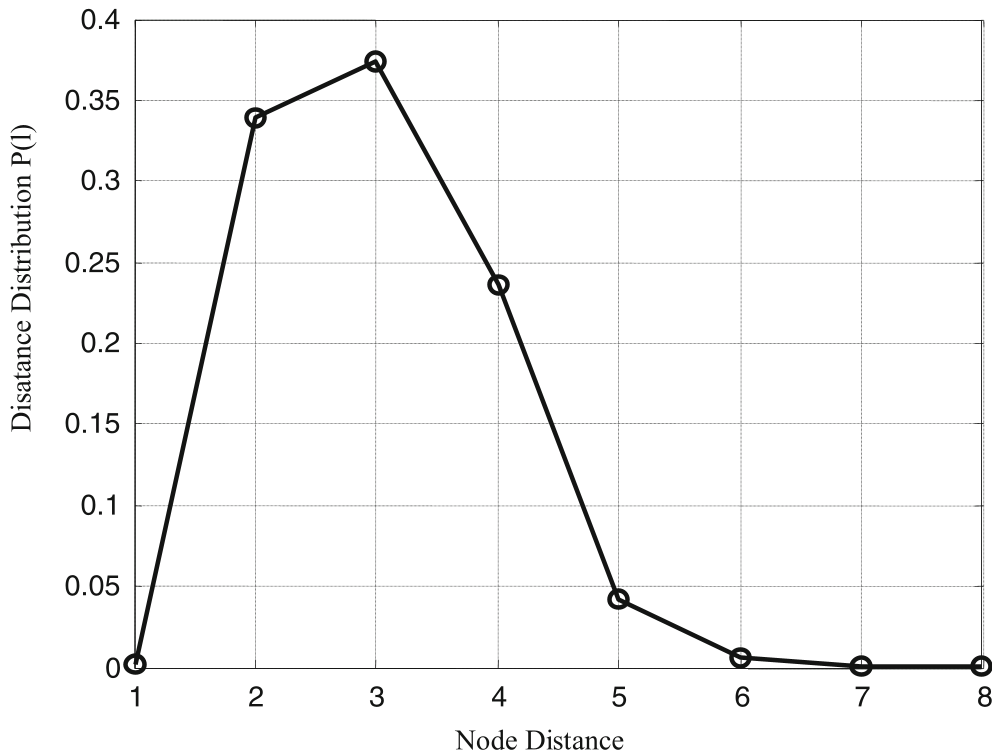
Using Dijkstra’s algorithm, the study calculates an average shortest path of 2.9976.
- Visual Evidence: Almost 95% of node pairs have a distance of less than 6. This confirms that the MSN is incredibly "tight," allowing for rapid communication across the entire population.
3. Closeness & Betweenness Centrality
Betweenness measures a node's role as a "bridge." The study identifies a positive correlation between degree and betweenness, though some low-degree nodes still act as vital bridges between different communities.
Experimental Validation
The paper demonstrates that as the network matures, the average social degree increases but eventually levels off. This indicates that while early adopters are eager to form connections, the "saturation level" of social interaction prevents a perpetual increase in connectivity density.
Deep Insight: Why This Matters for 5G/6G
The discovery that MSNs are scale-free and small-world is more than an academic exercise. It has significant implications for:
- Content Delivery: Caching content on "hub" nodes (high closeness) can reduce total network latency.
- Security: Scale-free networks are resilient to random failures but highly vulnerable to targeted attacks on high-degree nodes.
- Epidemic Spreading: Understanding these features allows for the design of better information dissemination protocols to prevent or facilitate "viral" trends.
Critical Analysis & Conclusion
While the paper provides an excellent empirical baseline, it focuses primarily on unweighted edges. In real MSNs, the frequency and duration of chats (edge weight) vary significantly, which would likely reveal deeper "community" structures.
Future Outlook: The next logical step is applying these topological insights to Resource Allocation and Software Defined Networking (SDN) to create more responsive, social-aware mobile infrastructures.