
The Multidimensional Reader: Decoding the Hidden Patterns of aNobii
Analysis of a heterogeneous social network of humans and cultural objects
This paper investigates the interplay between diverse user activities within aNobii, a heterogeneous social network for book lovers. By analyzing tagging behaviors, group affiliations, and reading wishlists, the study reveals that these distinct dimensions exhibit low correlation, suggesting that user interests are multifaceted and cannot be captured by a single signal.
Executive Summary
TL;DR: In the vast ecosystem of aNobii, a social platform for bibliophiles, users leave breadcrumbs across three main trails: the tags they use, the groups they join, and the wishlists they build. This study proves that these trails rarely overlap perfectly. By analyzing a complete snapshot of the network, the researchers discovered that the "semantic" self (tags) and the "social" self (groups) provide distinct, non-redundant data points, making a strong case for multidimensional profiling in modern AI systems.
Academic Context: This work sits at the intersection of Folksonomy analysis and Heterogeneous Social Network (HSN) research, acting as a critical bridge between early social link prediction and modern multidimensional recommender systems.
Problem & Motivation: The Illusion of the Unified User
Most social media research operates on a simplification: if I know who your friends are, I know what you like. This assumes strong homophily—the idea that "birds of a feather flock together." However, human behavior is messier. On a platform like aNobii, a user might use tags strictly for personal organization (knowledge management) while joining groups for social gossip that has nothing to do with their actual library.
The authors argue that a single "signal" (like a friendship graph) is a narrow window into a user's world. To build better AI, we must first understand if these different "signals" (tags, groups, wishlists) are repeating the same story or telling different ones.
Methodology: Mapping the Dimensions
The core of the study involves transforming user behavior into three distinct mathematical profiles:
- Tag-based (): Measuring similarity based on shared book labels.
- Group-based (): Measuring similarity through co-affiliation in thematic groups.
- Wishlist-based (): Measuring similarity via shared future reading intentions.
Architecture of Analysis
The researchers didn't just look for matches; they used Latent Dirichlet Allocation (LDA) to uncover the underlying topics of tags (finding they range from specific genres like "Crime Novel" to personal tags like "My Favorites") and Shannon Entropy to measure how much "surprise" or information each profile contained.
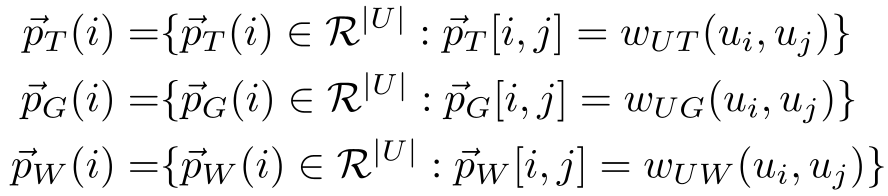 The mathematical definition used to bridge users across different behavioral dimensions.
Experiments & Results: The Low-Correlation Paradox
The most striking finding was the Spearman’s Correlation () results. For 98.9% of users, the correlation between their different profiles was incredibly low (under 0.4).
Key Insights:
- The Info-Gap: Tag-based and Group-based profiles are dense with information, while Wishlists are surprisingly sparse and less "predictive."
- Mutual Information (MI): The MI between dimensions was low, meaning knowing a user’s groups tells you almost nothing about their wishlist.
- Extreme Behavior: The study found "extreme users"—highly active in tagging but silent in groups, or vice versa—proving that some perceive aNobii as a private utility while others see it as a social hub.
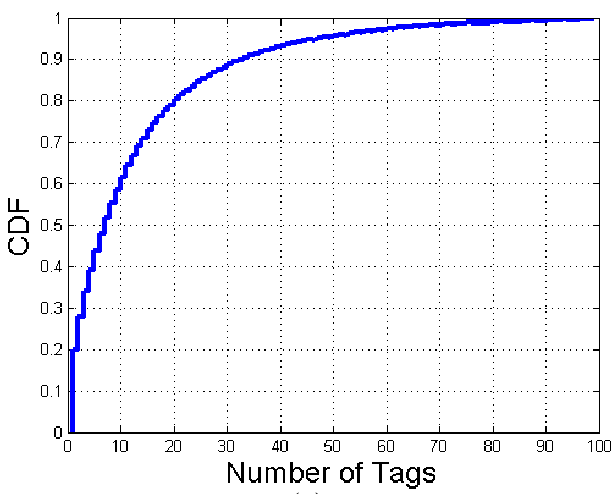 Figure 2: The distribution of Spearman’s ρ coefficients across the population, highlighting the lack of strong correlation between user dimensions.
Critical Analysis & Conclusion
Takeaway: This paper is a wake-up call for recommender system architects. If you only look at "what people tagged," you are missing the "who they talked to" dimension, which contains entirely different information.
Limitations: The study is based on a 2009 snapshot. In the modern era of algorithmic feeds, the "natural" behavior of users might be more influenced by the platform's own suggestions, potentially increasing the correlation between dimensions artificially.
Future Outlook: The next frontier is Cross-network Fusion. If a user’s behavior doesn't even correlate within one platform, how do we build a unified identity for them across Twitter, Amazon, and Goodreads? The answer lies in the information-theoretic approach pioneered here—treating each platform not as a replica of the user, but as a unique dimension of their digital soul.