
NodeRank and IDC: Redefining Influencer Identification in Weighted Social Networks
The Analysis of Key Nodes in Complex Social Networks
This paper introduces a "divide and conquer" framework to identify key nodes in directed-weighted social networks. It proposes two algorithms: Improved Degree Centrality (IDC) for small-scale networks and NodeRank for large-scale networks, both integrating edge weights (relationship strength) into traditional topological metrics.
TL;DR
In the era of massive social connectivity, not all "friends" are equal. This paper addresses the limitations of traditional graph algorithms—which often treat every connection as identical—by introducing Improved Degree Centrality (IDC) and NodeRank. By using a "divide and conquer" strategy, the authors provide a scalable way to identify key nodes in directed-weighted networks by factoring in "relationship strength."
The Problem: The Blind Spots of Classic Centrality
Traditional metrics for finding influential nodes (key nodes) have significant drawbacks:
- Topological Bias: Standard PageRank and Degree Centrality focus on the number of connections but ignore the quality or weight of those connections.
- Computational Bottlenecks: High-precision metrics like Betweenness Centrality are too slow for networks with millions of nodes.
- Context Ignorance: In a social network, a person you talk to daily (high weight) should influence your "rank" more than a distant acquaintance.
Methodology: Divide and Conquer
The authors argue that a single algorithm cannot fit all network scales. They propose a bifurcated approach:
1. Small-Scale: Improved Degree Centrality (IDC)
For small groups, the authors enhance simple degree centrality by introducing Weighted Degree (WD).
- The Intuition: A node's importance is the product of its connection count and the relative strength of the traffic it receives from neighbors.
- Formula: .
2. Large-Scale: NodeRank
For massive networks, the authors adapt the PageRank philosophy. Instead of distributing "rank" equally among all outgoing links, NodeRank distributes it proportionally based on relationship strength.
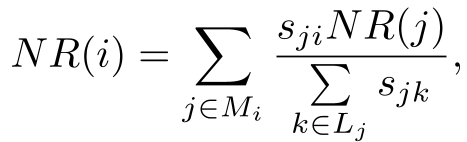 The NodeRank formula (Eq 3) showing how importance flows through weighted edges.
To handle the scale of Facebook-sized data, they use a Base Set approach:
- Filter the top 10%-20% of nodes using the computationally "cheap" IDC.
- Run the iterative NodeRank algorithm only on this candidate set.
Experimental Results
The authors tested their methods on two distinct datasets:
- University of Ljubljana (Small Scale): 11 nodes. IDC provided a ranking that aligned more closely with manual subjective judgment than PageRank or Closeness Centrality.
- Facebook User Interactions (Large Scale): 45,813 nodes.
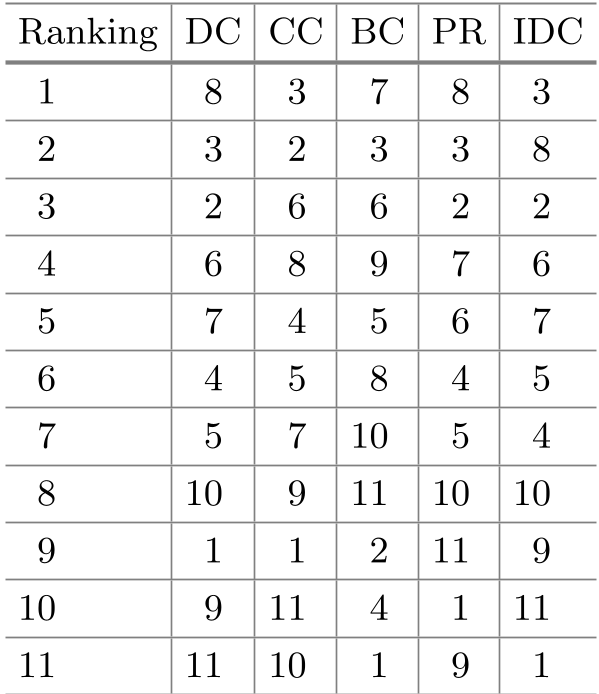 Table 1: Comparison of IDC against traditional metrics. Note how IDC (rightmost) reshuffles the leaders based on weight.
In the Facebook experiment, the authors proved that NodeRank identifies a different set of top influencers than Eigenvector Centrality or PageRank. This suggests that ignoring interaction strength leads to a fundamental misidentification of who truly holds power in a social network.
Critical Insight & Analysis
The brilliance of this work lies in the Base Set concept. By using IDC as a "high-pass filter," the authors reduce the search space for the iterative NodeRank algorithm without losing the critical "key nodes."
However, a limitation remains: the paper assumes weights (relationship strengths) are already provided. In real-world scenarios, defining what constitutes "strength" (Is it likes? Comments? Duration of friendship?) remains a subjective and difficult preprocessing step.
Conclusion
This research moves us closer to a "physics-informed" view of social networks, where the intensity of the bond is as important as the bond's existence. For developers and researchers building recommendation engines or viral marketing tools, the combination of IDC and NodeRank offers a pragmatic, scalable blueprint for finding the true "hubs" of any community.