
Scaling the Infinite: Navigating Large-Scale Systems with Mean Field and Markovian Agents
Analysis of Large Populations of Interacting Objects with Mean Field and Markovian Agents
This paper explores "Mean Field Analysis" and "Markovian Agents" as mathematical frameworks for modeling large-scale interacting systems like sensor networks and social systems. It formalizes these populations using fluid approximations and Ordinary Differential Equations (ODEs) to bypass the state space explosion problem.
TL;DR
As systems like IoT, social networks, and molecular biology grow toward millions of interacting components, traditional discrete modeling crashes against the "state space explosion" wall. This paper outlines two sophisticated alternatives: Mean Field Analysis and Markovian Agents. By treating discrete entities as continuous "fluids," we can describe global system evolution using Ordinary Differential Equations (ODEs) rather than impossible-to-calculate Markovian state transitions.
The Bottleneck: Why Combinatorial Logic Fails
In classical performance evaluation, we model systems by tracking every possible state. However, if you have objects each with states, the global state space is . For a sensor network with 1,000 nodes, this number exceeds the atoms in the universe.
The author's core insight is that for very large populations, the aggregate behavior becomes deterministic. We don't need to know which specific sensor is "on"; we only need to know the density of sensors currently in the "on" state.
Methodology: From Discrete Steps to Fluid Flows
1. Mean Field Analysis
The Mean Field approach assumes that all entities are similar and their transitions depend on the current global state distribution. The evolution of the population vector is captured by the following ODE:
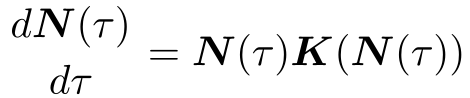
In this equation, is a transition rate matrix that dynamically updates as the population shifts. This transforms a stochastic nightmare into a calculus problem.
2. Markovian Agents (MA)
While Mean Field deals with "what" state objects are in, Markovian Agents add the "where."
- Spatial Density: Agents are distributed over an area with a density .
- Local vs. Induced Transitions: Interaction happens through messages. An agent changes state either due to its environment (Local) or because it received a signal from a neighbor (Induced).
- Perception Function: This maps how messages travel through the medium, allowing for the modeling of signal interference and spatial routing.
Experimental Insight & Results
The paper positions these methods within the lineage of Fluid Process Algebra (PEPA). The primary advantage highlighted is the limit-convergence:
- These models become exact as the population approaches infinity.
- Even for finite, medium-sized populations, they provide a "reasonable approximation" that is computationally cheap.
By utilizing these methods, researchers can calculate performance indices (like throughput or energy consumption) of a massive system in seconds on a standard machine, whereas a simulation might take weeks.
Critical Analysis & Future Outlook
The strength of this work lies in its unification of spatial distribution and fluid dynamics. However, there are inherent limitations:
- Homogeneity: The models assume "similar objects." Heterogeneous populations (where every agent has unique rules) still pose a significant challenge.
- Averaging Effects: Mean Field analysis can smooth over "rare events" or phase transitions that might be critical in security-sensitive applications.
The Takeaway: For the next generation of engineers building swarm intelligence or planetary-scale networks, "Fluid" thinking is not just an option—it is a mathematical necessity to bypass the limits of traditional computation.
References
- [1] Bobbio et al. (2008) - Mean field scale analysis.
- [3] Gribaudo et al. (2008) - On-off policies in sensor networks.