
Decoding the Pulse of SNS: How Personal Motivation Drives Message Diffusion
An Analysis Approach of Messaging Mechanism on Social Networking Services
This paper proposes an event-driven mathematical model to analyze the messaging mechanism on Social Networking Services (SNS) based on individual psychological motivations. By decoupling information quantity, reliability, and source trust, the authors model how personal motivations influence message modification and diffusion dynamics.
TL;DR
Why do some posts go viral while others die in obscurity? This paper moves beyond simple "positive/negative" link analysis to propose an event-driven mathematical model of SNS messaging. By quantifying personal motivation through specific modification factors—quantity, reliability, and trust—the researchers demonstrate how individual psychological thresholds dictate the flow of social information.
Background: Moving Beyond Binary Links
Traditionally, researchers viewed SNS interactions through static decision tables (e.g., Node A is positive, Node B is negative, therefore the link is -0.5). However, this "top-down" view fails to capture the human element: the motivation to edit, modify, and pass on a message. This paper repositions the user not just as a node in a graph, but as an active "editor" driven by internal psychological states.
The Problem: The "Why" is Missing
Current models face two critical limitations:
- They describe connections but not the motivation for the messaging act itself.
- They conflate the content of the information with the relationship between the sender and receiver.
If your best friend (high trust) tells you a dubious rumor (low reliability), your motivation to share it is calculated differently than if a stranger tells you a proven fact.
Methodology: The Anatomy of a Message
The authors propose a state vector to represent a message at time :
Where:
- : The quantity of modification/opinion editing.
- : The perceived reliability of the message.
- : The trust level toward the source.
The core of the model lies in the transition functions: Here, is the Motivation Factor. If exceeds a certain personal threshold, the user "edits" and transmits the message.
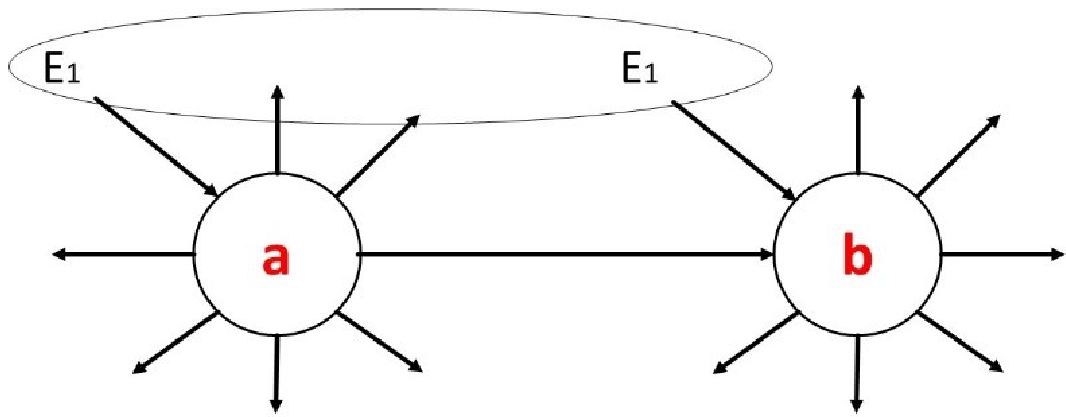 Fig 1: Relationship between Event (E1) and Nodes (a, b) showing trust levels (tr) and links.
Experiments: The Threshold of Virality
The researchers simulated a network of 100 nodes to observe how messages propagate. They found that diffusion is not linear; it is governed by phase transitions based on the modification factor .
- No modification (): The message stays stagnant.
- Active modification (): The message begins to diffuse across the network as users find enough "motivation" to pass it along.
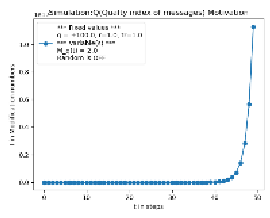 Fig 2: Comparison of different values (1.0 vs 1.1 vs 2.0). Increasing motivation dramatically shifts the diffusion pattern from "stagnant" to "viral".
Furthermore, by introducing randomness (), the authors observed "message termination." Even if an event is "open" or "stocked" in the SNS, if the collective motivation doesn't hit the required threshold, the information effectively dies.
Deep Insight: The User as a Filter
The heavy-lifting in this model is done by the individual thresholds. This explains why the same piece of news can explode in one community but be ignored in another—the "Motivation Factor" is localized.
Takeaway for the Future: This research suggests that to stop misinformation or boost healthy communication, we shouldn't just look at the network structure; we must understand the "Modification Functions" of the users. The "Reliability" () and "Trust" () are independent levers that platforms can theoretically tune.
Limitations & Future Work
While the mathematical framework is robust, the current study relies on simulated motivation factors. The next frontier for this research involves mapping these factors to real-world behavioral data (e.g., likes, shares, and comment length) to validate the thresholds of human social psychology in digital spaces.