
The Paradox of Trust: Why Couchsurfing Users Gamble with Privacy
Analysis of Information Disclosure on a Social Networking Site
This study investigates information disclosure behaviors on Couchsurfing.com, a trust-based travel social network. Using surveys and interviews, the authors analyze the gap between users' high levels of personal data sharing—motivated by the need to build rapport—and their low awareness of privacy risks such as re-identification.
TL;DR
A study of Couchsurfing users reveals a dangerous disconnect: while users share highly sensitive data (home photos, travel dates) to build trust with strangers, they are almost entirely unaware that 95% of them can be uniquely identified by malicious actors using simple demographic triangulation. The paper argues for moving beyond technical filters toward "persona-based" privacy education.
Contextual Positioning
This work sits at the intersection of Social Computing and Privacy Analysis. Unlike studies on Facebook or MySpace, which focus on social prestige, this research examines a platform where disclosure is a prerequisite for a physical transaction—sleeping in a stranger's home. It highlights the "Privacy Paradox": users value their safety but sacrifice their data privacy to achieve it.
The Problem: The Rapport-Risk Tradeoff
Mainstream social networks allow for anonymity, but Couchsurfing demands transparency. To get a "host," a user must prove they are trustworthy. This leads to a unique set of pain points:
- Involuntary Over-sharing: Users list home descriptions and travel dates that are goldmines for burglars.
- False Sense of Security: Participants often believe that "Googling my name" is the only way to find them, ignoring the power of re-identification via secondary datasets like census records.
- Optimism Bias: The prevailing sentiment among interviewed users was "I have nothing to hide" or "Nobody would bother to target me."
Methodology: Testing the Vulnerability
The authors didn't just ask about feelings; they audited profiles against established cryptographic and data-mining vulnerabilities.
The Re-identification Risk
Using the benchmarks set by researchers like Golle and Sweeney, they cross-referenced:
- Zip Code
- Gender
- Date of Birth
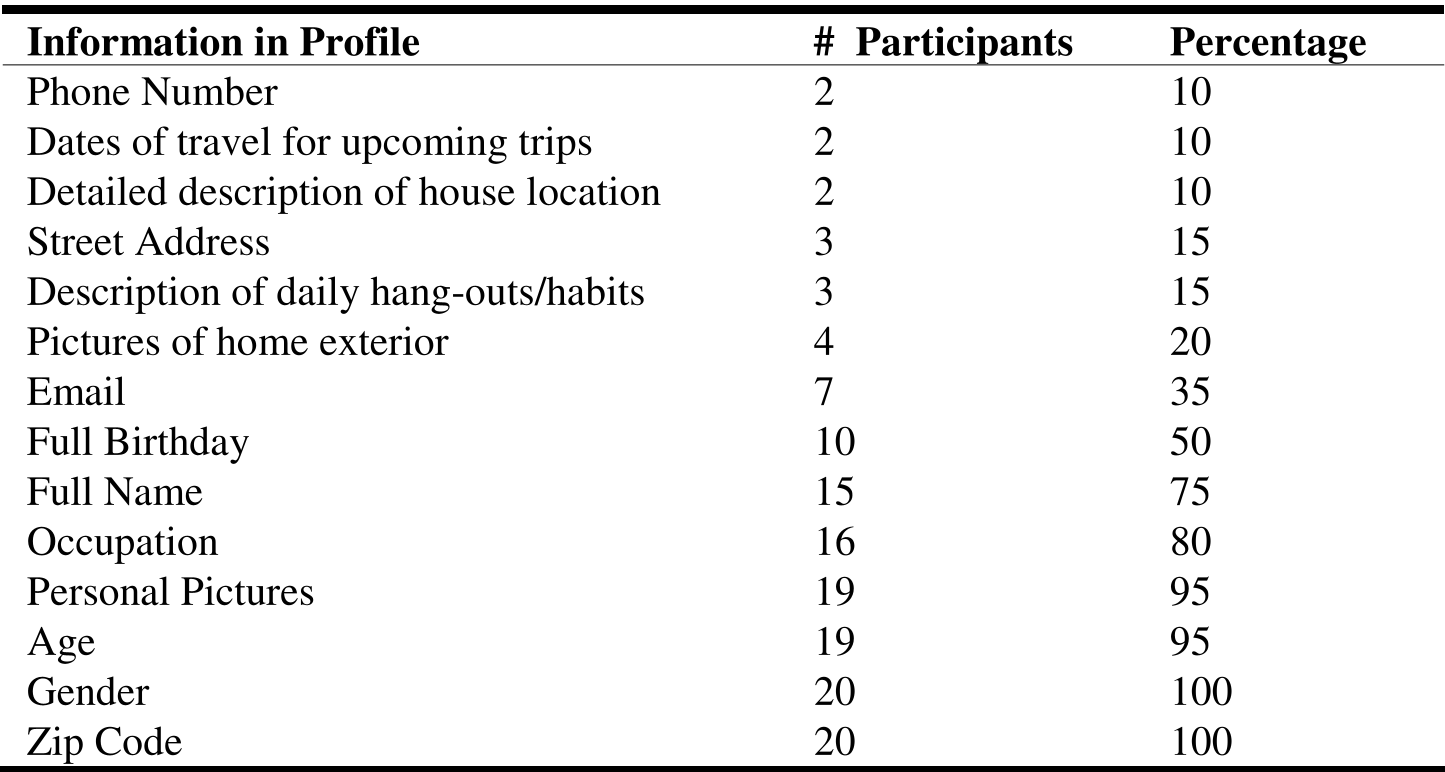
Key Evidence: Profile Disclosure Rates
The researchers compiled common data points shared by participants to highlight the "attack surface" available to third parties.
Critical Findings: Knowledge vs. Reality
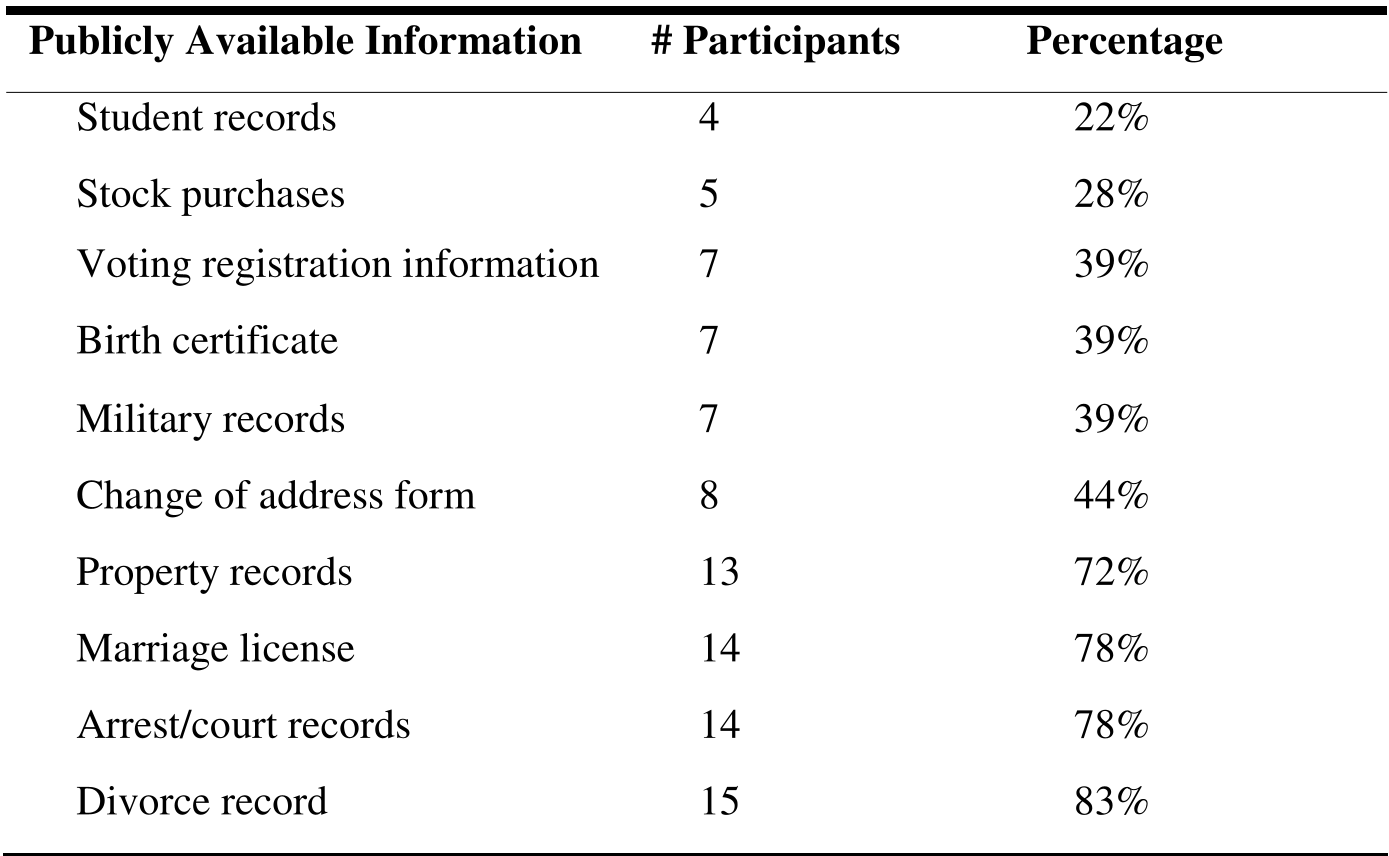
The study uncovered a startling lack of awareness regarding what information is "public record." While users were careful about their bank accounts, they were oblivious to how easily a third party could access their student records, marriage licenses, or court records once a profile provided the "seed" information (Full name and location).
Core Insight: Users are not irrational; they are simply uninformed about the interconnectedness of modern data. They view a Couchsurfing profile as a silo, whereas an adversary views it as a key to unlock a "Digital Dossier."
Deep Insight & Conclusion: Beyond Manual Filters
The authors conclude that simply building "filters" (e.g., a pop-up saying "Don't post your phone number") is insufficient because users will bypass them to establish trust.
The Strategic Shift: The paper proposes using Personas. Instead of abstract warnings, platforms should use narrative-driven alerts—profiles of "people like you" who experienced identity theft or harassment. By humanizing the risk, designers can counter the "it won't happen to me" bias.
Limitations: The sample size (n=20) is small and primarily North American, which may not capture global variations in privacy culture. However, as an exploratory study, it provides a chilling look at how the "economy of trust" inadvertently fuels the "economy of data exploitation."