
Decoding Influence: A Scientific Survey of Social Network Power Players
Analysis of Online Social Network Connections for Identification of Influential Users: Survey and Open Research Issues
Identifying Influential Users in Online Social Networks (OSNs) is a comprehensive survey that categorizes state-of-the-art algorithms—such as PageRank-like, k-core, and machine learning—to identify key individuals for information propagation or containment. The study evaluates these methods across various network types (social, propagation, interaction) and identifies critical research gaps in validation and data privacy.
TL;DR
In the vast digital ecosystem of Online Social Networks (OSNs), not all users are created equal. This seminal survey explores the algorithmic machinery used to identify the "Influential Users"—the few who can accelerate viral marketing or halt a rumor. Moving beyond simple follower counts, the research dives into deep topological measures like k-core decomposition and PageRank variants, while critiquing the industry's over-reliance on outdated epidemic models for validation.
The "Million Follower Fallacy": Beyond Surface Metrics
The primary motivation for this work is the realization that popularity influence. Early "Influentials" were identified simply by their friend counts. However, as the field matured, researchers realized that:
- Topological Position matters more than Degree: A user with fewer friends but a strategic position between communities (High Betweenness) can be more influential than a isolated hub.
- Incomplete Data is a Reality: Unlike academic graphs, OSN data is messy, incomplete due to privacy settings, and constantly evolving.
Methodology: The Taxonomy of Digital Power
The authors categorize the identification algorithms into five distinct families, each with its own "physical" intuition:
1. Iterative Ranking (The PageRank Family)
These algorithms, including TwitterRank and TunkRank, operate on the principle of prestige. Your influence is a function of the influence of the people who follow you.
- Intuition: If an influential person retweets you, you are likely influential.
2. Coreness-Based Measures (k-shell Decomposition)
The k-core method prunes the network layer by layer until only the "nucleus" remains.
- Key Insight: The most effective spreaders are often found in the core of the network, even if they aren't the most connected nodes.
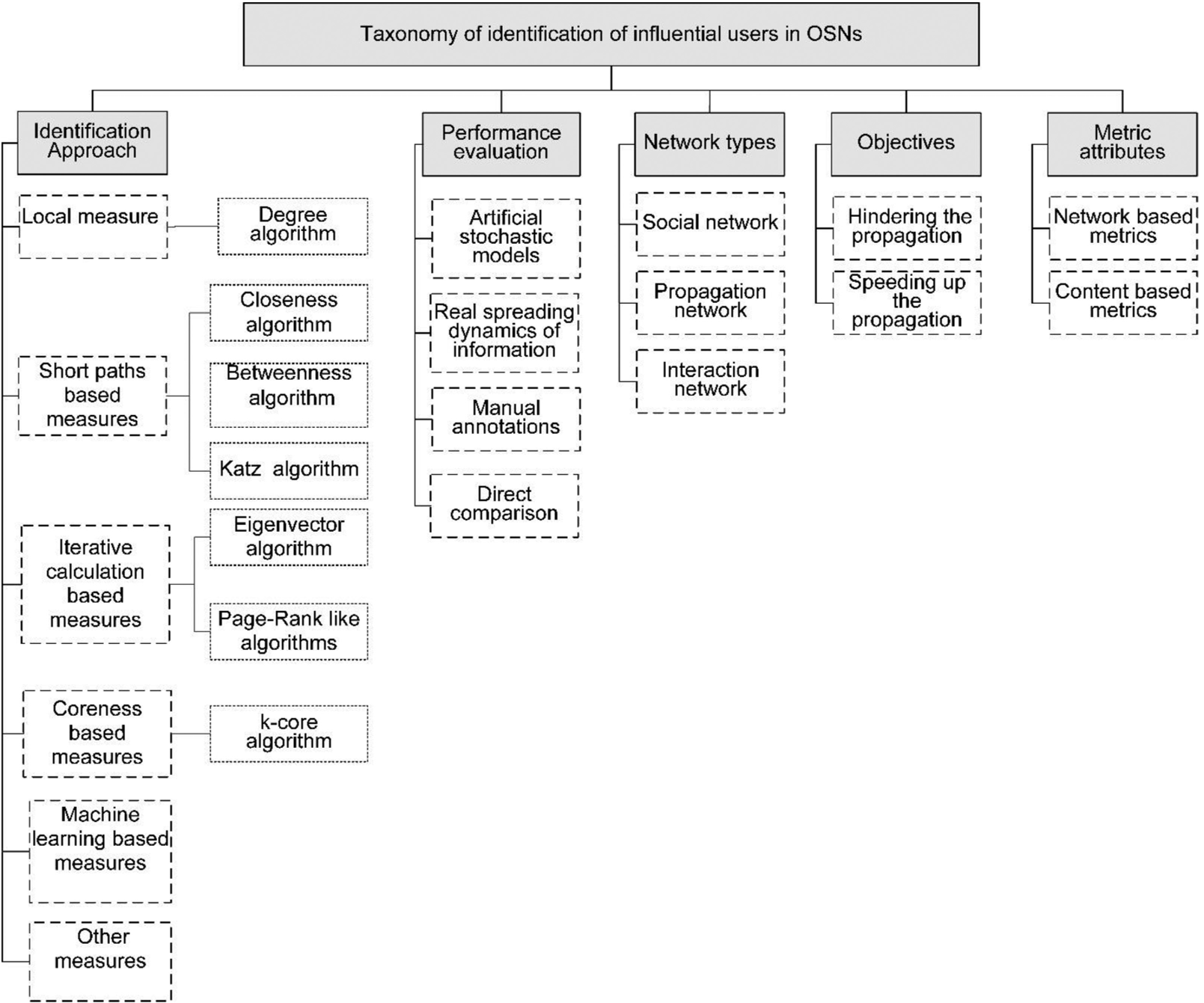
3. Machine Learning Approaches
Supervised learning attempts to predict influence by training on features like post quality, sentiment, and account age. However, the survey warns that these models are only as good as their (often biased) training data.
Critical Comparison: Why Most Models Fail
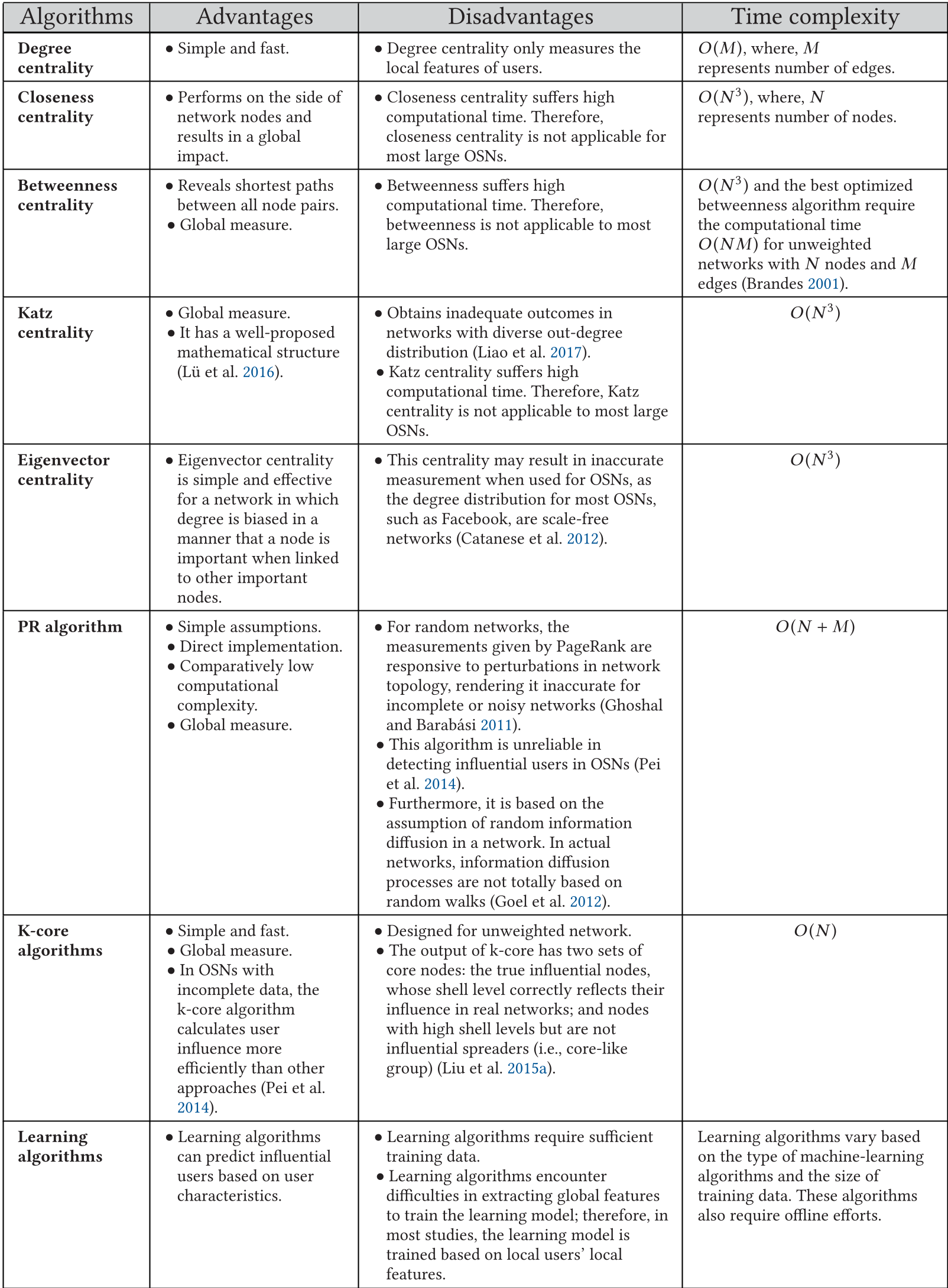
The survey provides a rigorous comparison of the trade-offs between speed and accuracy:
| Algorithm | Advantage | Fatal Flaw |
|---|---|---|
| Degree Centrality | Extremely fast () | Ignores global structure; easily gamed by bots. |
| PageRank | Global perspective | Sensitive to network "noise" and incomplete data. |
| K-Core | Robust to incomplete graphs | Often finds "core-like groups" that aren't actually spreaders. |
| Betweenness | Identifies bridges | Computationally prohibitive for large OSNs (). |
Real-World Applications: More Than Just Ads
While Viral Marketing is the obvious application, the paper identifies several critical societal uses:
- Malware & Rumor Restraint: Identifying seed nodes to "immunize" and block the spread of negative content.
- Health Applications: Finding experts in online cancer support communities to spread evidence-based health advice.
- Disaster Awareness: Leveraging bridge nodes to disseminate life-saving information during earthquakes or mass crises.
The Path Ahead: Multilayer Networks and Social Bots
The survey concludes with a forward-looking critique. Most current research treats OSNs as a single-layer graph (e.g., just "Follow" links). In reality, users interact across multiple layers (Follow, Retweet, Mention, DM).
Future Focus:
- Multilayer Interactions: Analyzing how influence in one layer (e.g., retweets) affects another (e.g., friendship).
- Social Bots: The rise of "non-human" influencers threatens to break current algorithms that rely on simple interaction counts.
- Human Behavior Validation: Abandoning SIR models for validation in favor of real-world information flow tracking.
Conclusion
This survey serves as a critical mapping of the field, reminding us that in the age of Big Data, the "value" of a user is defined not by how many people they reach, but by how many people they move.