
Decoding Policy Wars: Scaling Discourse Network Analysis with NLP
Analysis of Political Debates through Newspaper Reports: Methods and Outcomes
This paper introduces a hybrid framework for Discourse Network Analysis (DNA) that combines manual expert annotation with Natural Language Processing (NLP) to model political debates as bipartite actor-claim networks. Using the 2015 German immigration debate as a case study, the authors demonstrate how BERT-based models can semi-automate the identification and classification of political claims from unstructured newspaper reports.
TL;DR
Political scientists at the University of Bremen and Stuttgart have bridged the gap between qualitative discourse analysis and quantitative machine learning. By applying German BERT models to thousands of newspaper articles from 2015, they transformed unstructured text into "Discourse Networks," revealing how coalitions like the CDU and Greens shifted their stances during the peak of the European migrant crisis.
The Bottleneck of Manual Coding
In political science, understanding a debate requires more than just knowing what is being said; it requires knowing who said what, with what polarity, and when. This is "Discourse Network Analysis" (DNA). Historically, this meant human experts spent years manually highlighting text—a process that doesn't scale.
The authors argue that we are missing the "big picture" of democratic decision-making because we can't process the sheer volume of media coverage. The goal isn't to replace the expert but to provide an "NLP-powered lens" that can scan archives and surface the most influential claims.
Methodology: From Text to Bipartite Networks
The researchers developed a hybrid workflow that treats the newspaper Die Tageszeitung (taz) as a structured sensor for political shifts.
1. The DNA Architecture
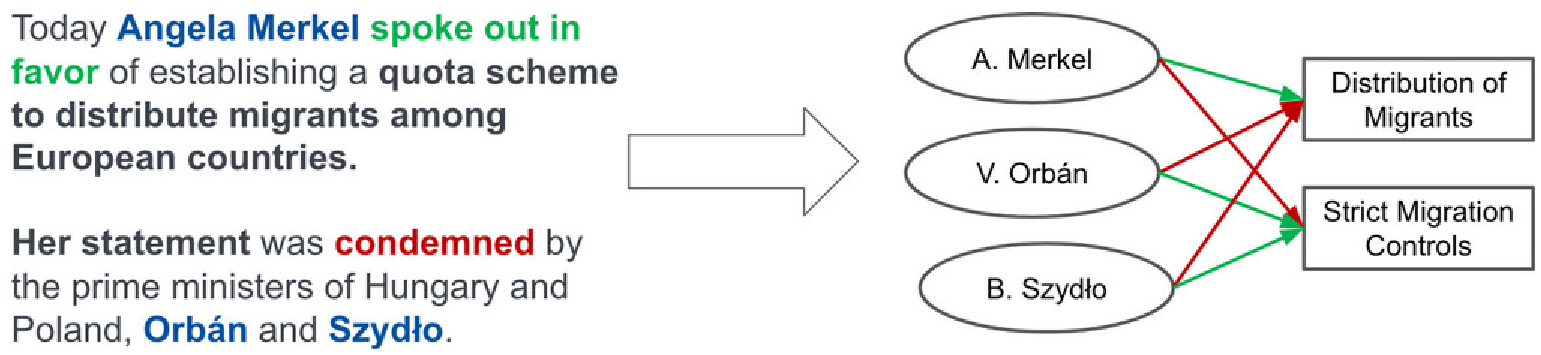
The framework represents debates as bipartite networks where nodes are either Actors (politicians, NGOs) or Claims (specific policy demands).
- Edges: Indicate support or rejection.
- Projections: Allow for the identification of "Discourse Coalitions"—groups of actors who may not officially be allied but share the same policy goals.
2. The ML Pipeline
The technical core uses German BERT + taz, a transformer model pre-trained specifically on German news. They tackled two primary tasks:
- Claim Detection: Is this sentence a policy demand?
- Claim Classification: Does it belong to one of the 8 major categories (e.g., Security, Integration, Economy)?
The authors made a strategic choice: Prioritize Recall. In a semi-automatic system, it is better for the AI to flag "maybe" results for a human to confirm than to miss a crucial minority opinion entirely.
Experimental Insights: The 2015 Migration Crisis
The study analyzed the "DEbateNet-mig15" dataset. The results show a striking evolution:
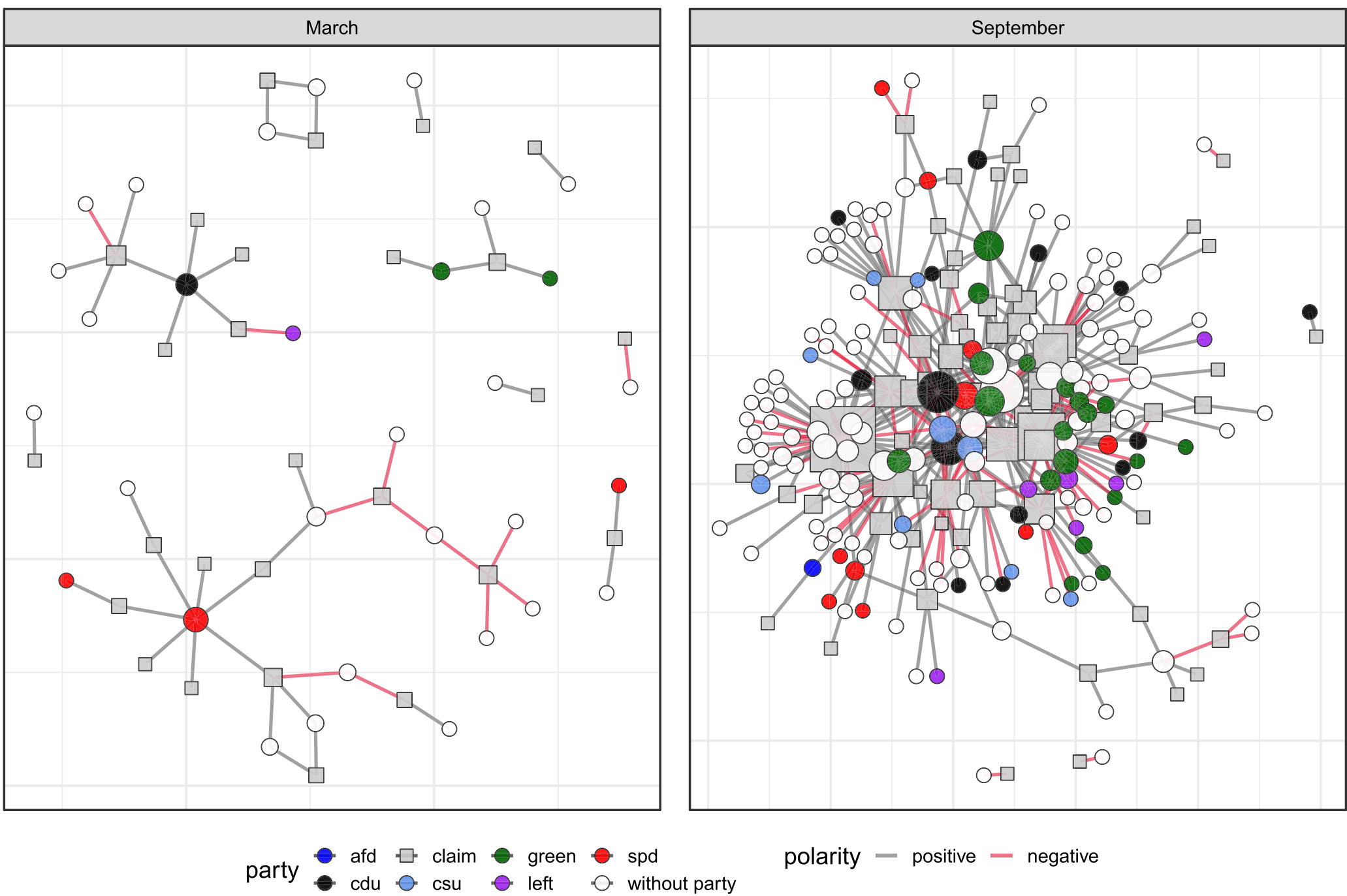
- Fragmenation (March 2015): The discourse was isolated, with parties focusing on narrow, unrelated issues (labor market vs. asylum numbers).
- Convergence (September 2015): Following the peak of refugee arrivals, the network became highly "connected." Angela Merkel emerged as the central node, with the "EU common solution" claim becoming the most controversial and central topic.
Critical Analysis: Why This Matters
The most profound finding is the "Redundancy Effect." While the ML models were not perfect at the sentence level (F1 score of ~0.52-0.60), they were 100% effective at identifying the "Core Network" (claims appearing at least twice).
In the real world, political actors and journalists repeat their key messages. This inherent redundancy makes NLP a viable tool for Social Science; the AI doesn't need to catch every single mention to accurately reconstruct the overall power structure of the debate.
Limitations & Future Work
One major hurdle remains: Bias. The authors noted an "Actor Frequency Bias," where models were more likely to label text as a "claim" if a famous politician (like Merkel) was mentioned. They proposed Actor Masking (replacing names with generic tags during training) as a successful fix to ensure the AI doesn't "silence" less prominent voices.
Looking forward, the team is moving toward Tripartite Networks—adding "Justifications" (the why behind a claim) to the mix, bringing DNA closer to the burgeoning field of Argument Mining.
Conclusion
This work marks a shift in Computational Social Science. By moving from "sentiment" to "structured networks," we can finally track the metabolism of democratic debates at scale. For researchers, the takeaway is clear: the future of social analysis is hybrid.