
Beyond the Like Button: How to Protect User Privacy Without Killing Social Data Analytics
Analysis-preserving protection of user privacy against information leakage of social-network Likes
The paper introduces a privacy-preserving protocol for social network "Likes" that allows users to anonymously express preferences while selectively disclosing non-identifying attributes. By leveraging partially blind signatures and a P2P-based Distributed Hash Table (DHT) infrastructure, the system achieves SOTA security properties like unlinkability and individual verifiability without sacrificing data utility for strategic business analysis.
TL;DR
Researchers have developed a cryptographic protocol that allows you to "Like" social media content without revealing who you are, while still letting companies know what kind of person expressed that preference (e.g., "A 25-year-old in New York liked this"). By combining Partially Blind Signatures with a P2P architecture, the system provides a middle ground between total surveillance and total anonymity.
The Hidden Danger of a "Like"
We often think of clicking a "Like" button as a harmless digital nod. However, academic research has proven that your cumulative Likes can predict your sexual orientation, religious views, and even your intelligence with frightening accuracy.
The current choice for users is binary and broken:
- Centralized Exposure: Your Likes are tied directly to your profile, accessible to the platform owner.
- Total Anonymity: Likes are treated like secret ballots (e-voting), which is great for privacy but useless for researchers and businesses who need to understand demographic trends.
The "Selective Disclosure" Insight
The core motivation of this paper is to solve the trade-off between Privacy and Utility. The authors argue that we don't need to know who liked a post; we only need to know the characteristics of the audience.
They introduce a protocol where a user carries a "Certified Attribute" card (CE). When you click Like, the protocol allows you to choose which specific attributes to reveal for that specific click. You might reveal your "City" for a local news post, but keep your "Political Leaning" hidden for a controversial status.
How It Works: The Methodology
The system relies on three pillars: Obscuring Operators, Partially Blind Signatures (PBS), and Distributed Hash Tables (DHT).
1. The Architecture
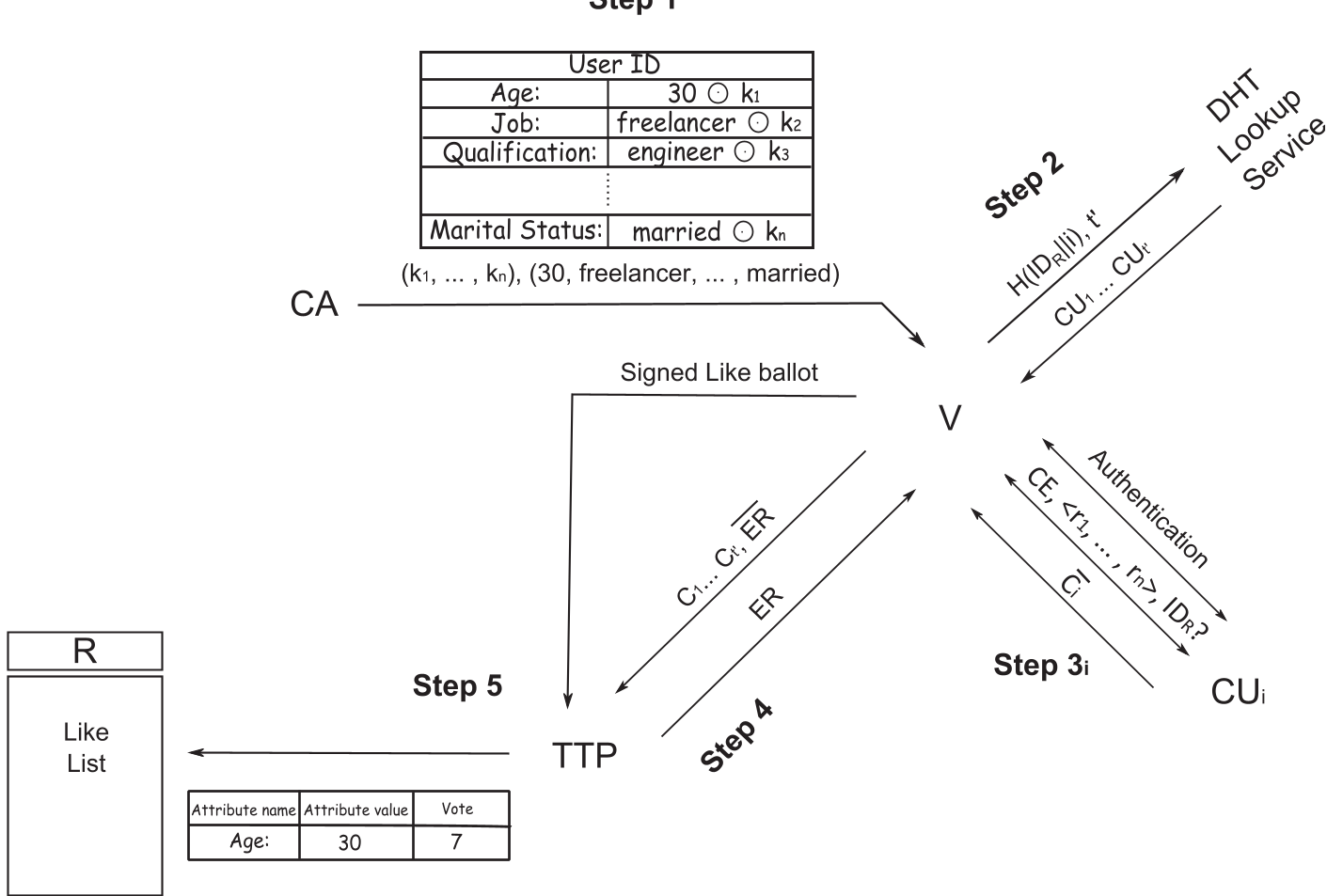
Unlike Facebook's centralized servers, this model uses a P2P social network. Credential users (CUs) are selected via a DHT to act as temporary witnesses to your Like without knowing what you are liking.
2. The Cryptographic Secret Sauce
The protocol uses Partially Blind Signatures. Imagine putting a ballot in an envelope with a window. The "window" shows your pre-approved attributes (like "Age: 30"), but the ballot itself (the "Like" and the "Resource ID") remains "blinded" to the signer until it's verified.
Key steps include:
- Certificate Issuing: A CA gives you obscured attributes (using ).
- Credential Issuing: You obtain "tickets" from random users in the network to prevent you from double-voting.
- Like Click: You unblind the signature and send the "Signed Ballot" to a Trusted Third Party (TTP).
Experimental Performance & Security
The authors conducted a rigorous analysis of 5 different security properties: Uniqueness, Secretness, Verifiability, Uncloneability, and Robustness.
- Anti-Replay: The system uses a 128-bit random sequence () to identify each Like. The probability of two users generating the same is less than —virtually impossible.
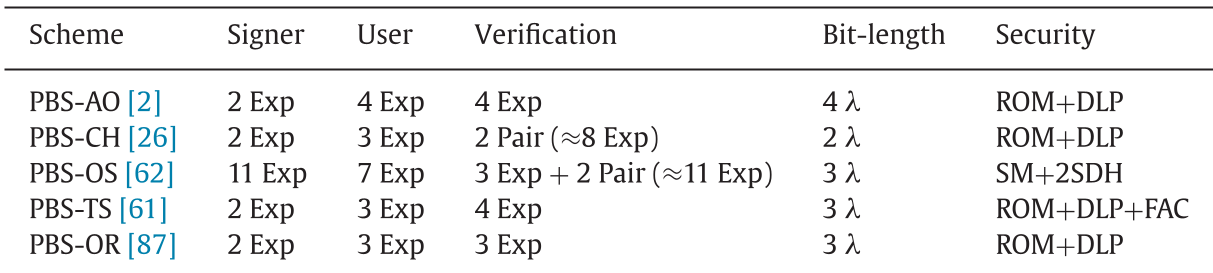
- Computational Efficiency: The protocol utilizes the PBS-OR scheme, which requires only 3 exponentiations for verification, making it significantly faster than pairing-based methods often used in modern blockchain applications.
Critical Insight & Future Outlook
While the technical foundation is sound, the paper acknowledges a major hurdle: Market Adoption. Social media giants currently profit from the very "privacy leaks" this paper seeks to plug.
However, as awareness of digital privacy grows—and as privacy-focused platforms like Mastodon or Nostr gain traction—decentralized protocols like this will become the gold standard. This research proves that you don't have to choose between a "smart" social network and a "private" one. You can have both.
Conclusion
This protocol represents a shift from Anonymization (hiding data) to Unlinkability (hiding connections). It empowers users to act as their own data gatekeepers, ensuring that while the "Like" counts towards an overall score and demographic analysis, it can never be traced back to the person behind the screen.