
Selective Disclosure: Protecting Privacy Without Killing Analytics in Social Media
Analysis-preserving protection of user privacy against information leakage of social-network Likes
The paper introduces a cryptographic protocol for social network "Likes" that ensures privacy by making user identities unlinkable to their resource evaluations. Using partially blind signatures and a P2P-based Distributed Hash Table (DHT), it allows users to selectively disclose non-identifying attributes for analysis while achieving SOTA efficiency in decentralized environments.
TL;DR
In an era where a single Facebook "Like" can reveal your political leaning, sexual orientation, or even cost you your job, privacy is no longer a luxury—it's a requirement. This paper proposes a decentralized protocol that decouples your identity from your "Like" while allowing you to share specific, non-identifying traits (like your age or country) for marketing analysis. By combining Partially Blind Signatures with a P2P Social Network architecture, the authors prove we can have "Private Data" and "Public Analytics" at the same time.
The Motivation: The Danger of the "Like" Button
Research has shown that digital footprints are terrifyingly accurate predictors of character. Analyzing Likes can reveal hidden aspects of personality that users never intended to share.
- The Problem: Current social networks are centralized. They own your data and the links between your identity and your preferences.
- The Trade-off: If we make Likes completely anonymous (like secret ballots), companies lose the ability to perform legitimate market segmentation. If we keep them public, your privacy is dead.
The authors propose a "Third Way": Unlinkable but Informative.
Methodology: How the Protocol Works
The system moves away from a central server to a Peer-to-Peer (P2P) model using a Distributed Hash Table (DHT).
Core Architecture
The protocol involves four main actors: The User (V), a Certification Authority (CA), Credential Users (CU), and a Trusted Third Party (TTP).
- Certificate Issuing: The CA gives the user a certificate where attributes (like "Gender: Male") are obscured using a modular exponentiation operator ().
- Credential Issuing: To prevent tracing, the user contacts random peers (Credential Users) to get "tickets" for a Like. These peers know who you are but not what you are liking.
- The Like Click: Effectively a "Secret Ballot." The user uses a Partially Blind Signature. The TTP verifies the signature (ensuring the user hasn't voted twice) but cannot see the user's specific identity.
- Selective Disclosure: The user reveals only the specific attributes they choose (e.g., "I am from Italy") by providing the "secret" to unmask only that part of the certificate.
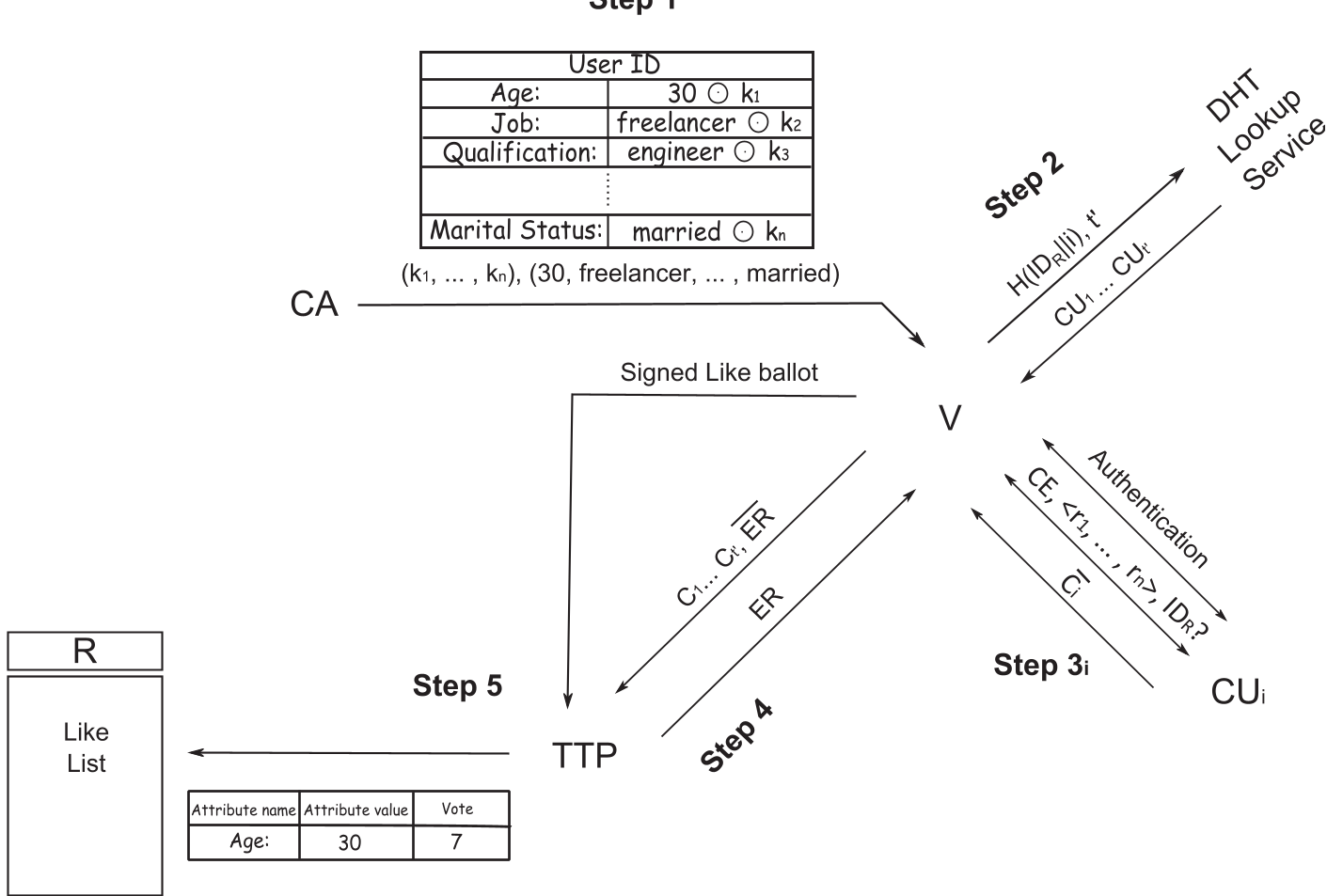 Figure 1: The flow of messages between the user, peers, and the TTP to ensure privacy.
Mathematics of Privacy: Partially Blind Signatures
The "Secret Sauce" here is the Partially Blind Signature (PBS). Unlike a standard blind signature (where the signer knows nothing), a PBS allows the signer to include "common information" (like the Resource ID) that remains visible, while the "Like score" and "Random Identifier" remain hidden.
The authors utilized the PBS-OR scheme, which is based on the hardness of the Discrete Logarithm Problem. This ensures that even if a Credential User and the TTP collude, they cannot mathematically link the Like back to the user's digital profile.
Results & Efficiency
A common critique of P2P and cryptographic protocols is that they are too slow. This paper tackles that head-on.
- Uniqueness: Through a birthday-attack analysis, they prove that the chance of two users having a collision in their "Like ID" is less than —essentially zero.
- Scalability: By using a Tree-Based DHT (TLS), the cost of adding or removing users from the network is , significantly more efficient than older models.
- Computational Efficiency: Compared to SOTA models using Bilinear Pairings (which are computationally expensive), their Discrete Log-based approach is much faster for mobile devices.
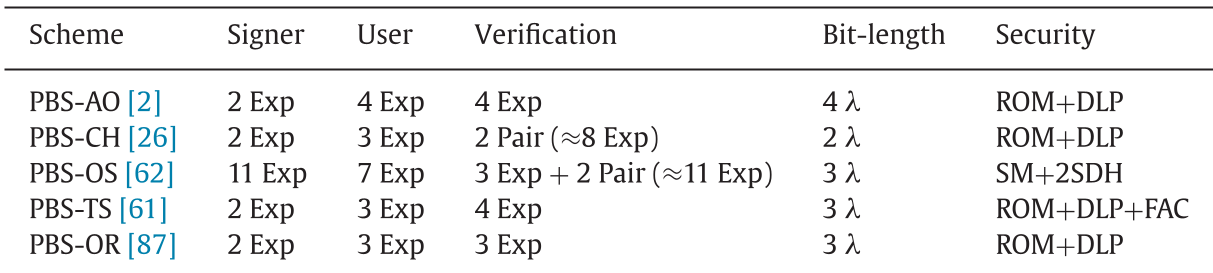 Figure 2: Efficiency comparison showing that the chosen PBS-OR scheme requires fewer exponentiations than competitors.
Critical Analysis & Conclusion
The protocol is a masterclass in applying heavy cryptography to a social problem. However, there are two hurdles for real-world adoption:
- Implementation Inertia: Current giants (Facebook/Meta) have no financial incentive to decentralize their "Like" system, as their business model thrives on identifying you.
- TTP Reliability: While the TTP is "functionally" trusted, its role in preventing double-voting still represents a potential bottleneck.
The Takeaway: This work provides the blueprint for Privacy-Preserving Business Intelligence. It proves that we can allow researchers to study what types of people like a product without ever knowing which specific person clicked the button. As P2P social networks (like Mastodon or Farcaster) gain traction, these protocols will likely become the standard for "social trust."