
IVq-ROPFGs: Breaking the Constraints of Uncertainty in Complex Network Modeling
Analysis of Social Networks, Communication Networks and Shortest Path Problems in the Environment of Interval-Valued q-Rung Ortho Pair Fuzzy Graphs
This paper introduces Interval-Valued q-Rung Ortho Pair Fuzzy Graphs (IVq-ROPFGs), a generalized fuzzy graph framework that utilizes interval-valued membership and non-membership grades. It extends existing models like Pythagorean and Intuitionistic fuzzy graphs to provide a more flexible space for modeling uncertainty in complex networks and decision-making tasks.
TL;DR
Researchers have developed Interval-Valued q-Rung Ortho Pair Fuzzy Graphs (IVq-ROPFGs), a major leap in fuzzy graph theory. By replacing crisp fuzzy numbers with intervals and loosening the mathematical constraints of previous models (like Pythagorean fuzzy sets), this framework provides a much more flexible and accurate way to model traffic systems, social networks, and engineering decision-making under high ambiguity.
Why Traditional Fuzzy Graphs Fail
In the real world, "truth" and "falsity" are rarely simple numbers. We often say, "The suitability of this road is between 40% and 60%." Traditional Fuzzy Graphs (FG) and Intuitionistic Fuzzy Graphs (IFG) struggle here.
The core issue is the constraint problem:
- Intuitionistic Fuzzy Sets: Membership + Non-membership .
- Pythagorean Fuzzy Sets: (Membership) + (Non-membership) \leq 1$.
If an expert believes the membership is 0.8 and non-membership is 0.7, both these systems crash because and . The "q-rung" approach solves this by allowing the power to increase until the condition is met, effectively expanding the "ortho pair" space.
Methodology: The Power of the Interval
The authors define a graph where both nodes and edges possess interval-valued membership and non-membership .
The Core Innovations:
- Generalized Space: By setting , you get Intuitionistic; at , you get Pythagorean. This makes IVq-ROPFG a universal framework.
- Score Function: A sophisticated ranking tool allows practitioners to compare different interval-valued fuzzy numbers, essential for finding the "shortest" path or "best" project.
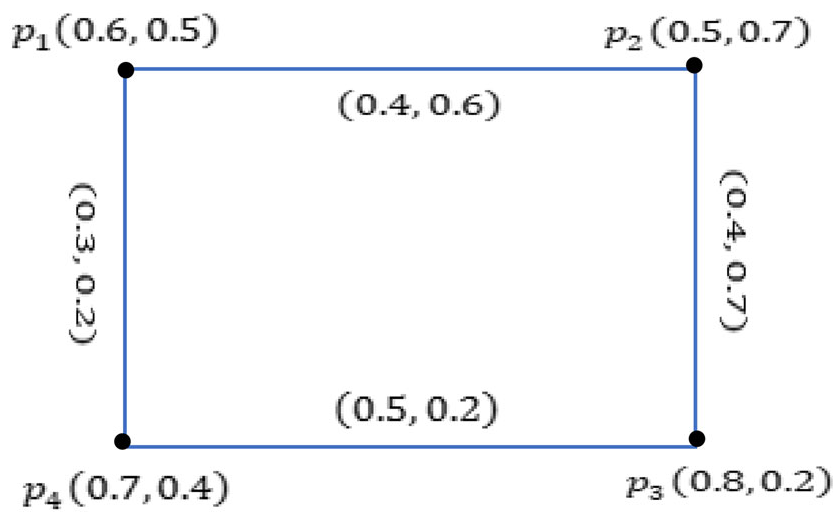 Figure 1: Comparison of spaces for IFSs, PyFSs, and q-ROPFSs. Note how the q-rung (red curve) covers a significantly larger area as q increases.
Real-World Applications
1. Traffic Engineering & Shortest Path
Using a modified Dijkstra Algorithm, the authors solved a routing problem. Unlike standard algorithms that use crisp distances, this method accounts for "suitability" and "non-suitability" ranges.
Result: The path was identified as optimal. When the same data was used in a standard Fuzzy Graph, the result changed to , proving that ignoring non-membership intervals leads to potentially sub-optimal real-world decisions.
2. Social & Communication Networks
The paper analyzes co-authorship strength across different countries. By calculating the "degree" of nodes (countries like Pakistan, India, Saudi Arabia), the model reveals the hidden strength of collaboration that traditional fuzzy math misses.
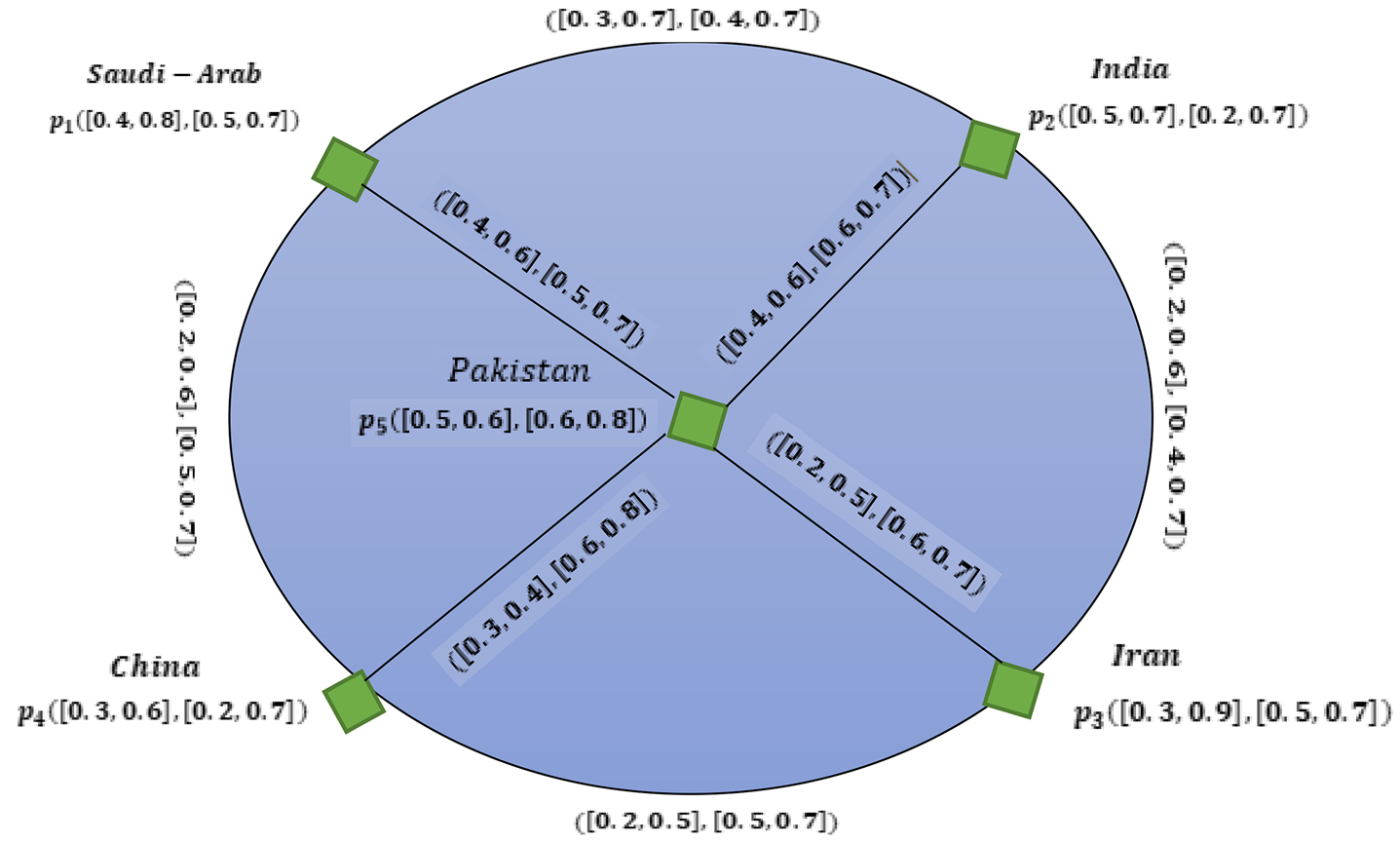 Figure 2: A social network modeled using IVq-ROPFGs, where edge weights represent the strength of international research collaboration.
Engineering Decision-Making
The study applied Weighted Averaging (IVQROPFWA) and Weighted Geometric (IVQROPFWG) operators to prioritize civil engineering projects.
Ranking Logic:
- Infrastructure experts provide interval-based assessments.
- Data is aggregated into a relational matrix.
- Score functions rank the projects.
Outcome: "Building a school" consistently emerged as the top priority across different operators, demonstrating the stability of the model.
Critical Insight & Conclusion
The true value of this work lies in its Inductive Bias. It assumes that human experts are more comfortable providing "ranges" of possibility rather than clicking a single percentage. By allowing to be an adjustable parameter, the model doesn't force reality to fit the math; it scales the math to fit the complexity of reality.
Limitations & Future Work
While mathematically robust, calculating the optimal rung still requires manual oversight. Future research could explore auto-tuning based on the variance of expert inputs. Furthermore, applying this to dynamic, time-varying networks (like real-time traffic) remains an open challenge.
Final Takeaway: This is a foundational shift for anyone working in network science or complex system optimization. It provides the mathematical "elbow room" needed for real-world uncertainty.