
Deciphering the DNA of Remix Culture: A Structural Analysis of ccMixter
An analysis of the social structure of remix culture
This paper presents a quantitative social network analysis (SNA) of ccMixter, a Creative Commons-based music remixing community, to explore the structural characteristics of "remix culture." By analyzing 9,300 submissions, the authors characterize "reuse networks" and demonstrate how communal creative production follows complex power-law distributions.
TL;DR
In this seminal 2009 study, researchers Giorgos Cheliotis and Jude Yew dive into ccMixter, a legal music-sharing hub, to quantify how "remix culture" actually works. They find that while the internet loves the idea of infinite collaboration, real-world creative reuse is constrained by "cultural modularity." Most importantly, they reveal a hard truth for community managers: flashy contests bring in the crowds, but they don't necessarily build a soul for the community.
Problem & Motivation: Beyond the Functional Commons
We often talk about "Commons-Based Peer Production" (CBPP) in the context of Wikipedia or Linux. In those cases, thousands of people work together to build one big, functional thing.
But what happens when the goal isn't a "finished" encyclopedia, but personal expression? In "Remix Culture," the output is a messy, living web of derivatives. The authors argue that we haven't had the data to see the "bones" of this culture—until now. They wanted to know:
- How "deep" does reuse go? (Do we actually remix remixes?)
- Do contests help or haunt a community's social structure?
Methodology: The Anatomy of a Reuse Network
The team analyzed ccMixter using two distinct lenses:
- The Content View: Tracks the genealogy of a song. If Song B uses a loop from Song A, a directed edge is formed.
- The Author View: Tracks the social ties. If User Y remixes User X, it creates a "social link" built on artistic appreciation.
1. The Bow Tie Analysis
To understand the community's social roles, the authors used a Bow Tie Analysis, a method originally used to map the structure of the World Wide Web.
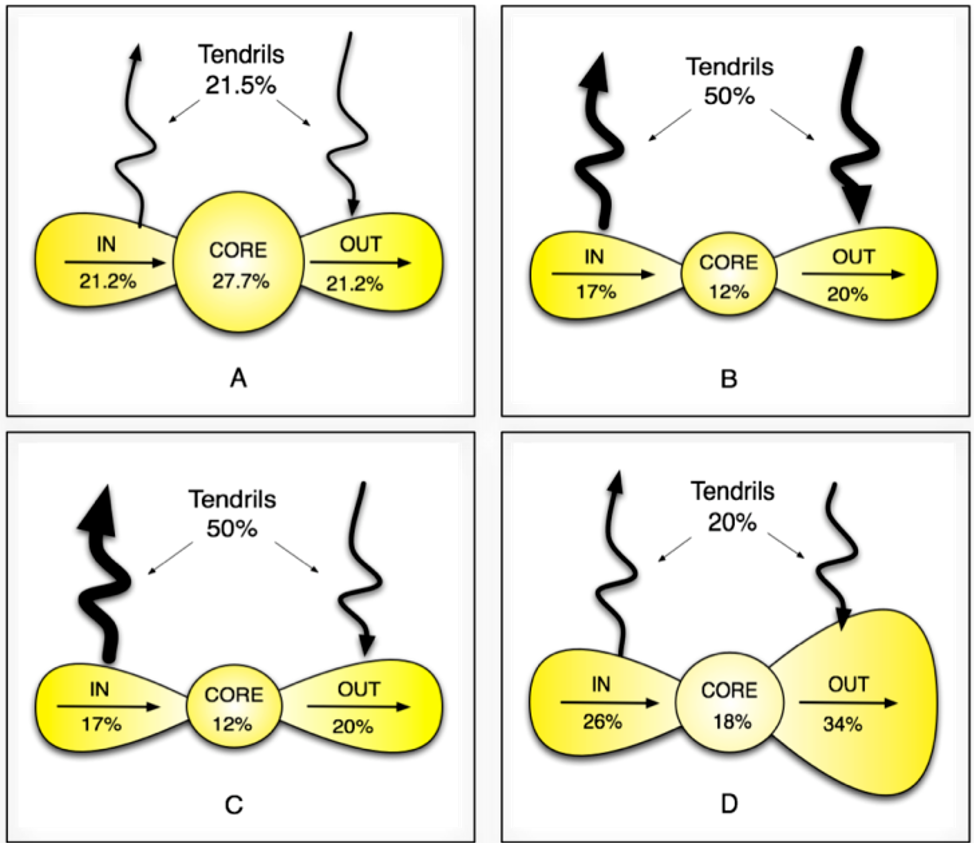
- The Core (SCC): The highly interconnected "engine room" where users remix each other reciprocally.
- IN/OUT: Users who only provide source material or only consume/remix without their own work being reused.
- Tendrils: Users connected to the periphery but not the heart of the community.
2. Motif Analysis: The "Logic" of Remixing
The authors looked for Network Motifs—recurring sub-patterns like "Branching" (one source, many remixes) or "Merging" (one remix, many sources).
Key Insights: The "Constraint" of Creativity
1. The Law of Diminishing Returns
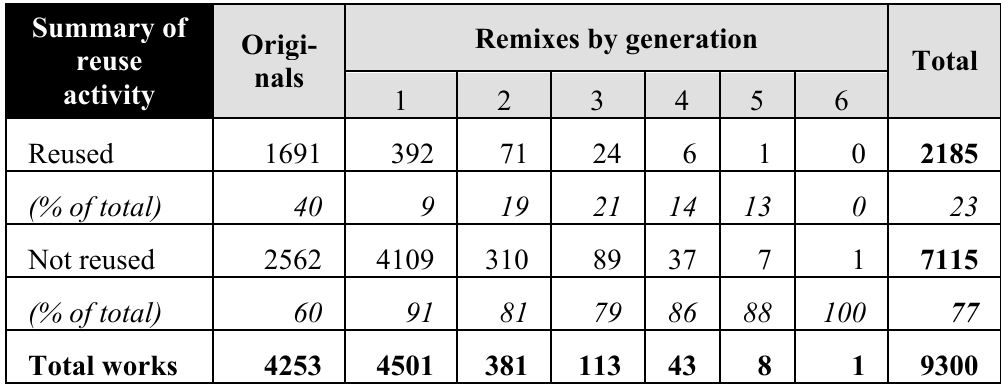
The data showed a surprising "reuse depth" limit. While some songs reached Generation 6, the vast majority of activity (81-91%) stopped after Generation 1. The Insight: As music gets "mixed down," it becomes more modularly complex and harder for another artist to pull apart. Creative reuse stands on the "shoulders of giants," but those shoulders get wobbly as the remix chain gets longer.
2. The "Contest" Trap
The paper analyzes high-profile events like the Fort Minor remix contest.
- The Good: Contests create massive spikes in registration and uploads.
- The Bad: Most contest participants are "one-hit wonders." They occupy the Tendrils of the network and never migrate to the Core.
Experiments & Results: Ad-Hoc vs. Organized
When the authors "removed" contests from their data to see the "natural" community, the results were telling:
- Branching vs. Merging: In contest-driven environments, everyone remixes the same celebrity track (Branching). In organic growth, users are more likely to synthesize multiple peers' works (Merging).
- Reciprocity: The Strongly Connected Core (SCC) is where the real "peer" in peer-production lives. Here, authors have a -score of 63.5 for "3-way mutual dyads"—meaning they are incredibly likely to form tight-knit, mutually supportive creative circles.
Critical Analysis & Takeaways
This paper serves as a warning for modern "Web3" or social platforms: Extrinsic incentives (money/prizes/contests) do not scale social capital.
Takeaways:
- For Designers: If you want a sustainable community, don't just optimize for "Total Uploads." Optimize for Reciprocity.
- Limitations: The study is limited to music. Visual arts (like Memes) might have different "reuse depths" because images are easier to "layer" than audio tracks.
- Future View: This research laid the groundwork for Cultural Analytics, suggesting that the way we share and reuse culture is not random—it has a mathematical signature.
Conclusion: Remix culture is a balance between the "Breadth" of a viral contest and the "Depth" of a dedicated core. Without the Core, the community is just a temporary marketing gimmick.