
The Resilience of Influence: How OSN Topology Dictates Spreading Power Under Attack
Analysis of the Spreading Influence Variations for Online Social Users under Attacks
Identifying influential spreaders in Online Social Networks (OSNs) under cyber attacks. The study utilizes k-shell decomposition to rank spreading capability and examines how network assortativity affects resilience. Major finding: Assortative networks maintain structural stability under core-targeted attacks, whereas disassortative networks collapse rapidly.
TL;DR
In the hyper-connected world of Online Social Networks (OSNs), influence is rarely static. This paper reveals a critical topological secret: the assortativity of a network (whether "hubs" connect to other "hubs") determines its survival against attacks. While assortative networks like Facebook are naturally resilient, disassortative networks like Epinions face catastrophic collapse of their information-spreading capacity when top influencers are compromised.
Problem & Motivation: The Static Influence Fallacy
Most influence ranking algorithms—such as PageRank or Betweenness Centrality—treat a user's power as a fixed attribute. However, in reality, influential accounts are prime targets for cyber-attacks (e.g., the 2013 Associated Press Twitter hack).
The authors argue that we must understand the dynamics of influence: what happens to the rest of the network when the "seeds" or the "core" are removed? The core challenge lies in the inherent structural differences of OSNs, specifically their Assortative Mixing patterns.
Methodology: K-Shells and Network Assortativity
The study employs the k-shell decomposition method. By iteratively pruning nodes with low degrees, the network is stripped like an onion to reveal its innermost core (the shell index ).
To explain why some networks break while others hold, the researchers introduce Assortativity ():
- Assortative (): High-degree nodes (popular users) tend to link with other high-degree nodes, forming a dense, self-reinforcing core.
- Disassortative (): High-degree nodes link to low-degree nodes, acting as hubs that support a massive, sparse periphery.
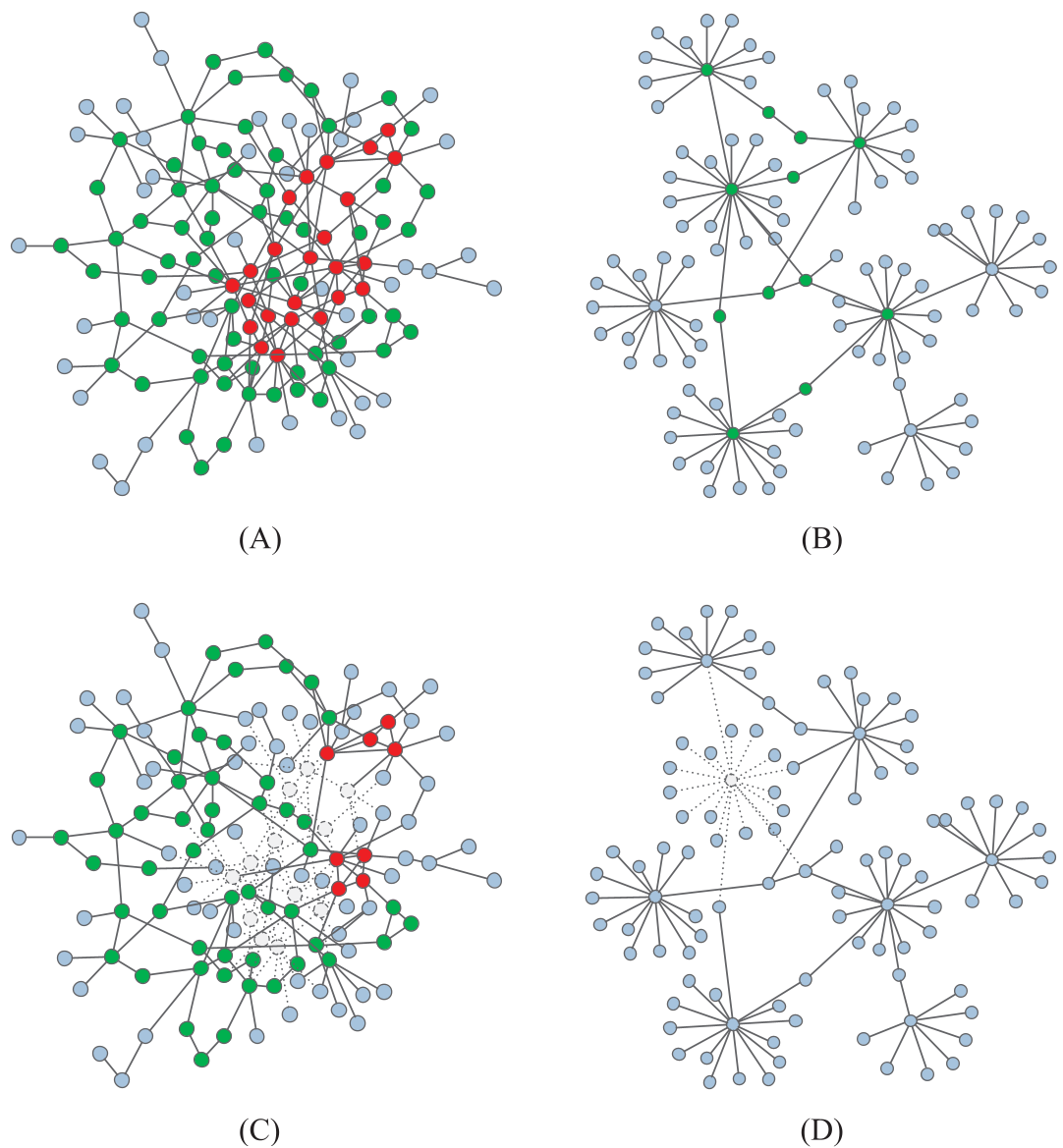
Experimental Analysis: The Collapse of Disassortative Cores
The authors tested their hypothesis across datasets including Facebook, Hamsterster, Epinions, and Digg.
1. Highest Spreading Capability
When core nodes are removed (simulating an attack), the total number of shells in a network represents its maximum potential for information diffusion.
- In assortative networks, the number of shells remains relatively stable even as nodes are removed.
- In disassortative networks, the shell structure "collapses" almost instantly.
2. Individual Node Degradation
The study tracked the coreness of individual nodes after an attack. In disassortative networks, a node that was previously in shell 80 might suddenly drop to shell 22 after only 1% of the core is attacked. They literally lose their ability to reach the rest of the network because their "connectors" are gone.
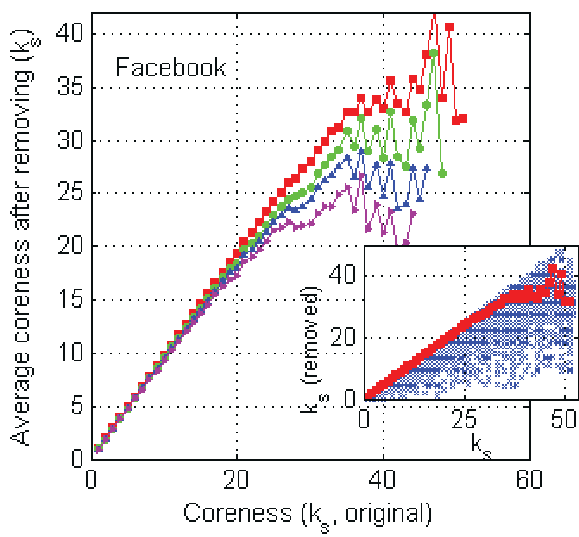
Deep Insight: Why Does Assortativity Save Networks?
The physical intuition behind this is revealed in the Shell Correlation analysis.
- In Assortative OSNs, neighboring nodes usually reside in similar shells. If you remove one core node, its neighbors are likely core nodes themselves, maintaining the density.
- In Disassortative OSNs, periphery nodes (low ) rely entirely on the core hubs to reach the rest of the network. The core is extremely sparse. Once the hubs are removed, the periphery nodes become disconnected or isolated into very low-index shells.
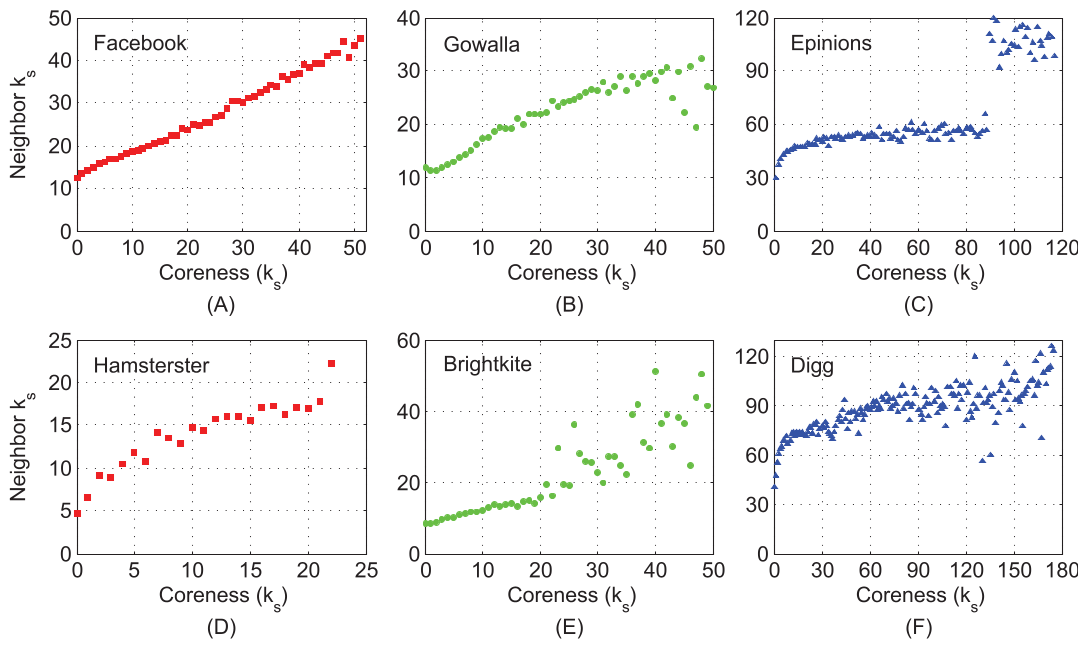
Conclusion and Takeaways
This research shifts the focus from finding the "best" spreader to understanding the "resilience" of the network environment.
- For Marketers: In assortative networks, your campaign is safer from the "loss" of a few key influencers.
- For Cybersecurity: Protecting the sparse cores of disassortative networks is paramount; otherwise, a small, targeted attack can disable the entire network's information flow.
- Limitation: The study assumes a static removal of nodes (pruning); future work should consider adaptive attackers who might strategically target specific "bridge" nodes rather than just the highest k-shells.