
Yuru-Chara Logic: Decoding the Social Media Power of Japan's "Loose" Mascots
An Analysis of Tweets by Local Mascot Characters for Regional Promotions, Called Yuru-Charas, and Their Followers in Japan
This research analyzes how Japanese local mascots, known as "Yuru-charas," utilize Twitter for regional promotion. By examining 16 major characters such as Kumamon and Fukka-chan, the study identifies distinct communication strategies and follower demographics, establishing that high-engagement mascots serve as critical bridges for both external tourism marketing and internal community building.
TL;DR
This study investigates the Twitter mechanics of 16 elite Japanese regional mascots (Yuru-charas). It reveals that the most successful characters act less like government broadcasters and more like authentic "personalities," leveraging high interactivity and visual content to drive regional interest both domestically and internationally.
Behind the "Looseness": The Motivation
In the landscape of Japanese "Soft Power," Yuru-charas occupy a unique niche. Unlike Pokémon or Disney characters—which are commercial products—Yuru-charas are essentially public servants. They exist to promote cities (e.g., Fukaya) or prefectures (e.g., Kumamoto). However, traditional government PR is often perceived as dry and factual. The authors sought to understand if these "loose" characters could bridge the gap between bureaucratic messaging and genuine public engagement via Twitter.
Methodology: Measuring Mascot Personality
To quantify the "vibe" of a mascot, the researchers developed six indices split into two categories:
1. Behavior (The "What" and "How")
- Reply Rate: Measures interactivity—are they talking to people or at them?
- Photograph Rate: Indicators of effort; visuals drive engagement.
- Notice Rate: The "advertisement" factor. High notice rates mean more "event reminders" and less "personality."
2. Audience (The "Who")
- Local vs. Non-local: Identifying if the mascot is for internal morale or external tourism.
- International Reach: Analyzing the global footprint (SOTA indicator for soft power).
 Fig 1: Fukka-chan, a classic Yuru-chara incorporating regional symbolism (green onions).
Key Insights: Why "Ads" Don't Work for Mascots
The most striking finding involves the Notice Rate. Contrary to intuition, the most popular mascots (like Kumamon) have very low notice rates.
- The Paradox: If a mascot tweets too many "notices" (ads for local festivals), fans lose interest.
- The Persona: Successful mascots speak as themselves. They post daily "diary logs" and "reports" of their awkward motions, which makes them icons with commercial value rather than just walking billboards.
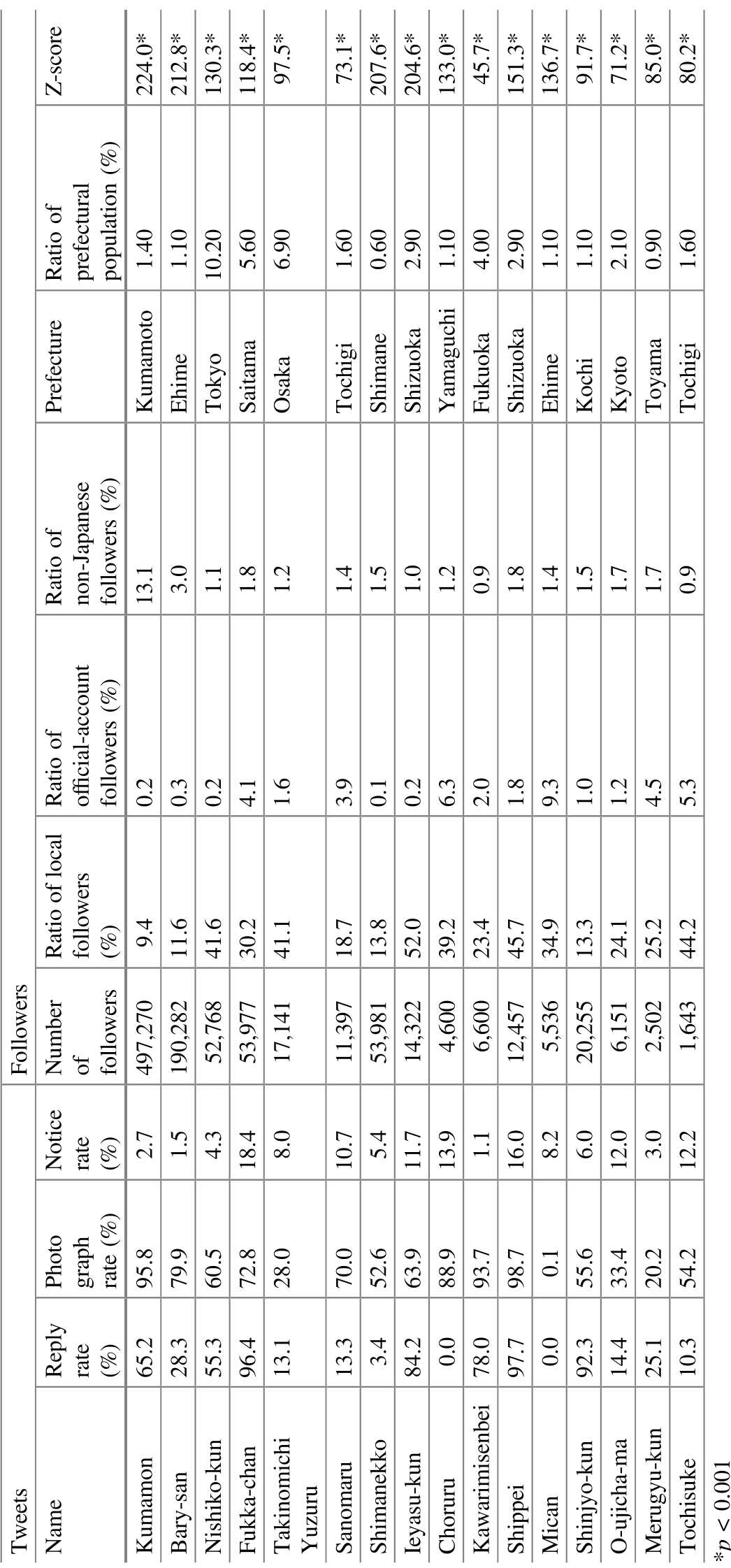 Table 1: Detailed metrics showing the vast differences in Twitter policy, from Mican (0% reply) to Fukka-chan (96.4% reply).
Global Potential and Internal Marketing
The data confirms that Kumamon is the "SOTA" mascot for international reach, with 13.1% of followers residing outside Japan—specifically in Taiwan and Thailand. This demonstrates that a well-managed mascot can bypass language barriers, provided the "visual language" and "personality" are strong enough.
Internally, the high Z-scores for local followers show that these characters are vital for "Internal Marketing"—encouraging local residents to take pride in their region and participate in community events.
Critical Analysis & Conclusion
Takeaway
The success of a Yuru-chara on social media is inversely proportional to how "official" they act. The more they embrace their "looseness" (Yuru-sa) and interact like a human friend, the more effective they become as marketing tools.
Limitations
The study notes a language barrier: since most mascots tweet only in Japanese, their global growth is capped. For a mascot to truly become a global "Cool Japan" asset, multi-lingual strategies are required.
Future Work
The next frontier is comparing these mascot accounts directly with their corresponding official government accounts to determine the specific "Trust Gap" that mascots bridge. As mascots like Lupita (Mexico) and BearlinTower (Germany) emerge, the Japanese model provides a blueprint for regional identity in the digital age.