
Unmasking the Silence: Text Mining Analysis of Violence Against Women in Brazil
An analysis of violence against women based on victims’ reports
This paper presents a text mining approach to analyze reports of violence against women in Brazil, utilizing Latent Dirichlet Allocation (LDA) for topic modeling and Naive Bayes for classification. The study successfully categorizes reports into "Constant" and "Sporadic" violence, identifying key patterns in domestic and family-related aggression.
TL;DR
In Brazil, a woman is victimized every few seconds, yet many cases go unreported to authorities. This research leverages Natural Language Processing (NLP) and Text Mining to analyze public testimonials from social media and news reports. By using Latent Dirichlet Allocation (LDA) and Naive Bayes, the study uncovers the linguistic markers of domestic abuse, distinguishing between sporadic incidents and terrifying patterns of "constant" violence perpetrated by those closest to the victims.
Background & Motivation
Despite the existence of the Maria da Penha Law and the Femicide Law in Brazil, structural barriers like financial dependence and fear prevent formal reporting. However, the digital age has provided victims with a "digital refuge"—platforms where they feel safer to share their stories. The authors recognized that these raw, unstructured texts contain vital data that could help NGOs and specialized police stations (Delegacias da Mulher) better understand and categorize the nature of aggression.
Methodology: From Raw Text to Insight
The researchers developed a rigorous pipeline to handle the nuances of the Portuguese language:
- Data Collection: 125 detailed reports were manually gathered from news portals (G1, VIX) and social media (Instagram).
- Preprocessing: A critical step was the creation of a custom slang and abbreviation dictionary (324 terms) to ensure the semantics of informal victim reports (e.g., "vc" for "você") were preserved.
- Topic Modeling (LDA): This unsupervised method identified clusters of related words, which were then manually labeled into themes like Family Abuse, Relationship, and Public Harassment.
- Classification: Using Naive Bayes, the study sought to automate the detection of whether a report indicated a one-off event or a cycle of constant abuse.
 Figure 1: The stages of the text mining process, from collection to analysis.
Key Discoveries: The Geography of Violence
The "Constant" vs. "Sporadic" Divide
The study found a striking difference in word usage based on the frequency of the violence:
- Constant Violence: Heavily characterized by words like "speak," "tell," and "report," suggesting a deep-seated urge for the victim to externalize long-term suffering. Family terms like "father" and "brother" appeared with high frequency.
- Sporadic Violence: Featured words like "friend," "bus," and "followed," highlighting incidents that often occur in public spaces or involve acquaintances.
Topic Modeling Insights
The LDA analysis provided "Bag of Words" representations for different scenarios. For example, the Family Abuse topic was strongly associated with words like "abuse," "father," "brother," "mother," and "sexually," pinpointing the perpetrators within the home.
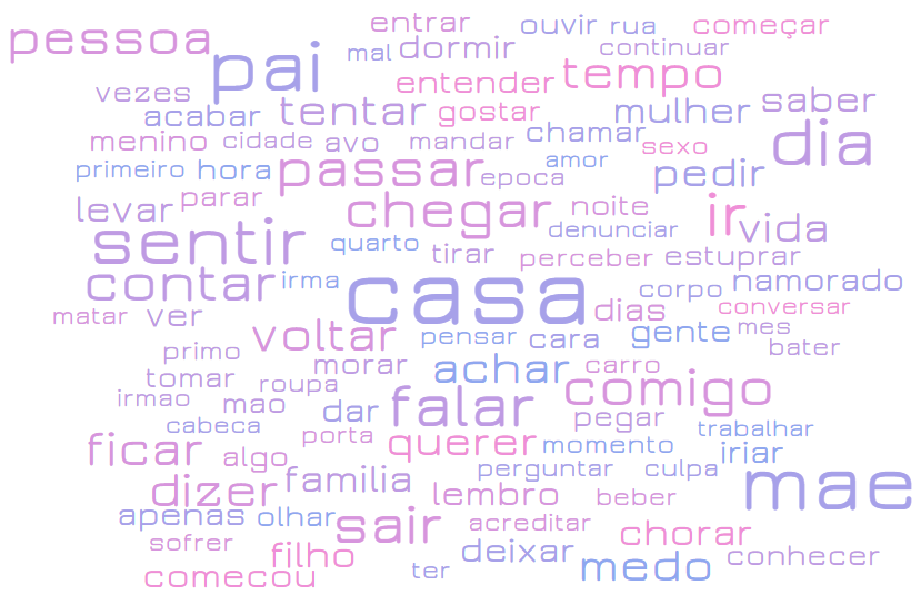 Figure 2: Word cloud visualization showing the prominence of domestic settings and family-related vocabulary.
Experimental Performance
The Naive Bayes classifier achieved a 71.2% accuracy rate. While promising, the authors noted that both sporadic and constant reports often share similar vocabularies (e.g., the word "house" appears in both), which creates classification noise.
| Metric | Result |
|---|---|
| Total Instances | 125 |
| Correctly Classified | 89 (71.2%) |
| Predominant Class | Sporadic (62.4%) |
Critical Analysis & Future Directions
The strength of this work lies in its linguistic specificity for the Brazilian context. By creating a custom dictionary for Portuguese slang, the researchers moved beyond the limitations of standard translated tools.
Limitations: The dataset (125 reports) is relatively small for high-stakes machine learning. Future work should look into BERT-based embeddings which can capture the context of a sentence better than the "Bag of Words" approach used here.
Takeaway: This research proves that text mining is not just a business tool for sentiment analysis—it is a powerful instrument for social justice, capable of turning silent digital cries for help into actionable data for protecting women.