
Deciphering Gender through the Lens: A Visual Analytics Approach to Social Media Profiling
1451_An Analytic System for User Gender Identification through User Shared Images.
This paper presents a multimedia analytic system for user gender identification by analyzing visual patterns in user-shared images across social networks like Fotolog and Flickr. By employing "non-user generated labels" through SIFT and CNN architectures, the system achieves up to 79% identification accuracy without relying on private profile data or noisy user tags.
TL;DR
Researchers from HKUST-NIE Social Media Lab have developed a system that can identify a user's gender with nearly 80% accuracy simply by analyzing the images they share. By moving away from noisy text-based tags and focusing on "non-user generated labels" derived from CNN and SIFT features, the system uncovers a fundamental social truth: our visual preferences are highly gendered and mathematically predictable.
Background & Motivation: The Privacy vs. Personalization Paradox
In the modern social media landscape, high-value data like gender is increasingly protected under privacy walls or left blank by users on platforms like WeChat or Instagram. Yet, for services like viral prediction and personalized marketing, knowing the user's demographic is essential.
Traditional methods rely on:
- Usernames: Easily faked or ambiguous.
- Textual Content: Highly dependent on language (English-centric) and culture.
- Social Tags: Messy, inconsistent, and often missing.
The authors' insight was simple but powerful: Users who share visually similar images are more likely to have the same gender. Because images are a universal language, an image-based approach can bypass the limitations of text-based analytics.
Methodology: The Power of Non-User Generated Labels
The core innovation lies in the transition from what a user says about an image to what the image actually contains.
1. The Processing Pipeline
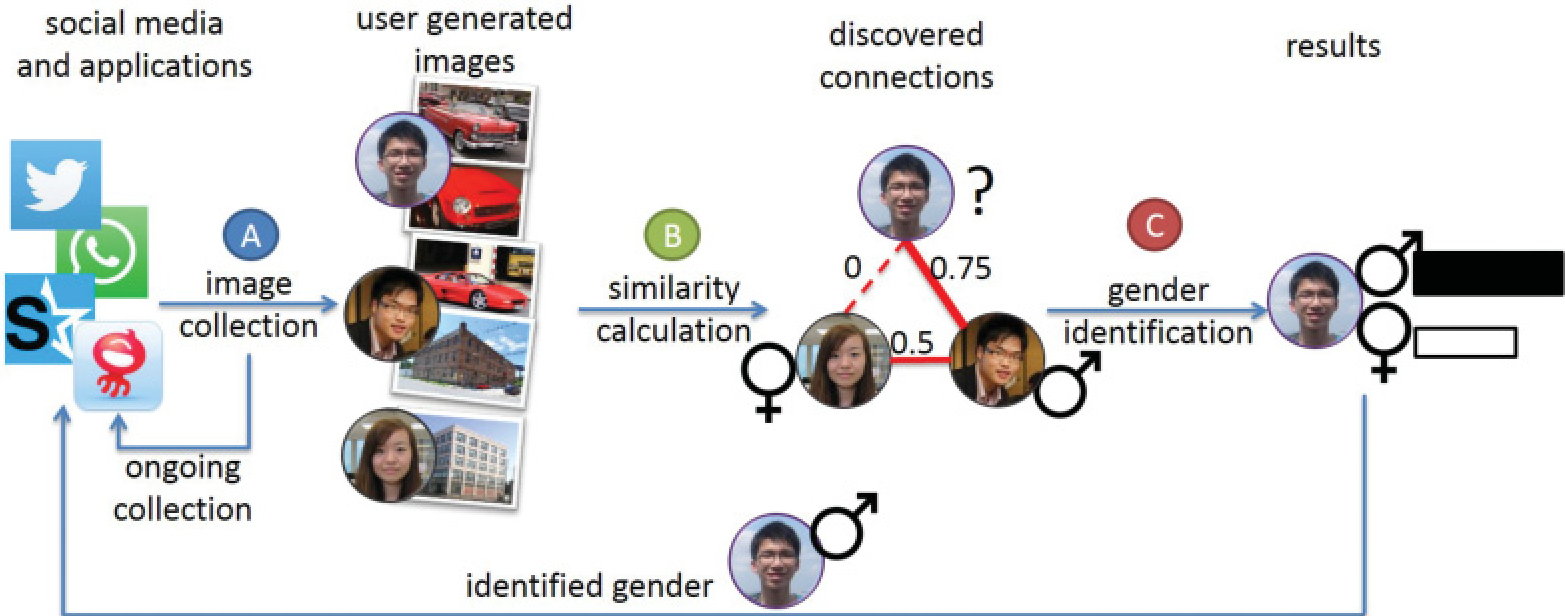
The system follows a three-stage workflow: Image Collection, Connection Discovery, and Gender Identification.
2. Feature Extraction and Labeling
Instead of manually tagging images as "cars" or "flowers," the system uses:
- SIFT (Scale-Invariant Feature Transform): Capturing local visual patterns.
- CNN (Convolutional Neural Networks): Leveraging deep learning (pre-trained on ImageNet) to extract high-level feature vectors.
These vectors are then clustered using K-means++. Each cluster represents a "non-user generated label." A user's profile is essentially a histogram of how many images they have in each visual cluster.
3. Similarity and Classification
By comparing user profiles using Cosine Similarity, the system identifies the "K-Nearest Neighbors." If most of your visual "neighbors" are male, the system identifies you as male.
Experimental Insights
The study analyzed a massive dataset of 3 million images from Fotolog and Flickr.
Key Findings:
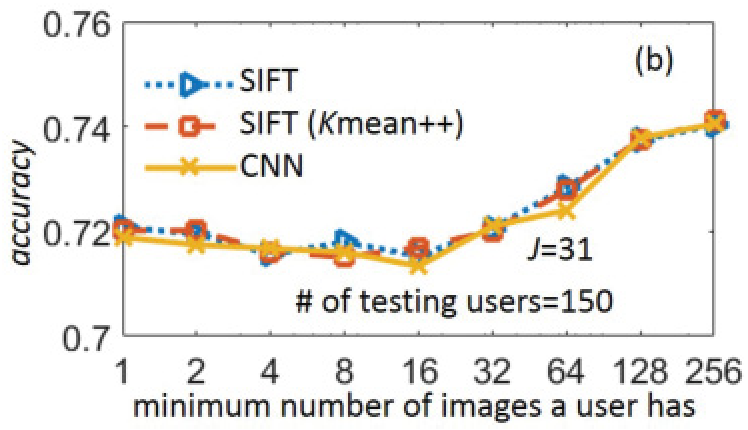
- The CNN Edge: CNN-based features consistently outperformed SIFT, highlighting the superiority of deep learning in capturing the "essence" of gendered visual preferences.
- Volume Matters: As shown in the figure below, the more images a user shares, the more accurate the prediction becomes. Accuracy stabilizes when the system has a larger "training" pool of known users.
- Performance vs. Baseline: The system outperformed pLSA-based methods (which rely on probabilistic topics) by a margin of 11.5% in some scenarios.
Deep Insight: Is it Object Recognition?
One might ask: is the system just identifying "trucks" for men and "flowers" for women? Not exactly. While CNNs do recognize objects, the researchers found that their unsupervised clustering approach performed better than a raw "Object Recognition" tag approach. This suggests that the subtle visual style and composition of shared images carry more demographic weight than just the literal objects within them.
Conclusion & Future Outlook
This work demonstrates that our visual digital footprint is a "leaky" source of demographic information. While this creates new opportunities for highly accurate recommendation engines and market research, it also raises significant privacy considerations.
As we move toward a more visual-centric internet—dominated by platforms like TikTok and Instagram—the ability to "de-anonymize" user traits through visual metadata will become a cornerstone of both business intelligence and digital privacy discourse.
Limitations
- Computation Cost: Processing 3 million images required six Amazon EC2 slaves running for over a week.
- Cultural Shifts: Visual gender markers may shift over time and across different cultural demographics, requiring the system to be constantly updated with new "ground truth" data.