
Controlling the Social Mind: Analytical Insights into Opinion Evolution
Analytical Methods to Investigate the Effects of External Influence on Socio-Cultural Opinion Evolution
This paper presents an analytical framework to study Socio-Cultural Opinion Evolution (SCOPE) by integrating rational cognitive models with social feedback mechanisms. By simplifying the model to a two-state system in a fully connected network, the author derives a Fokker-Planck equation that describes the influence of external agents on societal opinion dynamics, achieving a closed-form polynomial solution.
TL;DR
How do external influencers—like media outlets or political campaigns—change the collective mind of a society? This paper moves beyond simple simulations to provide a rigorous mathematical answer. By treating society as a dynamic system governed by the Fokker-Planck equation, the author derives an analytical solution showing how external agents act as "control inputs" to shape the probability of societal consensus.
Background: Beyond the "Spin"
For decades, sociophysics treated humans like atoms in a magnet (the Ising model). If your neighbors point "up," you point "up." While elegant, this ignores rationality. The SCOPE (Socio-Cultural Opinion Evolution) model introduced here upgrades this by assuming individuals are tiny "reward maximizers" using Probabilistic Finite State Automata (PFSA).
The Problem: The Chaos of Influence
Most social models break down when you add "external noise" or intentional influence. The math becomes hairy, and researchers usually resort to Monte Carlo simulations. The author's goal was different: Can we find a closed-form equation that predicts the distribution of opinions over time?
Methodology: From Automata to Fokker-Planck
The transition from individual logic to societal trends follows a sophisticated pipeline:
- Individual Choice: Each person is a PFSA where transitions are decided by a reward function .
- Social Feedback: In a fully connected network, people update their internal rewards based on their neighbors' states.
- The Master Equation: By defining magnetization (the net opinion bias) and external influence (the difference between influencing groups), the author constructs a master equation.
The Core Framework
The model simplifies into a 2-state system where the probability density function evolves according to:
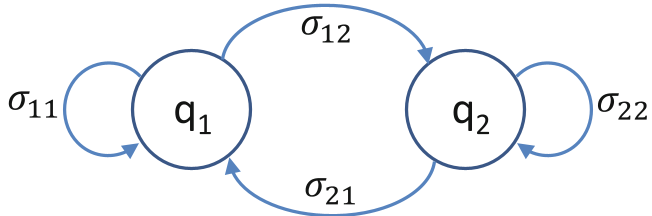 Figure 1: The 2-state PFSA showing transitions between neutral and polarized states.
Analytical Breakthrough: The Jacobi Solution
The real "magic" happens in Section 4. The author proves that this specific social system satisfies Wong’s conditions, meaning the complex evolution of opinions can be solved using Jacobi Polynomials.
- Equilibrium: The society eventually reaches a "steady state" described by a Beta distribution.
- Symmetry Breaking: The external influence acts as a bias that shifts the equilibrium point, effectively "dragging" the population toward a specific pole.
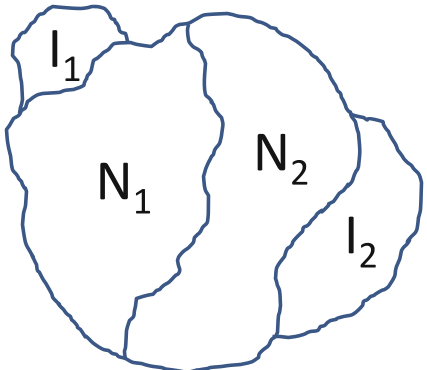 Figure 2: A society of N nodes influenced by I1 and I2 external agents.
Critical Insight & Results
The paper successfully demonstrates that:
- Convergence: The SCOPE model is a generalized version of the Sznajd model.
- Predictability: We no longer need to "guess" how a society might react to a media blitz; if we know the initial magnetization and the strength of the influence , we can compute the exact probability distribution at any future time .
Conclusion: A Tool for Stability (or Control)
This research is a double-edged sword. While it provides tools to "steer a population towards stability during political turmoil," it also lays the technical groundwork for more effective cyber-influence operations.
Future Work: The author points toward expanding this to multi-choice scenarios () and developing active control algorithms to drive societies toward a specific "target" opinion distribution. This moves socio-cultural modeling from a descriptive science to an engineering discipline.