
MRCD: Beyond Averages — An Analytical Breakthrough in Social Influence Propagation
An Analytical Model for the Propagation of Social Influence
This paper introduces the Markov chain based Reinforced Cascade Diffusion (MRCD) model, a novel analytical framework for social influence propagation. Unlike traditional methods that only estimate the expected number of influenced users, this work provides a closed-form equation to derive the exact probability distribution of the final propagation state.
TL;DR
Researchers from the University of Hong Kong have developed the Markov chain based Reinforced Cascade Diffusion (MRCD) model. This analytical framework moves beyond the "expected number of users" metric to provide the exact probability distribution of social influence states using a closed-form matrix equation, eliminating the need for costly Monte-Carlo simulations.
Background & Motivation: The "Average" Trap
In social media marketing and viral spreading, we usually ask: "How many people will this campaign reach?" Traditional models (Cascade, Threshold, LIM) provide an expected value (e.g., "1,000 people"). However, in the real world, the variance matters. A campaign might reach 1,000 people on average, but it could also have a 20% chance of reaching 0 and a 5% chance of reaching 10,000.
Existing methods rely on Monte-Carlo (MC) simulations to guess this distribution. MC is slow, computationally heavy, and never truly accurate. The authors argue that to manage marketing risk, we need a rigorous analytical way to calculate the entire distribution.
Methodology: Mapping Social Networks to Markov Chains
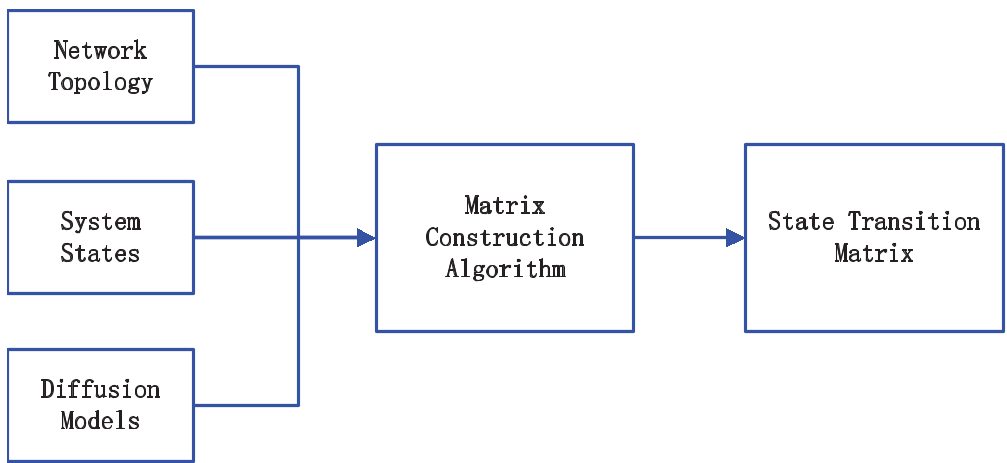
The core innovation lies in treating the entire network as a state-machine.
1. State Representation
For a network of nodes, the authors define possible binary states (where biological codes represent active/inactive nodes). They uniquely define Unstable states (process ongoing) and Stable states (process converged).
2. The Partitioned Transition Matrix
The authors construct a 1-step transition probability matrix structured as:
- A: Transitions between unstable states.
- B: Transitions from unstable to stable states.
- I: Identity matrix (stable states stay stable).
3. The Closed-Form Solution
Leveraging the fact that is a nilpotent matrix (eventually as the process must terminate), they derive the final distribution matrix : This formula allows a researcher to input an initial state and immediately receive the probability of ending up in any possible final configuration.
Experiments: Validation on Regular Graphs
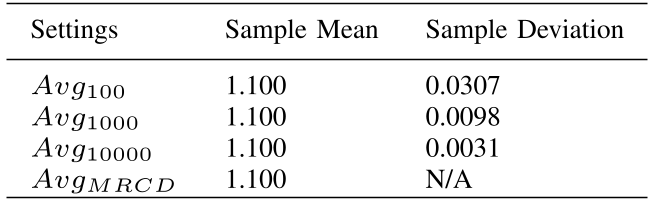
To validate the model, the authors tested it on regular graphs (where every node has the same degree) to isolate the impact of network topology.
Performance vs. Monte-Carlo
The results prove that while 10,000 MC runs still leave a small statistical deviation, the MRCD model provides the exact result instantly.
Visualizing the Distribution
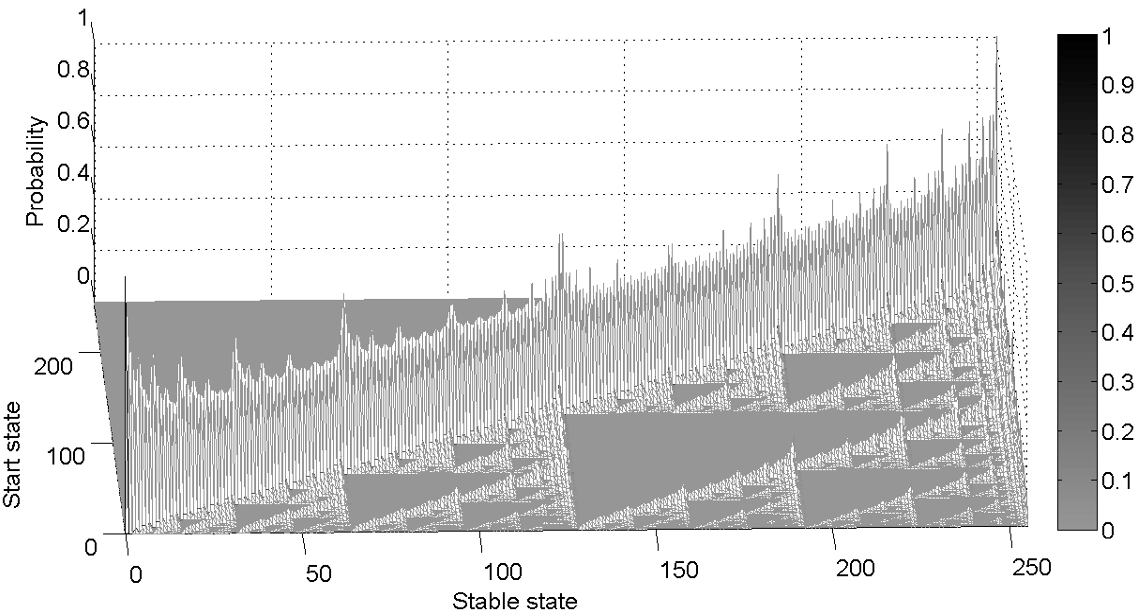
The authors generated 3D visualizations of the transition probabilities. As the network degree increases (higher density):
- The coverage of stable states increases (influence spreads further).
- Transition probabilities become more balanced outside the diagonal band, reducing the variance of the final results.
Deep Insights: Why This Matters for the Industry
- Risk Measurement: For the first time, a business can quantify the "Uncertainty ROI." If a strategy has high expected reach but massive variance, it might be too risky for a conservative brand.
- Precision Marketing: In heterogeneous networks where "favorable" nodes (high spenders) and "unfavorable" nodes (low spenders) exist, knowing the probability of hitting specific clusters is more valuable than knowing the total count of active nodes.
- Topology Optimization: The model shows exactly how changing network connections (topology) reshapes the probability landscape of information flow.
Conclusion & Future Outlook
The MRCD model is a powerful theoretical tool that brings mathematical rigor to the "art" of social influence. However, a major limitation is the state-space explosion: for a network with nodes, the matrix is . Future work will likely focus on state aggregation to scale this exact analytical method to networks with millions of nodes.
Takeaway: The future of social analytics isn't just about predicting what will happen on average, but understanding the full range of mathematical possibilities.