
Deciphering the DNA of Leadership: From Statistical Correlation to Actionable Data Mining
Analytics on the Impact of Leadership Styles and Leadership Outcome
This paper explores the impact of distinct leadership styles on employee performance and satisfaction using data mining techniques. By applying rule-based (OneR, Modlem) and decision tree (J48) algorithms to survey data from New Zealand SMEs, the study identifies Transformational leadership as the primary driver of positive leadership outcomes.
TL;DR
While we intuitively know that leadership styles affect employee morale, traditional statistics only tell us that they are related, not how to change. This paper moves beyond simple regression to apply machine learning—specifically Decision Trees and Rule-based algorithms—to survey data from New Zealand SMEs. The result is a series of "if-then" rules that provide a strategic roadmap for managers to optimize their impact on employee satisfaction and productivity.
Background: Beyond the Regression Line
In the realm of organizational psychology, the "Big Three" leadership styles—Transformational, Transactional, and Laissez-faire—have been studied for decades. Typically, researchers use Pearson correlation to say "Transformational leadership is good." However, social science data rarely fits the neat, linear assumptions of classical statistics.
The authors of this study argue that leadership is a complex information system. They transition from "What is the relationship?" to "What specific behavioral thresholds lead to high employee commitment?"
The Methodology: Turning Surveys into Classifiers
The study gathered 202 useable data samples from 24 organizations, measuring benchmarks like Extra Effort, Effectiveness, and Satisfaction.
The technical novelty lies in the application of three specific algorithms:
- OneR (One Rule): Identifying the single most influential variable (Transformational style).
- J48 (C4.5 Decision Tree): Creating a hierarchical flow of influence.
- Modlem: A sequential covering algorithm based on Rough Set Theory that generates a comprehensive set of rules even in noisy data.
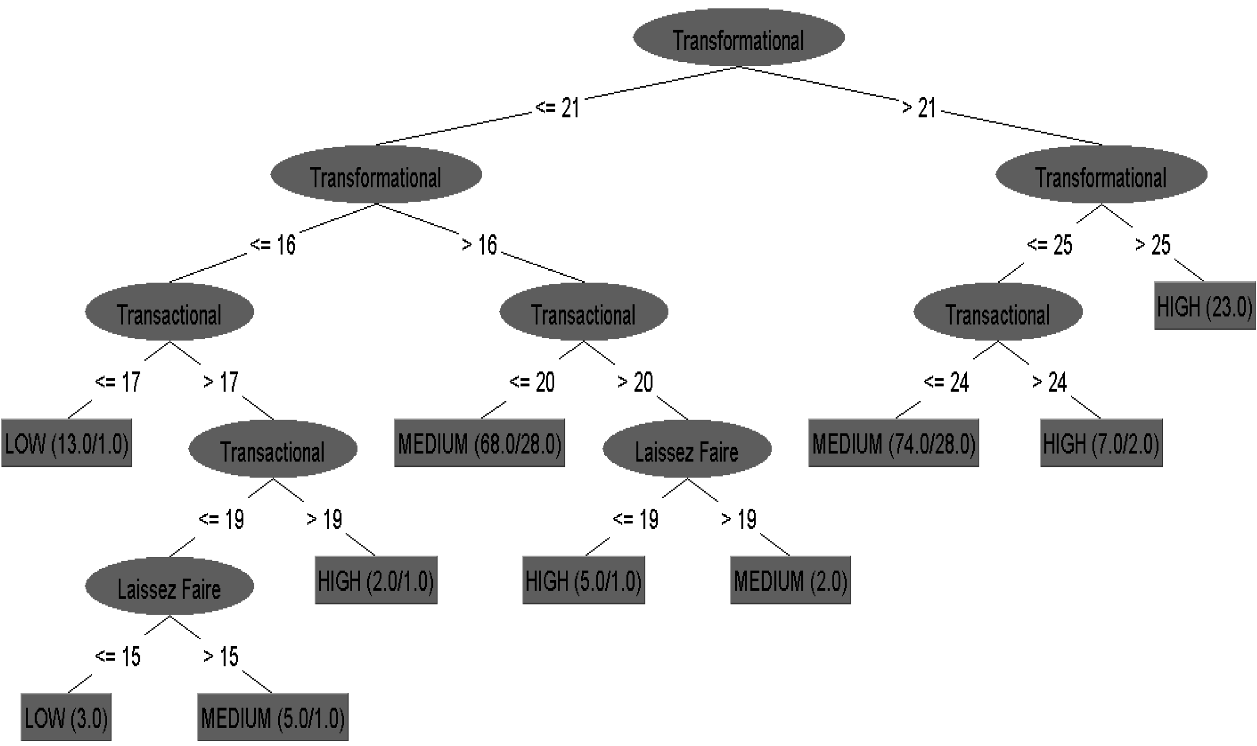 Figure 1: The J48 Decision Tree highlights how leadership styles branch into specific employee outcomes.
Key Insights: The Anatomy of an Effective Leader
The experimental results confirm that Transformational leadership is the heavyweight champion of outcomes. However, the data mining approach reveals a "Contingency" truth: even if you are not a natural transformational leader, specific combinations of Transactional and Laissez-faire behaviors can still yield high outcomes.
Significant Findings:
- The Transformational Threshold: An "Extra Effort" rule showed that if a Transformational score is , the probability of high employee effort is significantly improved.
- Multi-Factor Synergy: While regression suggested Transactional and Laissez-faire styles were less significant, the Modlem algorithm reached its peak accuracy (91.09%) only when all three styles were included. This proves leadership is an aggregate "profile" rather than a single trait.
 Table 1: Step-wise feature selection shows that combining all three styles (Tf + Tr + Lf) drastically improves model predictive power.
Professional Analysis: Moving from Analysis to Action
The most profound contribution of this work is the concept of Leadership Proximity. By looking at the generated rules, a supervisor in the "Low" category can see exactly which "Rule" they currently satisfy and which "Rule" exists in the "High" category.
Example: If a manager has a low score due to high Laissez-faire (lack of supervision) and low Transformational scores, the data mining output provides two distinct paths:
- Path A: Increase Transformational skills by 8 points.
- Path B: Reduce Laissez-faire behavior (increase active supervision) by 4 points.
This turns a vague "be a better leader" performance review into a quantified, achievable target.
Conclusion & Outlook
This paper successfully demonstrates that organizational behavior is not just a "soft" science. By applying J48 and Modlem algorithms, the authors prove that leadership can be modeled as a decision-support system.
Limitations: The study is limited by its sample size (202) and geographic focus (New Zealand SMEs). Future research could integrate real-time "digital traces" (Slack data, email frequency) instead of self-reported surveys to feed these machine learning models.
Ultimately, the value of this research lies in its utility: it provides an objective, data-driven "GPS" for professional development in the workplace.