
FacetNet: Deciphering the Flux of Social Communities through Unified Evolutionary Clustering
Analyzing communities and their evolutions in dynamic social networks
This paper introduces FacetNet, a novel framework for analyzing communities and their temporal evolutions in dynamic social networks using a unified MAP estimation process. By employing Non-negative Matrix Factorization (NMF) and Dirichlet priors, it achieves soft community membership while ensuring temporal smoothness across consecutive timesteps.
Executive Summary
TL;DR: FacetNet is a landmark framework in dynamic social network analysis that moves away from the "detect-then-match" paradigm. It treats community detection and evolution as a single optimization problem, using historical data to buffer against noise and utilizing soft memberships to capture the reality of human multi-community participation.
Background: Published in ACM Transactions on Knowledge Discovery from Data, this work is a foundational piece in Evolutionary Clustering. It sits squarely between static graph partitioning (like Spectral Clustering) and temporal event detection, providing a robust mathematical bridge between the two.
Problem & Motivation: The Noise of Snapshots
In the real world, social networks are messy. If you look at a co-authorship network or the blogosphere at a single point in time, "noise" (a temporary collaboration or a random link) can make an algorithm think a community has suddenly dissolved or merged.
The authors identify two fatal flaws in prior work:
- The Independence Trap: Treating time and as independent. This leads to "choppy" evolution where communities jump sporadically.
- Hard Borders: Forcing a person to belong to only one group. In reality, a researcher can belong to both the "AI" and "Database" communities.
Methodology: The Core Architecture
FacetNet formulates the problem as Maximum A Posteriori (MAP) estimation. The goal is to maximize:
1. The Snapshot Model
It uses a mixture model where the probability of an interaction between nodes and is mediated by latent communities. This is essentially a specialized form of Non-negative Matrix Factorization (NMF), ensuring all membership values are positive and interpretable.
2. The Temporal Prior
This is the "secret sauce." The algorithm doesn't just look at current data; it uses a Dirichlet distribution to say: "The community structure at time should probably look like the structure at , unless the new data strongly suggests otherwise."
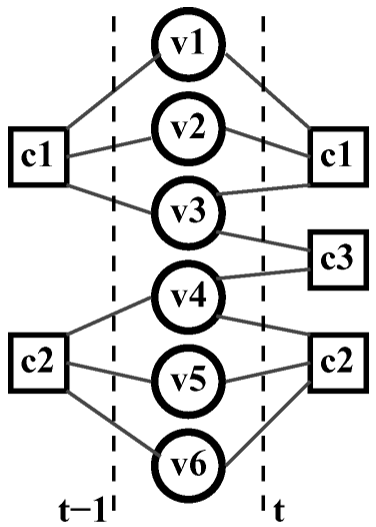 The figure above illustrates the unified process transforming network snapshots into Community Nets (inter-community ties) and Evolution Nets (temporal transitions).
Experiments: Validation through Evolution
The authors tested FacetNet against powerful baselines like EvolSpec (Evolutionary Spectral Clustering).
Robustness to Noise
On synthetic datasets where nodes were known to change communities with a fixed probability, FacetNet consistently maintained lower error rates. While traditional methods spiked in error when noise increased, FacetNet’s temporal smoothing kept the results stable.
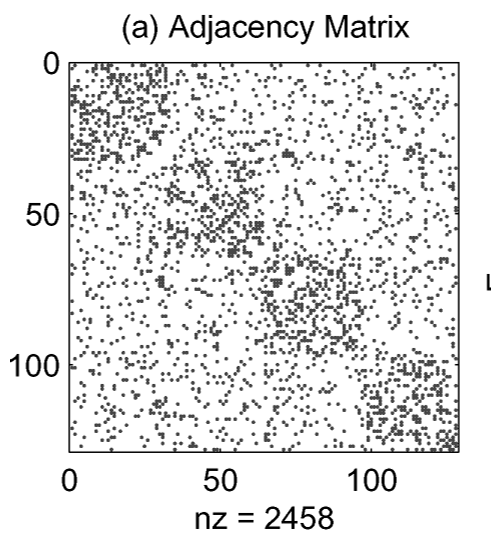 In noisy environments (higher ), FacetNet (red line) shows significantly lower error and higher stability than non-evolutionary methods.
Real-World Insight: DBLP Analysis
One of the most compelling results was the tracking of prominent researchers. For instance, the algorithm correctly identified Christos Faloutsos's research evolution. In the late 90s, his "soft membership" was primarily in the Database community. Over the decade, the model captured his gradual shift toward Data Mining, a transition validated by his publication history.
Critical Analysis & Conclusion
Takeaways
- Temporal Smoothness is Vital: By bridging the gap between and , we filter out the "flicker" of noisy data.
- Soft Membership is More Informative: Understanding that a node is 30% DB and 70% DM provides much richer insight than a hard label.
- Scalability: The iterative EM algorithm is , making it viable for large, sparse real-world networks.
Limitations & Future Work
The primary challenge remains the selection of the parameter (the weight of the historical prior). While the authors propose Soft Modularity to find the number of communities, the "optimal" level of smoothness is still somewhat subjective. Future iterations incorporating content analysis (the actual words in a blog or paper) alongside link structure promise even higher accuracy.
FacetNet remains a masterclass in how to apply Bayesian principles to the traditionally "hard" problem of graph clustering.