
FacetNet: Unifying Community Detection and Evolution in Dynamic Networks
Analyzing communities and their evolutions in dynamic social networks
The paper introduces FacetNet, a unified framework for detecting communities and their temporal evolutions in dynamic social networks. By leveraging a probabilistic generative model and Non-negative Matrix Factorization (NMF), it achieves SOTA robustness in tracking soft community memberships over time compared to traditional two-step methods.
TL;DR
FacetNet moves beyond the "snapshot-and-match" paradigm of social network analysis. By treating community detection as a unified probabilistic process, it uses historical data to "denoise" current observations. The result is a robust, soft-membership framework that tracks how individuals and groups evolve without the jitter associated with traditional methods.
Problem & Motivation: The "Jitter" of Static Snapshots
In any dynamic network—be it a collaboration graph like DBLP or the blogosphere—communities aren't static. However, previous SOTA methods often suffered from a "two-stage" fallacy: they would detect communities at , detect them at , and then try to "stitch" them together.
The author's core Insight is that this approach is highly sensitive to noise. A temporary dip in interaction might look like a community "dissolving" when it is actually just a transient fluctuation. Furthermore, traditional algorithms often force a node into one community (Hard Membership), ignoring the reality that a researcher can belong to both "Databases" and "Machine Learning" simultaneously.
Methodology: The Core of FacetNet
FacetNet formulates the problem using Maximum A Posteriori (MAP) estimation. The objective function balances two competing forces:
- Snapshot Cost (): How well does the current model fit the observed interactions today?
- Temporal Cost (): how much does the current structure deviate from the structure we saw yesterday?
Mathematically, this is expressed as:
By using Non-negative Matrix Factorization (NMF), the authors represent community membership as a matrix . Unlike spectral clustering, the non-negativity constraint ensures that the results are directly interpretable as probabilities, solving the "non-identifiability" problem where clusters would otherwise need to be manually re-aligned at every step.
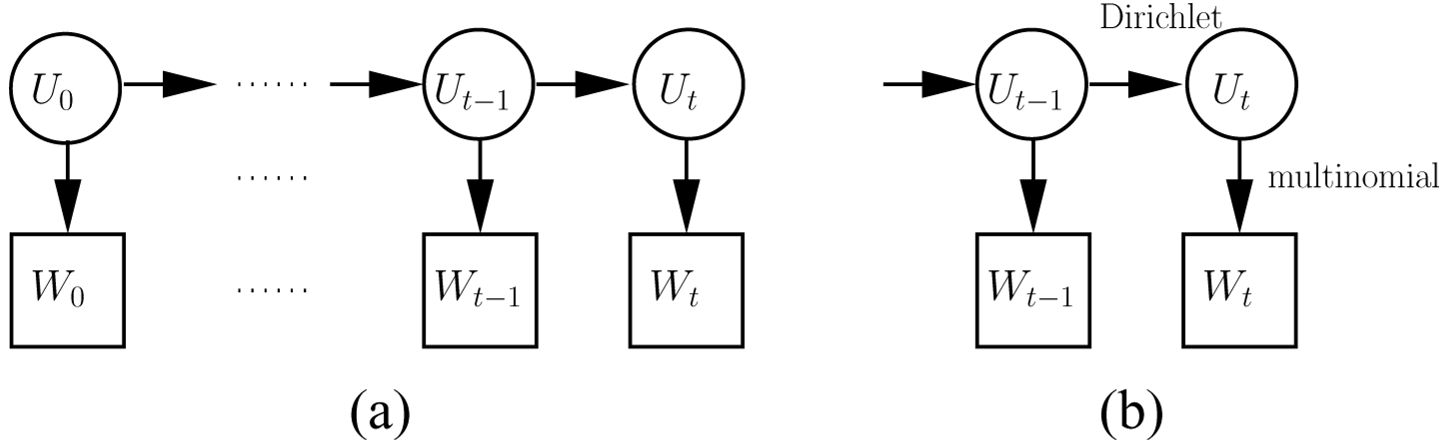 Fig 1: The probabilistic generative model showing how (community structure) is influenced by both and current observations .
Experimental Results: From Synthetic Noise to Real-World Transitions
The authors tested FacetNet against powerful baselines like EvolSpec (Evolutionary Spectral Clustering). In scenarios with high noise (), FacetNet maintained a significantly lower error rate relative to the ground truth.
Real-World Case Study: DBLP Evolution
The most compelling evidence comes from the DBLP dataset. FacetNet successfully tracked the career trajectory of prominent researchers. For instance, Christos Faloutsos was correctly identified as having a "homogeneous" membership in the Database (DB) community in the late 90s, but a "shifted" membership toward Data Mining (DM) in the mid-2000s. Traditional static methods would have missed this gradual migration of interests.
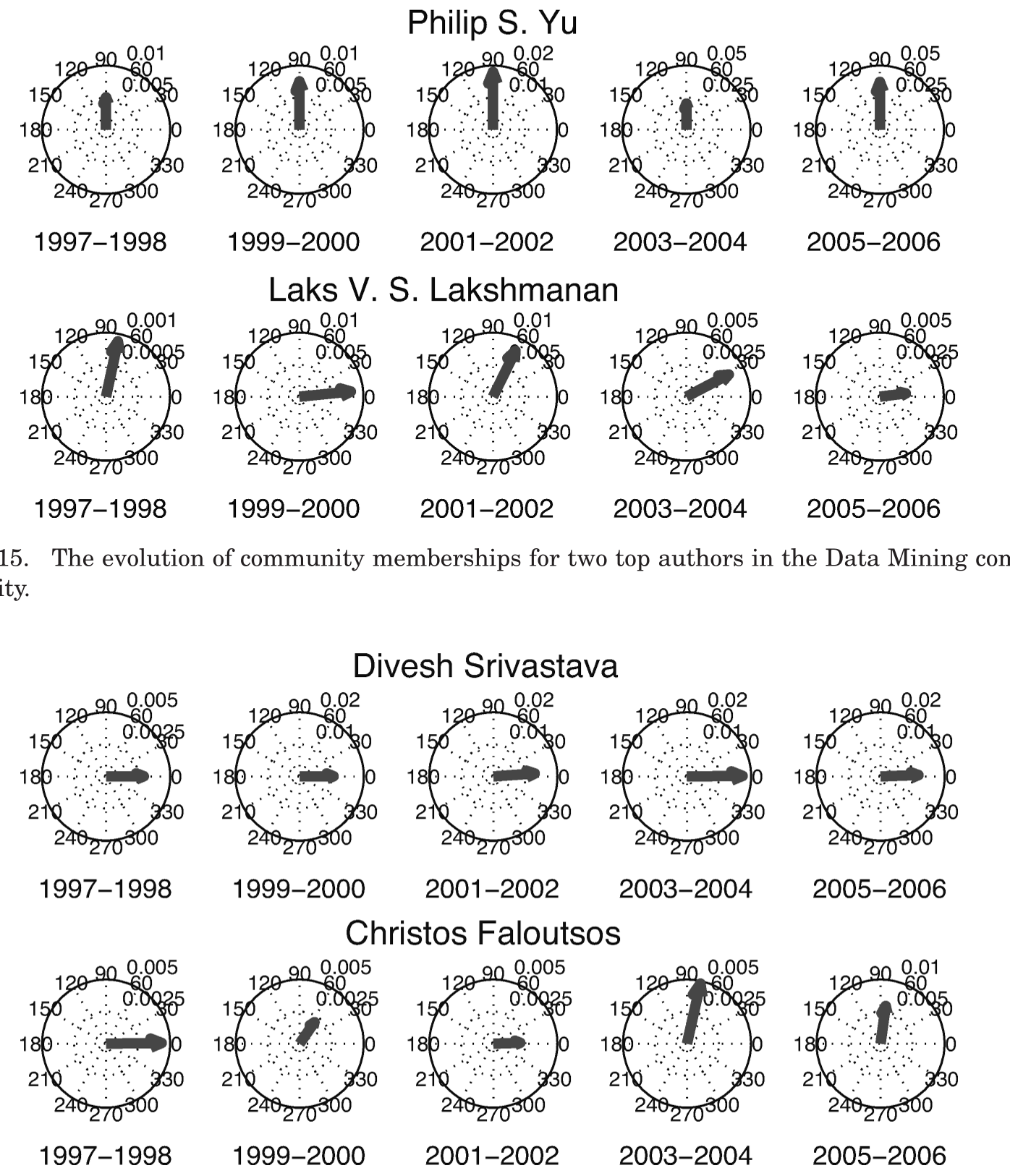 Fig 2: Visualization of authorship evolution, showing the transition of research focus from DB to DM over a 10-year period.
Critical Analysis & Conclusion
Takeaway
FacetNet’s primary contribution is the shift from "linking snapshots" to "continuous estimation." Its use of Soft Modularity and Evolution Nets provides a far more nuanced view of social dynamics than simple graph partitioning.
Limitations
- Hyperparameter Sensitivity: The value of (the weight of temporal smoothness) is still largely a manual choice. Over-smoothing might mask genuine, rapid changes in a network.
- Computational Cost: While linear in the number of nodes for sparse graphs, the multiplicative updates still require multiple iterations to converge, which might be slow for massive, billion-node graphs.
Future Outlook
The authors suggest that the next frontier is Multimodal Fusion—combining the link information (who talks to whom) with the content information (what they are talking about). This would allow FacetNet to not only track that a community evolved, but why it did so.