
Modeling the Digital Insurgency: Analyzing ISIL’s Deviant Cyber Flash Mobs
Analyzing Deviant Cyber Flash Mobs of ISIL on Twitter
2015-01-01
Summary
Problem
Method
Results
Takeaways
Abstract
This paper investigates the sophisticated use of social media by ISIL through the lens of a "Deviant Cyber Flash Mob" (DCFM). The researchers develop and operationalize a socio-computational model to identify powerful disseminators and their multi-platform propaganda strategies, focusing primarily on Twitter network dynamics.
## TL;DR
While much of the world views extremist social media as a chaotic stream of noise, researchers Samer Al-khateeb and Nitin Agarwal reveal it to be a highly orchestrated **Deviant Cyber Flash Mob (DCFM)**. By applying collective action theory to Twitter data, this paper quantifies the "Power" of top disseminators, demonstrating that ISIL’s digital success relies on a strategic core of influencers who maximize "Control" and "Interest" to ensure their messages go viral instantly.
## The Core Logic: Why DCFM?
The term "Flash Mob" usually evokes images of synchronized public performances. However, in the context of cyber warfare, a **Deviant Cyber Flash Mob** signifies a coordinated, sudden surge of online activity intended to radicalize, recruit, or spread terror.
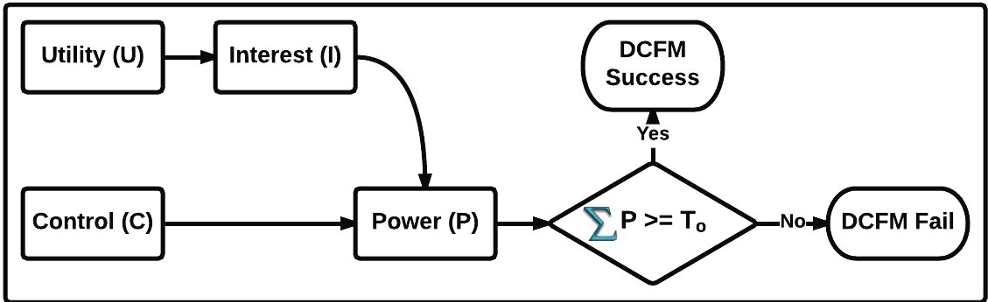
The authors argue that we cannot understand these groups by simply looking at *what* they post. Instead, we must look at *how* they act as a collective. The fundamental challenge is that social media platforms are biased and distorted; to filter through this, the researchers developed a conceptual framework that focuses on four pillars:
* **Utility (U)**: The perceived benefit of the campaign's success.
* **Interest (I)**: The dedication of a node to the cause.
* **Control (C)**: The structural reach of an actor.
* **Power (P)**: The actualized ability to drive the flash mob.
## Methodology: From Sociology to Math
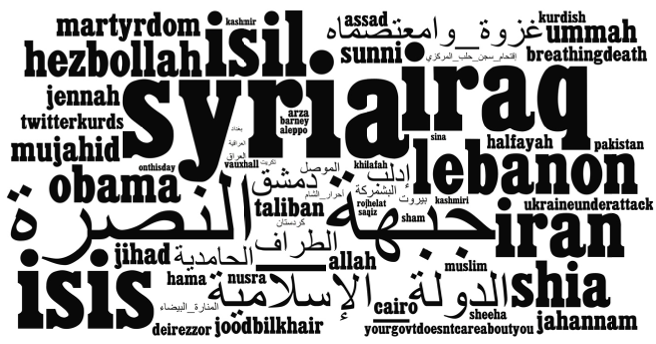
The researchers didn't just track hashtags; they mapped the technological ecosystem of ISIL. By clustering keywords (see Figure 2), they identified that extremists strategically pivot between platforms based on the audience—using Twitter for broad outreach and YouTube/Tumblr for long-form propaganda.
### Operationalizing "Power"
The paper’s most significant contribution is the mathematical estimation of an extremist's influence:
1. **Control ($C$)**: Measured via **In-degree Centrality**. If many people follow you, you have high control over who sees the message.
2. **Interest ($I$)**: Measured as the ratio of $( ext{Retweets} + ext{Mentions}) / ext{Total Tweets}$. This filters out "loud" but irrelevant users, focusing on those who actively engage with the propaganda.
3. **Power ($P$)**: Defined as $C imes I$.
## Identifying the Power Brokers
The analysis of the "Top 10" disseminators highlights a counter-intuitive truth in network science: **Volume does not equal Influence.**
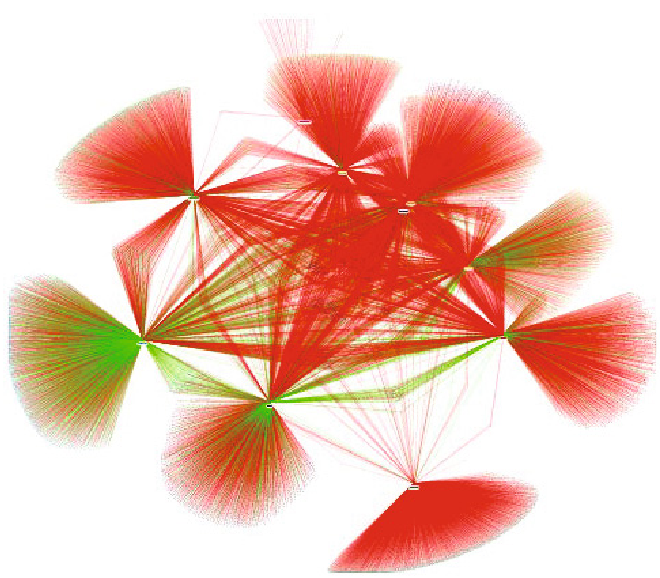
As shown in the researchers' data, an account like *shamiwitness* had over 114,000 tweets but a relatively low Power score (1.428) because their specific engagement ratio was diluted. Conversely, *musaCerantonio*, with only 698 tweets, achieved a Power score of **234.95**. This suggests that *musaCerantonio* acts as a high-efficiency broker—a "quality over quantity" approach to radicalization.
## Critical Insights & Future Outlook
This work shifts the focus of counter-terrorism from content moderation to **network disruption**.
**Key Takeaways:**
* **Strategic Synchronicity**: ISIL doesn't just post; they mobilize "flash mobs" to overwhelm algorithms and achieve trending status.
* **The Broker Effect**: Identifying actors with high In-degree Centrality and high Interest ratios allows platforms to target the "hubs" of the network rather than just the "leaves."
**Limitations**: The current model relies heavily on structural network features. As extremist groups move toward encrypted platforms (Telegram) or use AI-generated personas, future iterations of the DCFM model will need to incorporate deep NLP content analysis and cross-platform "identity bridging" to maintain accuracy.
## Conclusion
By treating extremist propaganda as a sociotechnical flash mob, Al-khateeb and Agarwal provide a blueprint for a more proactive defense. Success in the cyber-information age is not measured by who shouts the loudest, but by who controls the network's resonance.