
Digital Graying: Does Age Still Matter in the World of Twitter?
Analyzing Elderly Behavior in Social Media Through Language Use
This study investigates the linguistic patterns and social media behavior of elderly Dutch Twitter users compared to younger demographics. By analyzing pronoun usage and hashtags, the researchers examine whether age-related linguistic markers persist in digital environments, utilizing manual classification and statistical T-scores for validation.
TL;DR
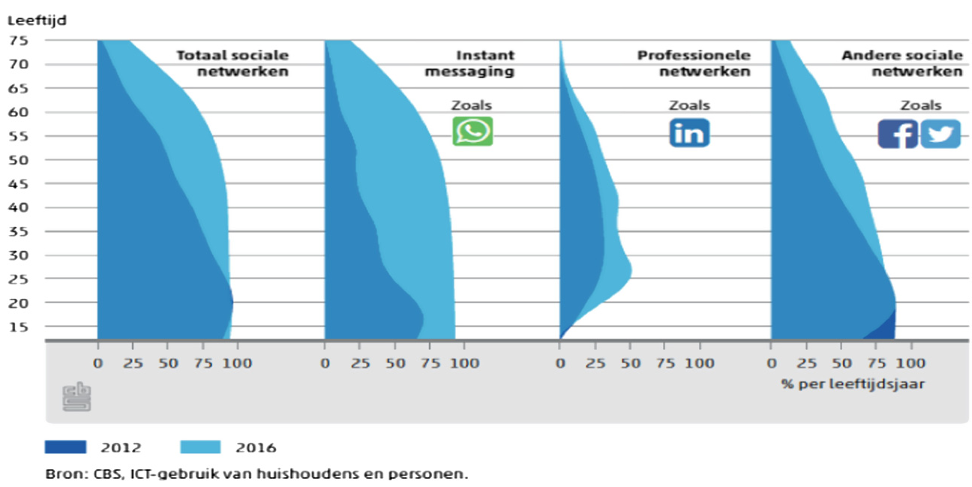
As the Dutch elderly population rapidly adopts social media, researchers at Utrecht University asked a fundamental question: Does our language "age" online? While traditional linguistics suggests that older people use fewer "I-references" and more "we-references," this study finds that on Twitter, the platform's nature forces a linguistic convergence. While their grammar looks the same as the youth, their hashtags reveal a different world focused on politics and leisure rather than careers and sustainability.
Probing the "Age" Variable
Age is more than just a number; in sociolinguistics, it is often viewed through the lens of "Life Stages." Previous literature (Pennebaker et al., 2003) established a clear trajectory: as people age, they become less self-focused (lower use of "I", "me", "my") and more collective (higher use of "we").
The authors of this paper noticed a gap: most of these findings were based on spoken language or blogs from over a decade ago. Does a 70-year-old on modern Twitter actually sound different from a 30-year-old professional?
Methodology: Segmentation by Retirement
Instead of simple chronological buckets, the researchers split users based on their relationship to the labor market:
- Under 55: Active working life.
- 55 to 67: Pre-retirement transition.
- Above 67: Post-retirement.
By manually verifying profiles (checking bios and photos) and ensuring a high baseline of activity (400+ tweets, 300+ followers), they curated a dataset representative of "active" social media participants.
Core Findings: The Linguistic Great Equalizer
The most striking result of this study is the rejection of the pronoun hypothesis.
1. The Death of the "Collectivist Elderly" Myth
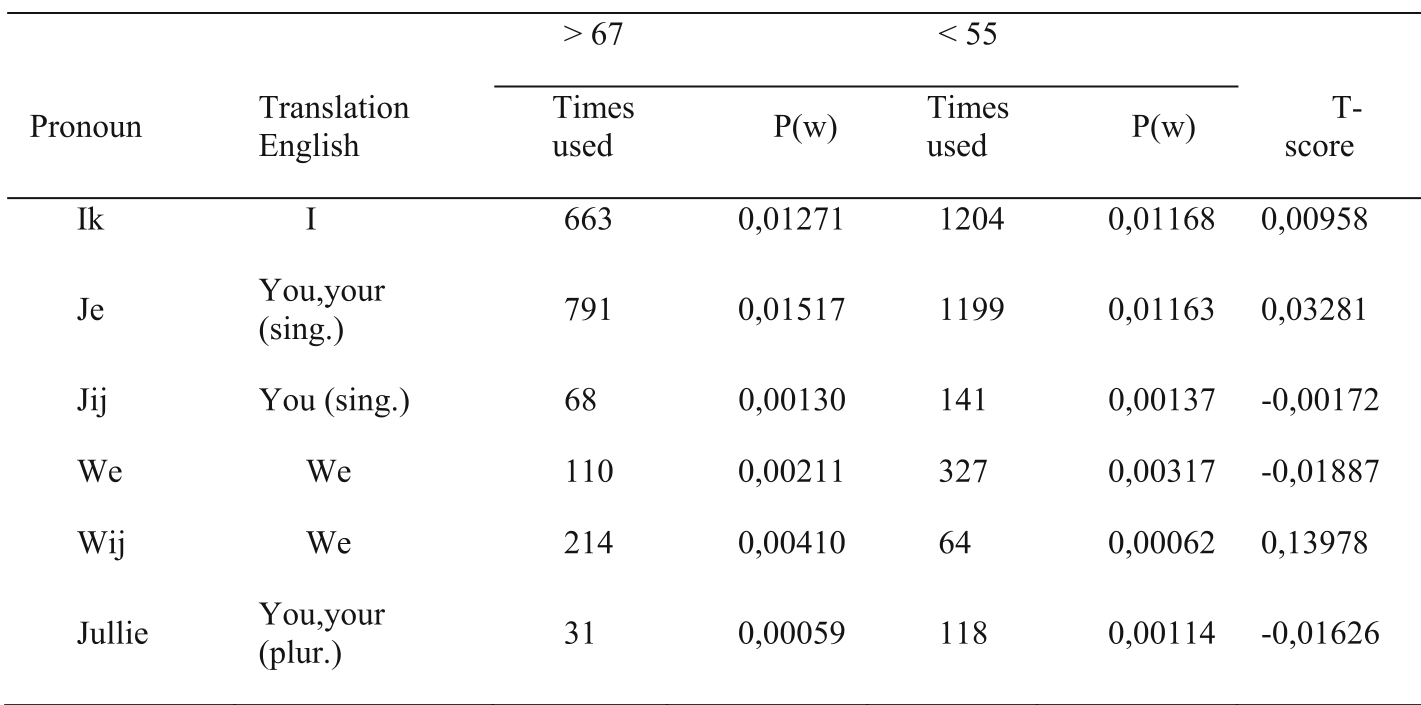
In the analyzed Dutch corpus, both groups used "ik" (I) and "je" (you) at almost identical rates. The statistical T-score analysis showed that the elderly do not shy away from self-reference.
- The Insight: The authors claim that social media platforms have their own "native language." Users, regardless of age, adapt to the platform's ego-centric and spontaneous style.
2. Hashtags as Behavioral Signatures
While the form of the language was similar, the content (hashtags) showed a massive divergence:
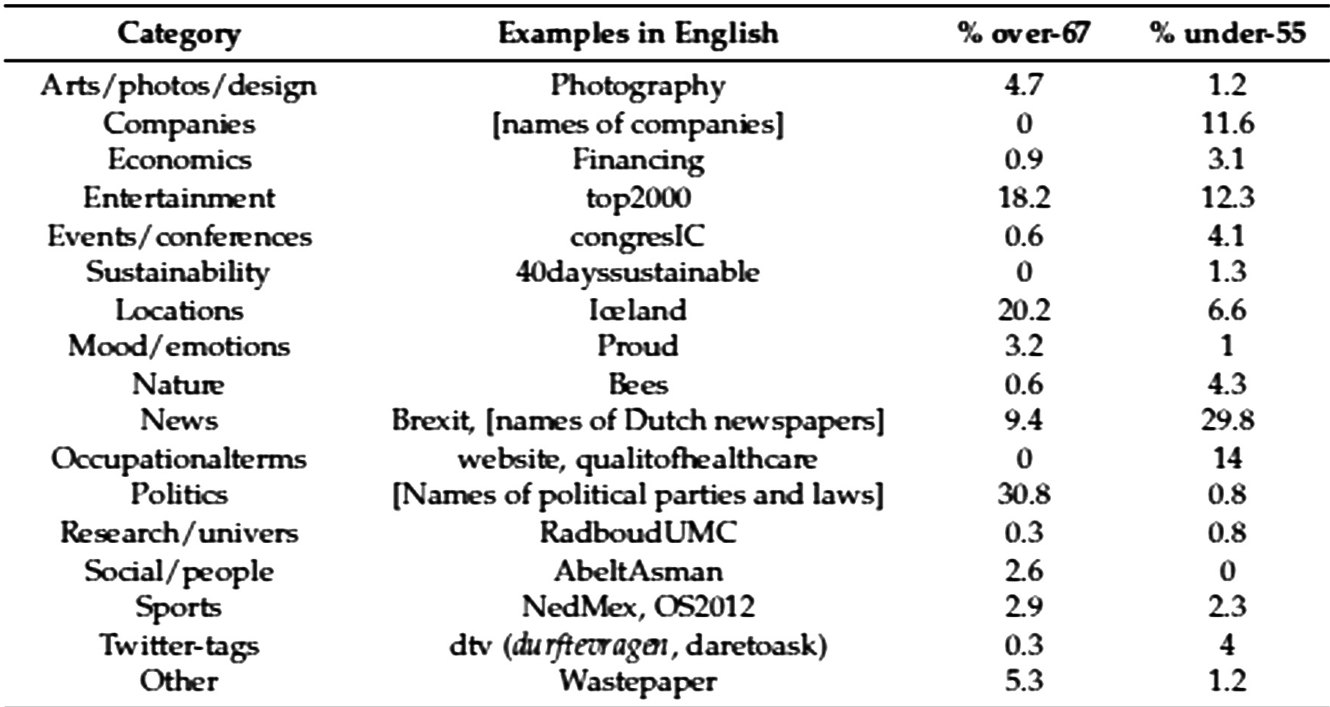
- The Working Class (<55): Dominated by "Occupational Terms" (14%) and "News" (29.8%). They use Twitter as a professional tool.
- The Retirees (>67): Politics was the undisputed king (30.8%). They also used "Location" tags (20.2%) three times more than younger users, signaling a focus on leisure and travel.
- The Sustainability Gap: Interestingly, sustainability and nature tags were almost exclusively used by the younger group, usually in a work-related context, suggesting the elderly are less engaged with "green" digital discourse.
Critical Insight: Convergence vs. Divergence
The study highlights a fascinating paradox in digital sociology:
- Syntactic Convergence: We all start to "type" the same way to fit in with the community.
- Thematic Divergence: Our interests remain tethered to our socio-economic reality (retirement vs. career).
Conclusion & Future Look
The paper concludes that since the elderly are now prominent actors on social media, they are no longer "outsiders" but active participants who shape and are shaped by the platform's norms. However, the lack of interest in sustainability among the elderly—who actually hold significant political and social capital—presents a challenge for "green" urban initiatives.
The next frontier for this research is "Membership Age": Does a senior who has been on Twitter for 10 years sound more "youthful" than a senior who just joined? The answer may lie in how long we spend in the digital "melting pot."