
Deciphering the Retweet: How Behavioral Strategies Define Social Media Personas
Analyzing information sharing strategies of users in online social networks
This paper introduces a flexible framework to analyze and infer <b>User Retweet Strategies</b> in online social networks. By categorizing behavioral signals into four strategies—Interest Matching, Trustability, Linguistics, and Freshness—the authors propose a Random Forest-based model that characterizes users through "Feature Strength" and directional correlation.
TL;DR
Why do you retweet? Is it because the content matches your hobbies, or because the author is a celebrity you trust? This paper argues that every user has a unique "Retweet Strategy." By analyzing Twitter logs, the researchers identified four core pillars of sharing behavior—Interest, Trust, Linguistics, and Freshness—and proved that these strategies are powerful enough to predict future sharing behavior more accurately than traditional topic models.
The "Why" Behind the Click: Motivation and Intuition
In the era of information overload, a "retweet" is the currency of influence. However, previous research often treated retweeting as a black-box prediction task. We knew what features were important on average, but we didn't know how individual users prioritize them.
The authors' core Insight is that user behavior is governed by underlying strategies. For instance, a "News Junkie" might prioritize Freshness, while a "Fan-base Follower" might prioritize Trustability (authority). By quantifying these priorities, we can create a "behavioral fingerprint" for every user.
Methodology: Mapping Behavior to Math
The researchers categorized 17 behavioral signals into four primary Behavior Groups:
- Interest Matching: TF-IDF similarity between the user’s history and the tweet.
- Linguistics: Use of URLs, hashtags, mentions, and message length.
- Trustability: Author characteristics (followers, verified status, account age).
- Freshness: How "novel" the information is compared to the user's local timeline.
Quantifying Feature Strength
To turn these into a strategy vector, the paper uses Permutation Accuracy Importance. Instead of just looking at raw correlation, they measure how much the prediction error increases if a specific feature is "shuffled."
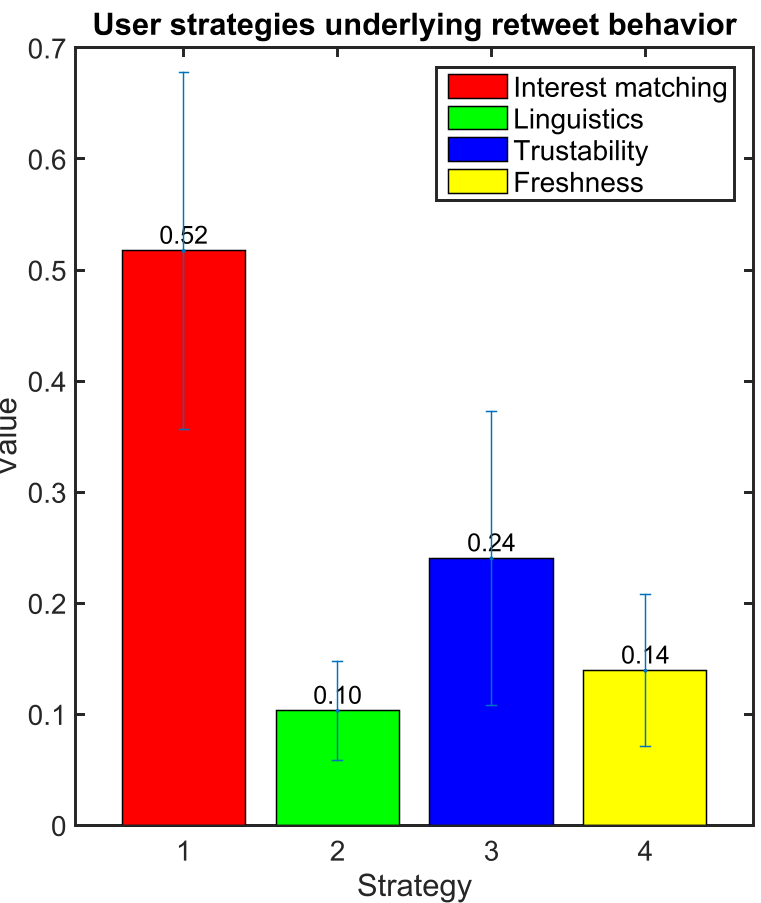 (a) Shows the raw strength of specific features; (b) visualizes the aggregated strategies across the population.
The math doesn't stop at strength. They use Pearson Correlation to determine the direction of influence. If a user retweets less when a tweet is long, the "Linguistics" strategy carries a negative sign, providing a much richer characterization of the user.
Experimental Insights: Interest vs. Trust
The study discovered a fascinating divide in user behavior:
- The Interest-Driven Majority (82.66%): These users are eclectic. Their hashtags span politics (#gaza), sports (#worldcup), and news.
- The Trust-Driven Minority (15.22%): These users are highly focused on Entertainment. They follow "Trustable" icons—celebrities like Justin Bieber or 5 Seconds of Summer. Their sharing behavior is driven by the source rather than the topic.
Performance Boost
When these strategies were added to a standard Latent Dirichlet Allocation (LDA) topic model, the results showed clear improvement:
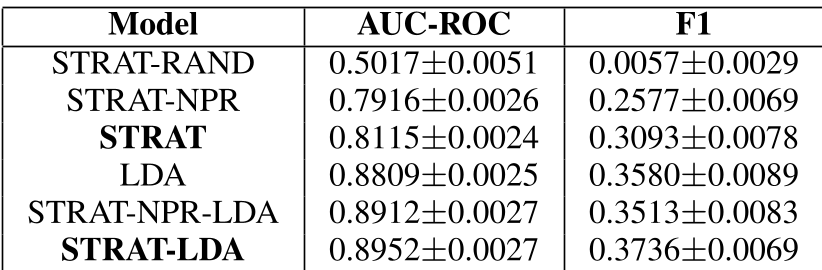 The STRAT-LDA model achieves the highest AUC-ROC (0.8952) and F1-score, proving that behavioral strategies capture information that "text-only" models miss.
Critical Analysis: The Road Ahead
While the paper successfully identifies these strategies, it reveals a limitation: Linguistics and Freshness appear to play a very minor role for most users. However, this might be a byproduct of the feature set; perhaps "Freshness" is more critical for professional journalists than the general Twitter population used in the study.
Takeaway: This work shifts the focus from "what is being shared" to "who is sharing and why." For future AI-driven marketing and rumor control, understanding the strategy of the user is just as important as understanding the content of the message.