
Analyzing Online Discussion: The Blueprint for Modern Marketing Intelligence
Analyzing Online Discussion for Marketing Intelligence
This paper presents a pioneering end-to-end system for gathering and mining online discussions (Weblogs, message boards, Usenet) to extract marketing intelligence. By integrating large-scale web crawling, sentiment analysis, and interactive data visualization, the system transforms massive unstructured text into actionable consumer insights regarding brand perception and product features.
TL;DR
Long before "Big Data" and "LLMs" were household terms, this 2005 paper by Glance et al. (Intelliseek) established the gold standard for mining consumer sentiment from the early web. The system moves from raw crawling of blogs and message boards to extracting high-level "Marketing Intelligence," allowing analysts to pinpoint exactly why a product (like the Dell Axim) might have high visibility but poor reputation.
Background: Decoding the "Voice of the Public"
In the mid-2000s, the "World Wide Web" transitioned into a social space. For the first time, marketers could "listen" to customers. However, the volume was overwhelming. The authors identified a critical gap: simple search queries could tell you what people were talking about, but couldn't tell you how they felt or who was influencing the conversation.
Methodology: From Raw Text to Actionable Insight
The system's power lies in its structured pipeline, which bridges the gap between raw data and decision-making:
1. Smart Harvesting & Segmentation
Unlike standard crawlers, this system used XPath-based model discovery to carve up messy blog pages into clean, dated posts. This was crucial for maintaining the temporal context of discussions.
2. The Hybrid Extraction Engine
The core innovation was the "Search and Relevance" layer. Rather than relying on simple keywords, the team used Active Learning. An analyst would label a small sample of data, "teaching" the classifier to identify relevant messages with high precision.
3. Sentiment & Polarity Analysis
The system didn't just look for "happy" or "sad" words. It used shallow NLP and a specialized lexicon to link sentiment to specific topics.
- Topic: "Screen" or "Battery Life"
- Sentiment: "Negative"
- Result: A "Fact" stating the user is unhappy with the battery.
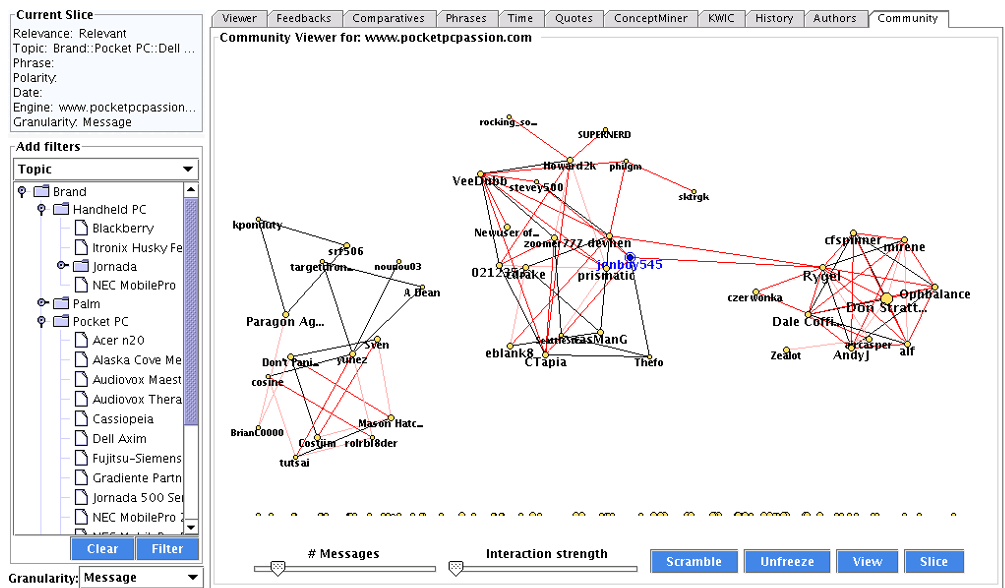 Figure 1: The Interactive Analysis tool showing "Buzz Count" (volume) vs. "Polarity" (sentiment).
Case Study: The Dell Axim Breakdown
A compelling example provided in the paper involves the Dell Axim handheld. While it enjoyed the highest "Buzz" (12% of all discussion), its Polarity Score was a dismal 3.4.
By drilling down into the negative clusters, the system identified two distinct "pain points":
- Technical Incompatibility: Specifically with SD cards.
- Hardware Quality: Sub-par audio and IRDA output.
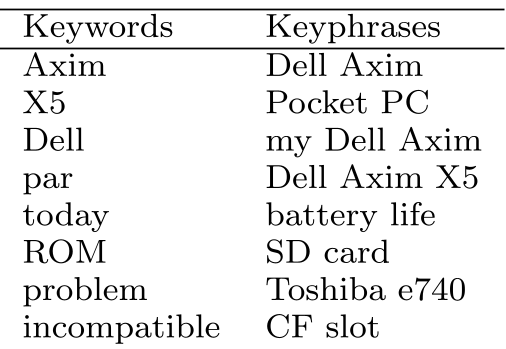 Table 1: Key phrases identified as drivers of negative sentiment for the brand.
Social Network Analysis (SNA)
The paper also pioneered the use of "Author Clusters." By mapping who responds to whom, the system identified influencer groups. If a cluster of high-influence authors (power users) is complaining about a specific bug, the marketing risk is significantly higher than a localized complaint.
Critical Insight & Future Outlook
While the NLP used here (rule-based and shallow parsing) has since been superseded by Transformers and LLMs, the logic of the pipeline remains the same. The transition from "Volume" to "Sentiment" to "Root Cause" is still the fundamental workflow of modern social listening tools like Brandwatch or Meltwater.
Takeaway: This paper reminds us that data mining is not just about counting occurrences; it’s about discovering the relationships between entities, sentiments, and people. It effectively laid the groundwork for the modern field of Aspect-Based Sentiment Analysis.
Limitations
As an early work, the system relied heavily on manual rule-writing for synonyms and domain-specific terms. In today’s world of slang and rapidly evolving internet memes, these static lexicons would struggle without the dynamic embeddings we use today.
Main Reference: Glance, N. et al. (2005). Analyzing online discussion for marketing intelligence. Proceedings of the 14th international conference on World Wide Web.