
Designing for Privacy: Optimizing Choice Architectures in Social Media
10816_Analyzing and Optimizing Access Control Choice Architectures in Online Social Networks.
This paper introduces an algorithmic framework to evaluate and optimize "Choice Architectures" (default settings) for access control in Online Social Networks (OSNs). By analyzing the gap between system defaults and actual user behaviors/preferences, the authors propose a method to maximize "usability coverage" and measure architectural bias.
Executive Summary
TL;DR: Researchers from Tel Aviv University have developed a mathematical approach to evaluate how well "default settings" in social networks actually serve their users. By applying algorithmic optimization to real-world Facebook data, they proved that current system defaults are often poorly aligned with user needs, intentionally nudging users toward high-disclosure sharing.
Background Positioning: This work bridges the gap between Behavioral Economics and Cybersecurity. It moves beyond the "What" of privacy settings and digs into the "How" of decision framing—establishing a formal metric called Usability Coverage to judge existing systems like Facebook.
Problem & Motivation: The "Default" Trap
In the world of Online Social Networks (OSNs), the most powerful tool for security is not a complex algorithm, but a simple default button. Most users suffer from status-quo bias; they rarely change their initial settings.
The authors argue that current choice architectures are often designed for "information sharing" (the service provider's goal) rather than "user privacy." This creates a conflict:
- Complexity: Fine-grained controls (like Facebook's "Custom" settings) are too hard for the average user.
- Misalignment: Canonical defaults (Public, Friends, Only Me) don't cover the nuanced needs of modern social interaction.
- Hidden Bias: Defaults act as "nudges," quietly pushing users to expose more data than they intend.
Methodology: The Optimization Algorithm
The core innovation is a method to select "optimal" options that maximize Usability Coverage—the proportion of users whose needs are met by the provided defaults.
The Two Types of Coverage:
- Choice Coverage: Treats all posts equally (weighting heavy users more).
- User Coverage: Treats every user equally, normalizing for their activity frequency.
The authors proposed a Choice Reduction Algorithm that processes thousands of unique configuration combinations to find the "Sweet Spot"—the 3 or 4 options that provide the highest social welfare.
 Fig 1: The mathematical definitions for Coverage (Eq 3) and User satisfaction.
Experiments & Results: Is Facebook Biased?
The study analyzed 21,950 posts from 266 users and surveyed 533 participants.
Key Findings:
- The Optimality Gap: The research found that by simply changing Facebook's 3 defaults to a more data-driven set, coverage could jump by 8.5%.
- Openness Bias: The authors created an "Openness Index." While Facebook’s default "Public" option has an openness score of 20, the average score of users' actual choices was only 11.6. Users are far more private than the system encourages them to be.
Temporal Decay
The study also traced Facebook's defaults over time. In 2009, Facebook switched to "Friends-of-Friends" as a default—a setting that experimental data shows has nearly 0% coverage, meaning almost no one actually wanted to use it.
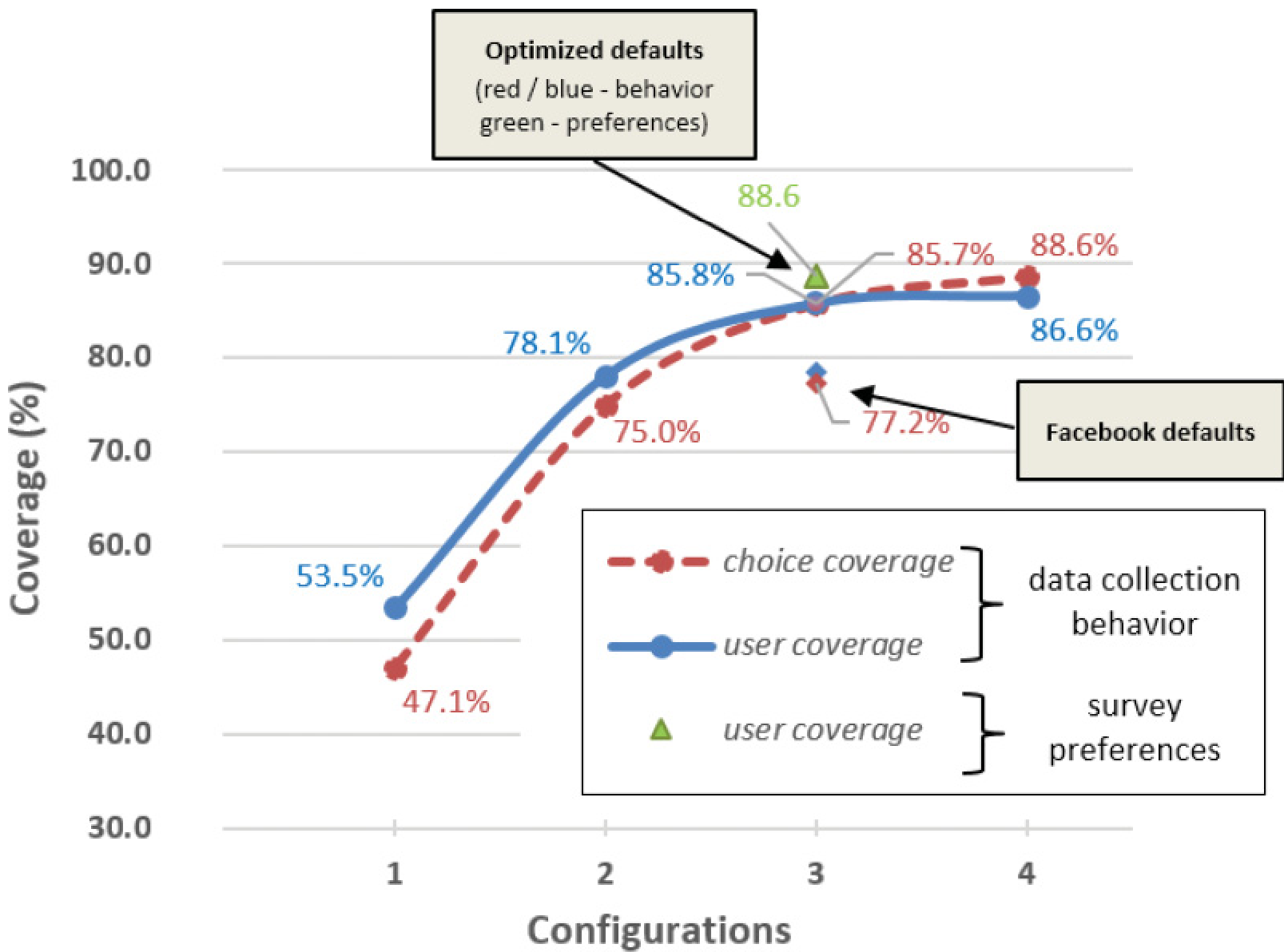 Fig 2: Coverage vs. Number of Options. Note the gap between the optimal orange line and the current Facebook rhombuses.
Critical Insight & Conclusion
Takeaway
The design of a choice architecture is never neutral. Every default is a recommendation. This paper provides a tool for regulators and designers to ensure that "security by default" is not just a slogan, but a mathematically verified reality.
Limitations
A notable limitation is that the behavioral data was collected within the existing Facebook UI. Since the UI itself biases behavior, the "optimal" options might still be influenced by the very architecture they seek to fix.
Future Outlook
This methodology isn't just for social media. It can be applied to browser cookies, IoT device permissions, and enterprise firewalls. In an era of "privacy-by-design" regulations (like GDPR and CCPA), algorithmic auditing of choice architectures will likely become a standard tool for digital compliance.