
Deciphering the Legal Labyrinth: Scaling Privacy Policy Analysis with AI and Crowdsourcing
Analyzing Privacy Policies At Scale: From Crowdsourcing To Automated Annotations
This paper presents a comprehensive framework for scaling the analysis of website privacy policies using a "human-in-the-loop" trajectory, evolving from manual crowdsourcing to automated machine learning. It introduces the OPP-115 corpus and demonstrates that while individual policies are complex, aggregated crowd annotations can reach 96% accuracy, eventually enabling SOTA automated classifiers for data practices and user choice extraction.
TL;DR
Privacy policies are "hidden in plain sight"—essential yet unreadable. Researchers from CMU and the University of Washington have developed a scalable system that leverages crowdsourcing, relevance modeling, and deep learning to transform these dense legal documents into actionable data. By creating the OPP-115 Corpus, they moved from manual human interpretation to automated classifiers capable of identifying data practices and "opt-out" choices with high precision.
The Motivation: The "Cost" of Reading
It is a well-known academic trope that if an average user actually read every privacy policy they encountered, they would lose months of their lives every year. The "Notice and Choice" framework is fundamentally broken because:
- Length: Policies average over 2,500 words.
- Vagueness: Legal "weaseling" makes it hard for even experts to agree on whether data is shared.
- Complexity: Information about a single practice (e.g., location tracking) is often scattered across multiple sections.
The authors' insight was that we don't need to choose between human intuition and machine speed; we can use the former to train the latter.
Methodology: The Path to Automation
The research followed a structured trajectory of decreasing human intervention:
1. High-Precision Crowdsourcing
The team built a custom annotation tool. They discovered that while a single crowdworker might be unreliable, an 80% agreement threshold among 10 workers acts as a powerful filter. This "wisdom of the crowd" produced results that matched law students with 96% accuracy.
2. Supporting Humans with Relevance Models
To speed up the process, the researchers implemented a "highlighting" system. Using logistic regression and specific regex features, the tool identifies the top 5-10 paragraphs most likely to answer a specific question (e.g., "Does this site collect health data?").
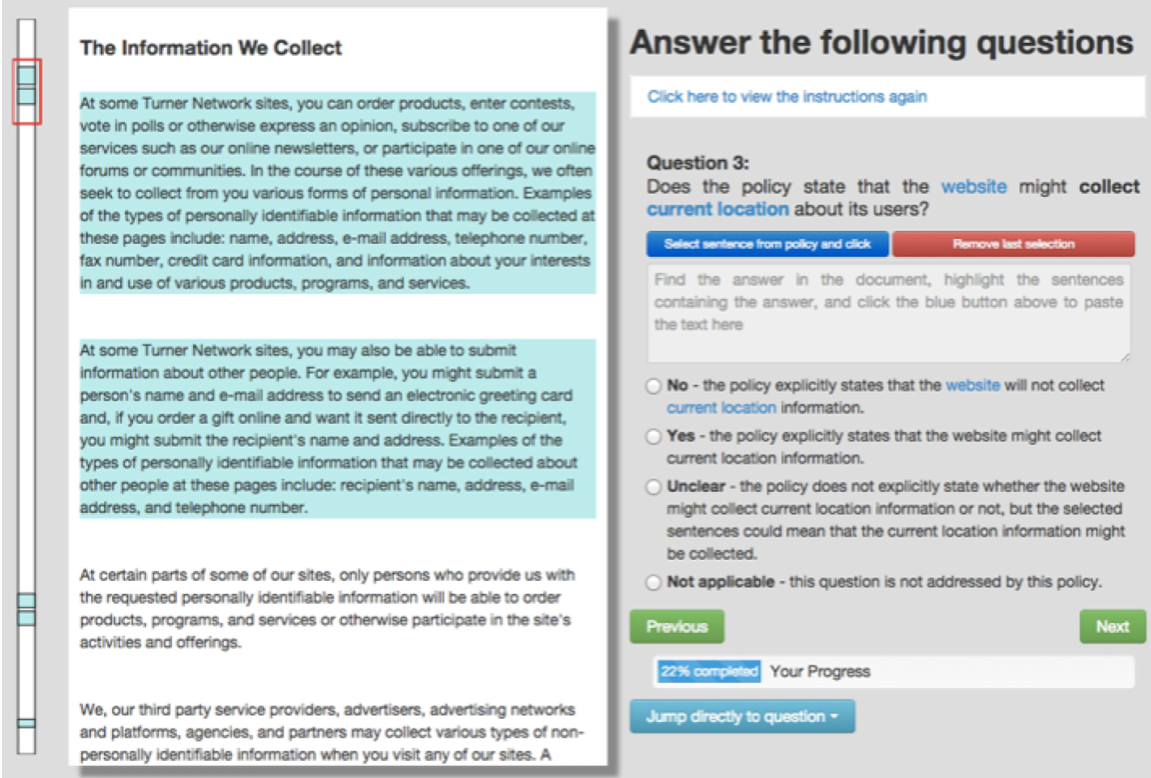 Figure: The annotation interface showing paragraph highlighting and the overview bar for quick navigation.
3. Full Automation: The OPP-115 Corpus
The crowning achievement was the creation of the OPP-115 Corpus—115 policies meticulously labeled by legal experts. They used this to train:
- Segment Classifiers: Using CNNs and SVMs to categorize text into themes like "Third-Party Sharing" or "Data Security."
- Choice Extractors: A two-tier model that identifies if a sentence offers a choice (e.g., an opt-out link) and then determines the purpose (e.g., Advertising vs. Analytics).
 Figure: The two-tier architecture for automatically identifying and categorizing privacy choices.
Experimental Results: Machines vs. Lawyers
The automated segment classification achieved a Micro-F1 of 0.78 at the segment level. While humans still outperform machines in nuance, the system showed remarkable robustness:
- Opt-out Detection: In a practical test of the 180 most popular websites, the model achieved perfect precision on its positive predictions for opt-out links.
- Productivity: The relevance-based highlighting reduced the median time to analyze a policy from ~19 minutes to ~16 minutes, proving that AI cues can significantly augment human efficiency.
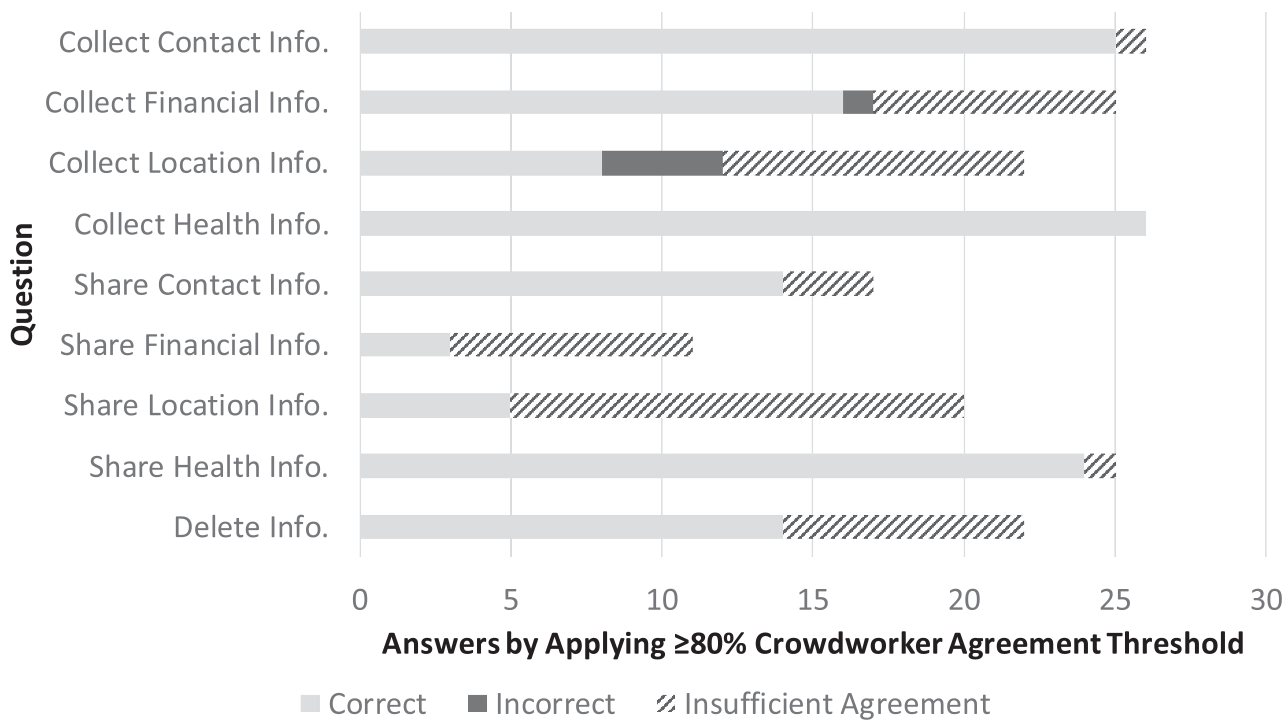 Figure: Comparison of crowdworker accuracy across different privacy themes.
Critical Insights & Future Outlook
The "Holy Grail" of this research is a Personalized Privacy Assistant. Imagine a browser extension that doesn't just block cookies but reads the policy for you and says: "Heads up! This site sells your location data to advertisers, but you can opt out here [Link]."
Limitations
- Context Loss: Models currently struggle when information is split across the document (e.g., a "no sharing" header followed by special exceptions pages later).
- Vagueness: NLP still has difficulty quantifying "reasonable" or "may share" compared to human legal scholars.
Conclusion
This work transitions privacy policy analysis from a niche legal task to a scalable data science problem. By providing the OPP-115 Corpus, the authors have laid the foundation for a new generation of privacy-centric UI/UX tools that empower users rather than overwhelming them with "Legalese."