
SSC: Modeling Social Media Interactions with Stochastic Process Calculus
Analyzing the Shared Information in Social Networks
The paper introduces a Simple Stochastic Calculus (SSC) to formally model and analyze information sharing within social networks. By leveraging a rate-based operational semantics, the authors transform network interactions into Continuous-Time Markov Chains (CTMCs), enabling quantitative verification of security and accessibility properties using the PRISM model checker.
TL;DR
Researchers have developed a Simple Stochastic Calculus (SSC) to formalize the messy, "who-sees-what" world of social media. By treating social interactions as timed events in a mathematical framework, they can convert a network's behavior into a Continuous-Time Markov Chain (CTMC). Using the PRISM model checker, they can then mathematically prove the probability of specific outcomes—like whether a "denied" user will receive a notification before a "granted" one.
Background: Beyond Static Graphs
Most social network analysis relies on graph theory (nodes and edges). While great for mapping "who knows whom," graphs are poor at modeling behavior over time. Real social platforms involve asynchronous message passing, conditional logic (e.g., "if friend on Flickr AND Twitter"), and varied interaction speeds. Prior work like the Stochastic -calculus attempted to solve this but often struggled with compositionality—the ability to build complex systems from smaller parts without the math breaking down.
Methodology: The Core of SSC
SSC introduces a refined approach to modeling. Its architecture is built on three pillars:
- Symmetric Actions: Instead of rigid input/output labels, SSC uses "action" and "co-action," making it more flexible for many-to-many communications.
- Linksets: These represent the state of the network (e.g., existing friendships or access rights). Creating a link is a global event that propagates across processes.
- Stochastic Rates: Every action has a "rate" from an exponential distribution, defining its duration. This allows the system to model the "speed" of human or system responses.
Model Architecture and Flow
The authors define Alice's privacy policy through nested if-then-else structures. The mathematical transitions are then fed into a rate-based transition system.
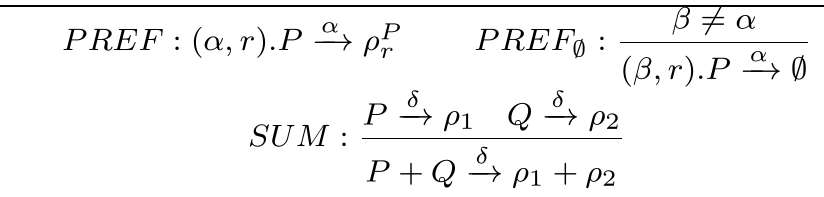
The logic follows a strict flow:
- Inquiry: User sends a request.
- Decision: Alice's process checks against the "Linksets" (Flickr/Twitter databases).
- Notification: A stochastic event returns
grantedordenied.
Experiments: Testing Alice's Privacy
The case study involved Alice and three users: Bob, Carol, and Diana. Alice only wants to share photos with friends present on both Flickr and Twitter.
Using the PRISM model checker, the researchers performed a Quantitative Simulation. They weren't just checking if the code worked; they were checking the probability of state transitions.
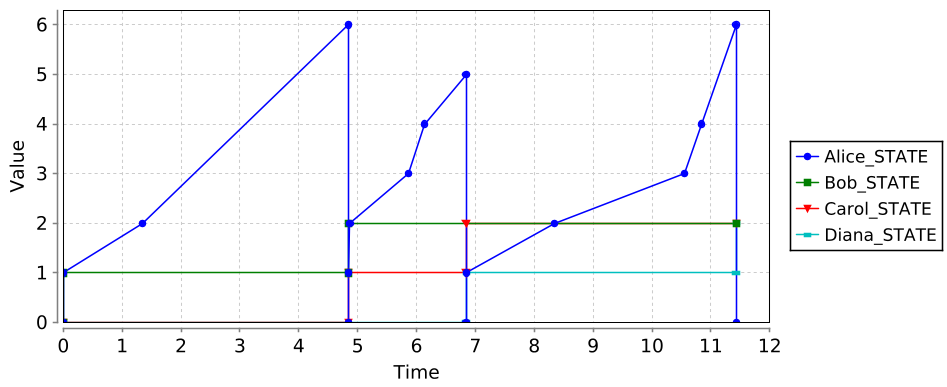 Fig 1. State transition path showing Alice interacting with Bob and denying access.
Key Quantitative Insights:
- Termination Check: They proved the network always reaches a stable final state (Probability = 1).
- Race Conditions: They calculated the exact probability of one user finishing their "handshake" before another. For instance, the probability of Bob reaching a finished state before Diana was exactly 0.4375.
Critical Analysis & Conclusion
Takeaway
SSC provides a highly compositional way to model social networks. Because the "Parallel" operator is associative, you can model Carol and Diana separately, join them together, and the stochastic math remains consistent. This is a significant improvement over previous stochastic versions of the -calculus.
Limitations
- Scalability of Model Checking: While the calculus is scalable, model checking large CTMCs (millions of users) often suffers from the State Space Explosion problem.
- Distribution Choice: The paper assumes Exponential Distributions for simplicity (memoryless property). In reality, human behavior might follow "heavy-tailed" or "power-law" distributions.
Future Outlook
The next step for this research is automating the translation from high-level social media API descriptions directly into SSC code. This would allow platform developers to "stress test" their privacy settings against formal verification before deploying them to millions of users.