
Deciphering the Pandemic’s Digital Pulse: A Deep Dive into Early COVID-19 Societal Impact
16218_Analyzing Societal Impact of COVID-19 A Study During the Early Days of the Pandemic.
This paper presents a comprehensive computational study of over 530,000 tweets to analyze the societal impact of COVID-19 in the US during the early pandemic (March 2020). By combining Semantic Role Labeling (SRL), LSTM-based Dependency Parsing, and Seeded LDA, the authors categorize public discourse into six thematic pillars and quantify shifting public sentiments and behavioral patterns.
TL;DR
As the COVID-19 pandemic first reached the United States in March 2020, Twitter became a digital town square for fear, advocacy, and survival. This study analyzes over half a million tweets using advanced NLP—including Dependency Parsing and Seeded LDA—to map how the American public moved from demanding school closures to struggling with the "toilet paper crisis." It reveals a surprising trend: while panic buying sparked outrage, the controversial decision to close schools was met with overwhelming public support.
Problem & Motivation: Beyond the Infection Curve
While epidemiologists were focused on and hospitalization rates, the societal fabric was tearing in ways data failed to capture in real-time. Prior social media studies often treated "COVID tweets" as a monolith. The authors of this paper noticed a gap: how do we distinguish between general fear and specific calls for policy change (like #CloseNYCSchools)?
The challenge lies in the signal-to-noise ratio. In a dataset where "#COVID19" is ubiquitous, how do you extract the nuance of a "bidet" being discussed as a solution to a "toilet paper" shortage? The authors set out to move from simple word counts to Semantic Understanding.
Methodology: Parsing the Public Mind
1. The Taxonomy of a Crisis
The authors categorized the chaos into six distinct buckets:
- General COVID: The baseline noise.
- Quarantine: Focus on social distancing and "flattening the curve."
- School Closures: Active demands for government intervention.
- Panic Buying: The logistics of shortage (sanitizers, toilet paper).
- Lockdowns: Specifically targeting the closure of bars/cities.
- Frustration and Hope: The emotional toll and "Cancel Rent" movements.
2. Semantic Role Labeling (SRL) & Dependency Parsing
To go deeper than "what" people were saying, the researchers looked at "how" they were acting. Using a Bi-LSTM dependency parser with biaffine classifiers, they extracted Verb-Noun pairs.
- Insight: The verb "deal" was almost exclusively paired with nouns like "anxiety," "stress," and "crisis," providing a direct window into the mental health of the nation.
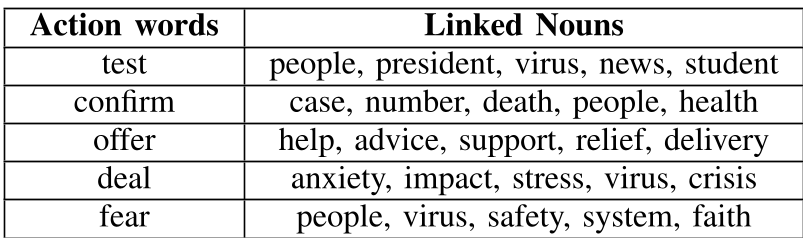 Table: Action words linked to nouns via dependency parsing, revealing the context of public concern.
3. Seeded LDA: Guiding the Machine
Standard Latent Dirichlet Allocation (LDA) is unsupervised—it finds topics it thinks are there. The authors used Seeded LDA, providing "anchor words" (e.g., roll, shop, panic for the Panic Buying category). This forced the model to categorize even "rare" topics that would otherwise be swallowed by the "General COVID" cluster.
Key Results: Sentiment and Scarcity
The findings challenge some common assumptions about the early pandemic:
- The School Closure Paradox: While often debated in the media, the Twitter data showed a high positive sentiment for school closures. Parents and teachers were advocating for safety (#closenycschools), seeing the closure as a proactive protection rather than a burden.
- Panic Buying Negative Peak: This group had the highest negative sentiment. Linguistic analysis found the word "bidet" trending alongside "toilet paper," as people crowdsourced survival alternatives.
- The Temporal Shift: Panic buying and school closure tweets peaked mid-March and died down once the schools actually closed and rationing began. However, "Frustration and Hope" increased as economic anxiety (rent/unemployment) took over.
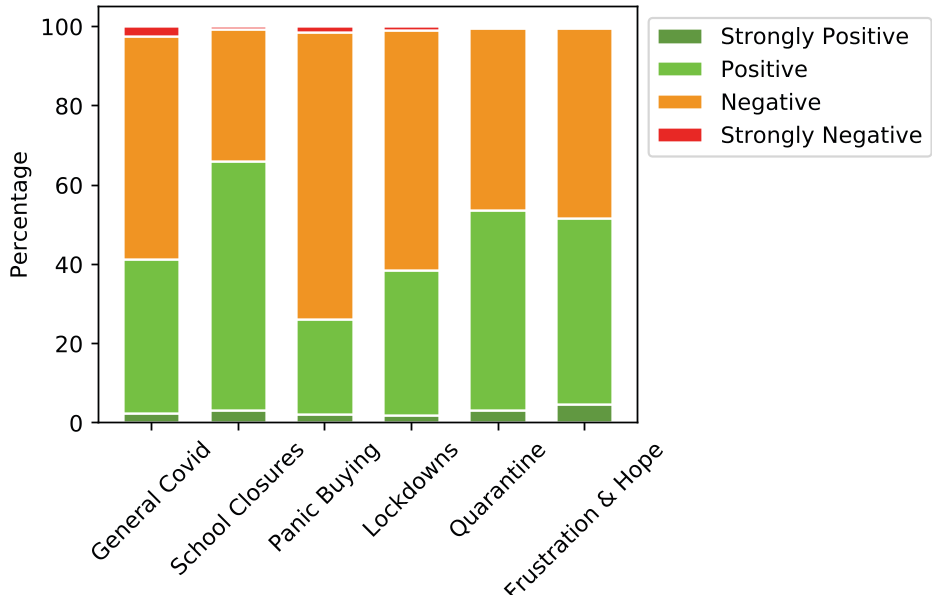 Figure: Multi-class sentiment classification showing the positive reception of school closures vs. the negativity of panic buying.
Critical Analysis & Future Outlook
The Value of "Seeded" Intelligence: The brilliance of this work lies in using Seeded LDA. By guiding the algorithm, the researchers achieved a Quarantine category precision of 88.5%. This proves that pure "unsupervised" learning isn't always the goal; human-in-the-loop "seeding" is essential for crisis management.
Limitations: The authors acknowledge Twitter Bias. Twitter users are generally younger and more tech-savvy than the general population. Furthermore, the "Frustration and Hope" category was difficult to model even with seeded LDA due to the polarized nature of the language.
Conclusion: This paper serves as a sophisticated post-mortem of a global crisis. It tells us that in times of disaster, the "Action Words" (verbs) used by the public are just as important as the keywords. For future policy-makers, this framework offers a way to listen to the "digital scream" of a population and respond to specific needs—whether it's mental health support for "anxiety" or supply chain fixes for "toilet paper."