
Beyond the Static Graph: Mastering Temporal Networks in Social Media
Analyzing Temporal Networks in Social Media
This paper provides a comprehensive review of temporal network analysis methods applied to social media data. It introduces specialized metrics and randomization techniques to understand how the simultaneous convergence of network topology and time-stamped interactions dictates information spreading dynamics.
In the realm of social media analysis, we often treat "networks" as static snapshots of relationships. However, as Petter Holme argues in this seminal review, a graph that ignores the timing of interactions is fundamentally blind to how information actually moves. To understand viral cascades or epidemic spreads, we must transition from static topology to the logic of Temporal Networks.
TL;DR
This paper establishes temporal networks as the gold standard for analyzing social media metadata. By focusing on "time-respecting paths"—where info can only move forward in time—it reveals that the temporal structure of our interactions often acts as a significant bottleneck ("Slow-World Effect") compared to what a static graph would predict.
The Problem with Static Abstractions
When we collapse a year of Facebook posts into a single "friendship graph," we lose the Non-Transitivity of Time.
- The Logic: If Alice talks to Bob at 10:00 AM, and Bob talks to Charlie at 9:00 AM, Alice's information cannot reach Charlie through Bob.
- The Error: A static graph would show a path from Alice to Charlie, leading to massive overestimations of spreading potential.
Methodology: The Temporal Toolbox
1. Time-Respecting Paths and Latency
The core of temporal analysis is the Time-Respecting Path. Unlike static paths, these are not commutative. The paper adopts the concept of Vector Clocks from distributed computing to measure Latency—the age of information.
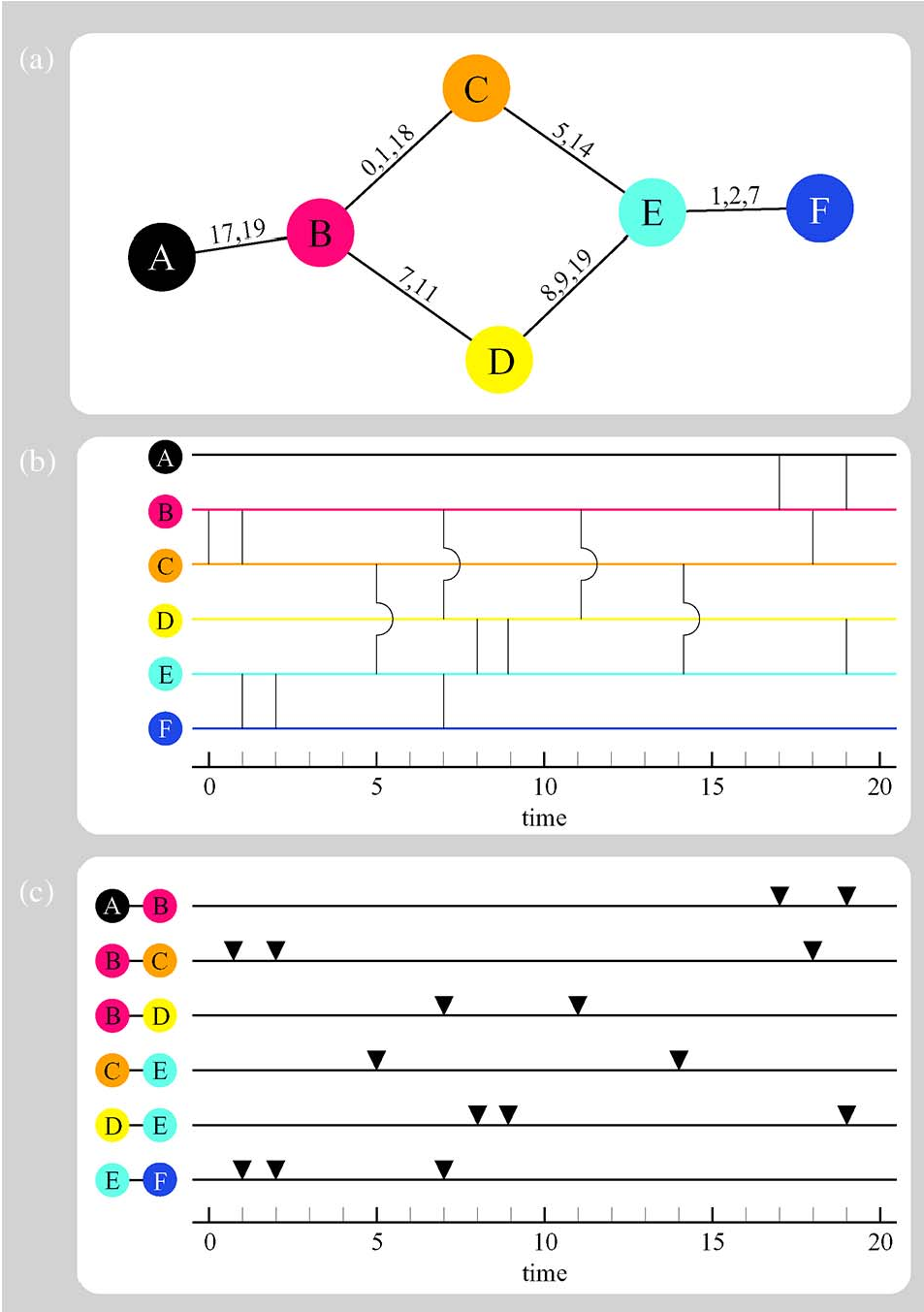 Figure 1: Panel C illustrates how information can flow from A to B, but not A to D, because the B-D contact happened before the A-B contact.
2. The Power of Null Models (Randomization)
How do we know if a spreading pattern is caused by the who (topology) or the when (timing)? The paper outlines a hierarchy of randomization techniques:
- Randomized Edges (RE): Keeps the timing but shuffles the people.
- Randomly Permuted Times (RP): Keeps the people but shuffles the timing.
- Randomized Contacts (RC): Redistributes total contact volume across edges.
Empirical Evidence: The "Slow-World" Effect
Analyzing data from an Internet dating community, Holme discovers a counter-intuitive phenomenon. While static networks are known for the "Small-World" effect (short distances), temporal networks often exhibit a Slow-World effect.
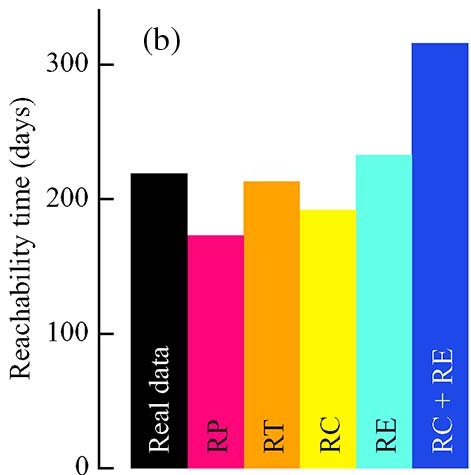 Figure 2: Analysis of an online dating site shows that actual temporal order (Empirical) significantly restricts information reach compared to randomized versions.
Key Insight: The empirical reachability was only ~29%. Simply shuffling the time stamps (RP) jumped reachability to 47%. This proves that human timing (burstiness, daily cycles) is a purposeful or accidental filter that inhibits the "viral" spread of information.
Critical Analysis & Future Outlook
Strengths
- De-Noising Complexity: The paper provides a rigorous mathematical framework to move beyond visual heuristics.
- Product Utility: These methods are directly applicable to "sentinel" detection—identifying early adopters to track epidemic outbreaks (or marketing trends) through social media.
Limitations
- Data Granularity: Most logs record sending time, but spreading depends on reception time. This temporal "jumble" is a known bias that future research must address.
- Simplicity of Contagion: The paper acknowledges that "complex contagion" (requiring multiple exposures) is harder to model temporally than "simple contagion."
Takeaway for Researchers
If you are building an influence maximization algorithm or a sentiment analysis tool, stop relying on static adjacency matrices. The value of social media data lies in its high-resolution timestamps. By leveraging the randomization techniques and latency metrics discussed here, you can identify "influential spreaders" who aren't just well-connected, but are well-timed.