
Beyond the Graph: Navigating the "Slow-World" of Temporal Social Networks
Analyzing Temporal Networks in Social Media
This paper reviews the methodology of temporal networks applied to social media data, focusing on "contact sequences" rather than static graphs. It introduces essential tools for identifying influential spreaders and analyzing information cascades by considering both the topology and the exact timing of interactions.
TL;DR
Static network analysis is no longer enough for the high-velocity metadata of modern social media. Petter Holme’s review argues that the timing of contacts is just as vital as the connection itself. By utilizing "contact sequences" and "time-respecting paths," we can finally understand why information sometimes fails to "go viral" despite a dense social graph, and why empirical human activity often creates a "slow-world effect."
The "Static" Fallacy in Social Media
In traditional network science, we represent Facebook or Twitter as a collection of nodes (users) and edges (friendships). While this provides a snapshot of potential influence, it fails to capture the actuality of influence.
The core problem is transitivity. In a static graph, if A is connected to B, and B to C, then information can flow from A to C. In a Temporal Network, this only holds if the contact (A, B) happens before the contact (B, C). If B talks to C at 10:00 AM and A talks to B at 2:00 PM, the path from A to C is broken.
Methodology: The Anatomy of Time-Respecting Paths
The paper formalizes the "Contact Sequence" representation—triples of (i, j, t)—and introduces several key metrics:
- Time-Respecting Paths: Sequences of contacts with non-decreasing time stamps.
- Latency & Vector Clocks: Measuring the "age" of information between any two nodes at a specific point in time.
- Reachability Ratio: The average fraction of nodes reachable via valid temporal paths.
 In the figure above, a simple 6-vertex system demonstrates how complex temporal paths become when we account for the exact sequence of events.
The Power of Randomization: Isolating the "Why"
One of the paper's most significant contributions is the categorization of null models. To understand if a "viral" spike is caused by the who (topology) or the when (timing), Holme suggests eight randomization techniques:
| Randomization Method | What it preserves |
|---|---|
| Randomly Permuted Times (RP) | Topology and number of contacts; destroys the order. |
| Randomized Edges (RE) | Degree distribution and timing; destroys the specific community structure. |
| Edge Randomization (ER) | Inter-contact time distributions; destroys weight-topology correlations. |
By comparing real data against these null models, Holme identifies the "Slow-World Effect": the observation that real-world temporal structures (and human burstiness) usually make information spread slower than it would in a random system.
Experimental Insight: The Dating Site Study
Using data from an Internet dating community, Holme demonstrates that temporal ordering is the dominant factor in reachability.
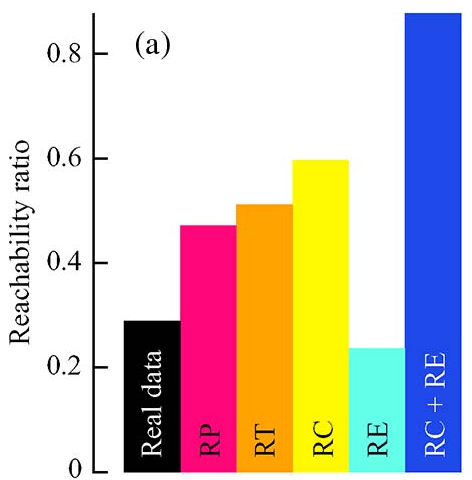 Fig 3: The gap between the "Empirical" line and randomized models (RP, RT) shows that real-world timing significantly restricts information flow.
Critical Analysis & Future Outlook
The value of this work lies in its rigor. It moves social media analysis from "marketing fluff" to a branch of statistical physics.
Key Takeaway: To find an "influential" person, don't look for the node with the most friends; look for the node that sits at the intersection of active, forward-moving time-respecting paths.
Limitations: The paper notes a bias in "sending vs. receiving" timestamps. Most logs record when a message is sent, not when the recipient reads it. In the high-frequency world of social media, this small delay could fundamentally alter the perceived structure of informatic flow.
Conclusion
As we move toward 2026, the integration of temporal and spatial data will be the next frontier. Whether for public health surveillance or behavioral interventions, recognizing that networks are living, breathing, and time-dependent structures is no longer optional—it is the standard.