
The Ghost in the Machine: How Mimicking Human Playstyles Solves the Multiplayer Lag Problem
Analyzing User Behavior Data in a Mobile Tennis Game
This paper investigates user behavior data from the mobile game "World of Tennis: Roaring ’20s" to validate a pseudo-multiplayer AI system. The research utilizes heatmap-based similarity analysis to prove that players develop consistent, diverse playstyles that can be effectively mimicked by AI agents to bypass traditional multiplayer connectivity issues.
TL;DR
In the fast-paced world of mobile tennis, a few hundred milliseconds of lag is the difference between an ace and a missed swing. This paper explores how "World of Tennis: Roaring ’20s" solves the connectivity nightmare by replacing real-time opponents with AI clones trained on human behavior. By analyzing thousands of matches, the researchers proved that players have unique "behavioral fingerprints" that are consistent enough for AI to learn and diverse enough to keep the game fun for years.
Background: The Multiplayer Paradox
Tennis is inherently competitive, making Player-vs-Player (PvP) a necessity. However, mobile networks are notoriously unstable. Traditional solutions—waiting for perfect matchmaking or tolerating lag—often lead to user churn. The authors proposed a Pseudo-Multiplayer model: you don't play against a person; you play against an AI agent that thinks like that person.
The "Heatmap" Fingerprint
To make an AI behave like a human, you first have to define what "human-like" means in data. The researchers focused on two core actions:
- Movement: Where do you stand on the court?
- Shots: Where do you aim your ball?
By treating the tennis court as a grid, they generated Heatmaps. These heatmaps were converted into vectors, allowing the team to mathematically calculate how similar two players are using a simple dot product.
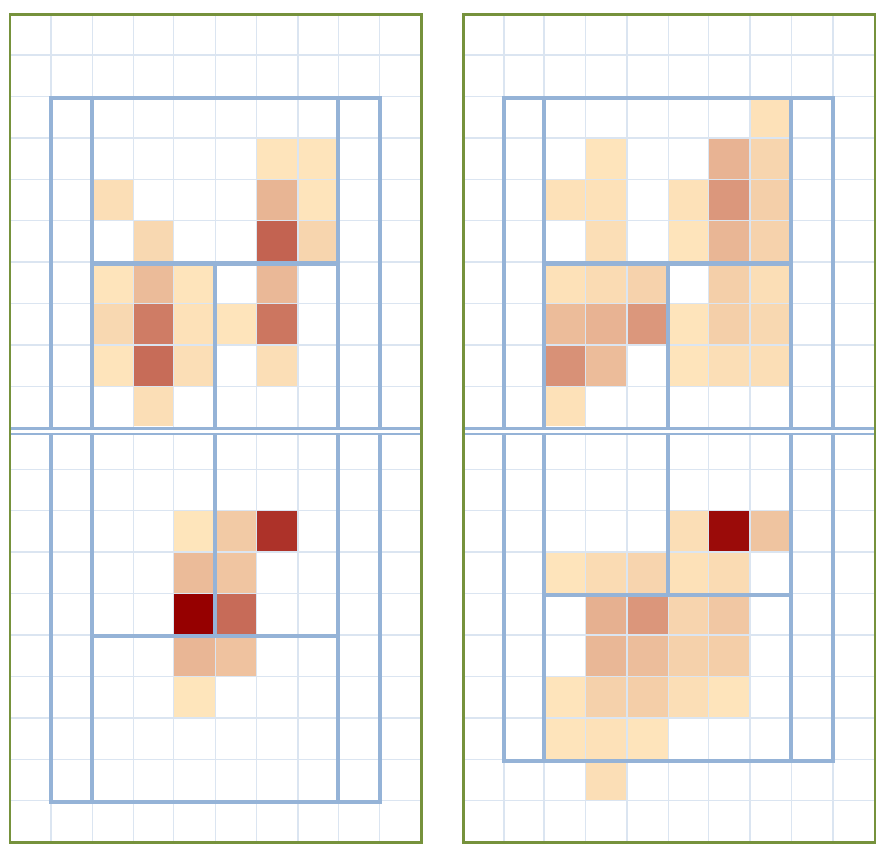 Fig 2: Heatmaps of two distinct players. The darker areas represent "hot zones" for movement and ball placement.
Key Insights: Consistency and Diversity
The study yielded several high-value insights for game designers:
1. Players are "Stuck" in Their Ways
One of the most surprising findings was that individual playstyles are incredibly stable. Once a player hits "maturity" (around Level 10), their tactical behavior rarely changes, even as they upgrade their character's power or speed. The similarity within a single user’s matches averaged a staggering 96.8%. This is great news for AI training: it means a single behavioral profile is enough to represent a player.
2. The Four Tribes of Tennis
While individuals are consistent, the player base as a whole is diverse. Using Hierarchical Clustering, the researchers identified four distinct "types" of players:
- The Novices (Clusters A & B): Either repetitive or erratic, often ignoring the middle zone of the court.
- The Veterans (Clusters C & D): More efficient, covering the whole court but focusing on high-percentage winning zones.
- The Outliers: Highly idiosyncratic players who use unusual court locations to win.
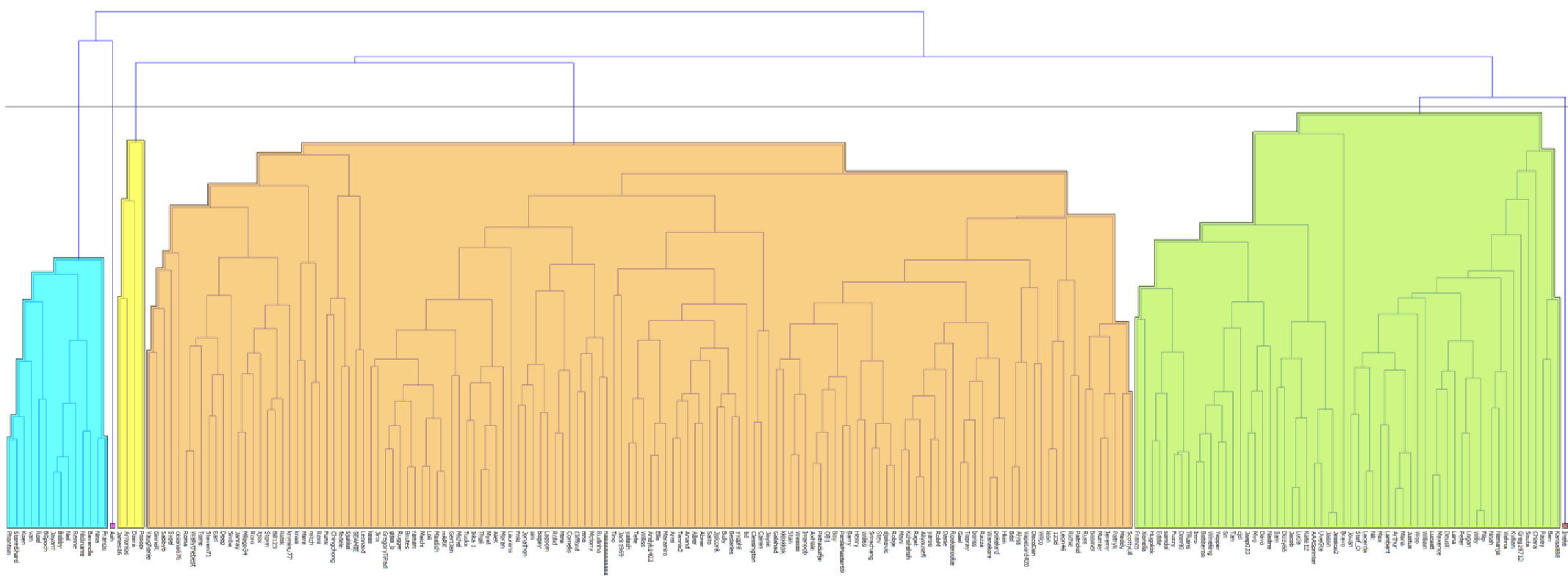 Fig 3: Dendrogram showing the hierarchical clustering of users based on behavioral similarity.
Experimental Results
The data confirms that the AI system works. Some dedicated users have played over 4,000 matches against these AI agents over 1.5 years. Because the AI profiles are derived from a wide variety of human clusters, the "pool" of opponents feels fresh and challenging, despite the lack of a "real" person on the other end of the connection.
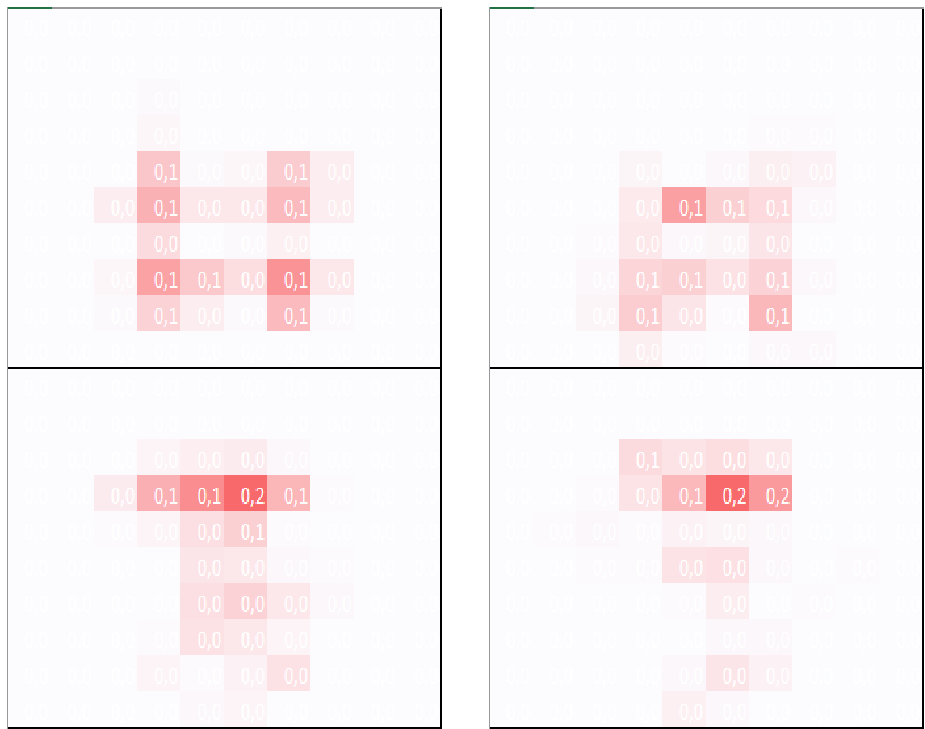 Fig 4: Visual evidence of distinct strategies in Cluster A vs Cluster B.
Critical Analysis & Conclusion
This work provides a robust blueprint for Asynchronous Multiplayer. By focusing on "Learning by Observation," the developers created an AI that avoids the "uncanny valley" of bot behavior.
Limitations: The current similarity function is "crude"—it looks at locations but not the sequence of actions (tactics). A player who always hits left then right might look the same on a heatmap as a player who hits randomly, even though their tactics are different.
Future Outlook: The next step is "loopholes detection." By analyzing the behavior of top-tier players, developers can see if certain AI strategies are "broken" or if human players have found exploits that the AI should—or shouldn't—be allowed to learn.
For mobile devs, the takeaway is clear: Don't fight the lag. Model the human.