
Reconstructing Network Reality: A Behavior-Centric Approach to SNS User Experience
Analyzing on User Behavior and User Experience of Social Network Services
This paper investigates user behavior characteristics within Social Network Services (SNS) to model and evaluate Quality of Experience (QoE). The authors propose that complex network communication scenarios can be reconstructed using a small set of typical user actions, validated through statistical analysis of usage frequency and data distribution.
TL;DR
This study shifts the focus of network performance testing from raw data flows to human behavior. By proving that Social Network Service (SNS) usage follows a "centralized distribution," the authors demonstrate that we can simulate complex network loads using just a few typical user actions. Their experiments reveal that user behavior, rather than just raw bandwidth, is a critical factor causing perceptible delays in modern 5G-ready networks.
Background: The Limits of Traditional Testing
In the era of intelligent 4G and 5G networks, operators use Deep Packet Inspection (DPI) to treat different types of traffic differently. However, our testing systems are stuck in the past—either replaying old data packets or relying on manual "dial-up" tests that can't scale. The gap lies in understanding the "Why" and "How" of user interaction.
The authors' central insight is that if we can model the physics of how a user interacts with an app (logging in, posting a comment, scrolling), we can more accurately predict and test how the network will react.
Methodology: The Mathematics of Social Interaction
The paper employs a modified traffic model where the network load is a function of the number of users (), the number of data flows (), and the length of those flows ().
- User Arrivals: Modeled using a Poisson distribution.
- Flow Characteristics: The frequency and length of data flows follow geometric distributions ( and ).
The logic is elegant: if usage habits are concentrated (i.e., most people do the same few things), then the parameters and become predictable constants for a given scenario.

Evidence of "Centralized Distribution"
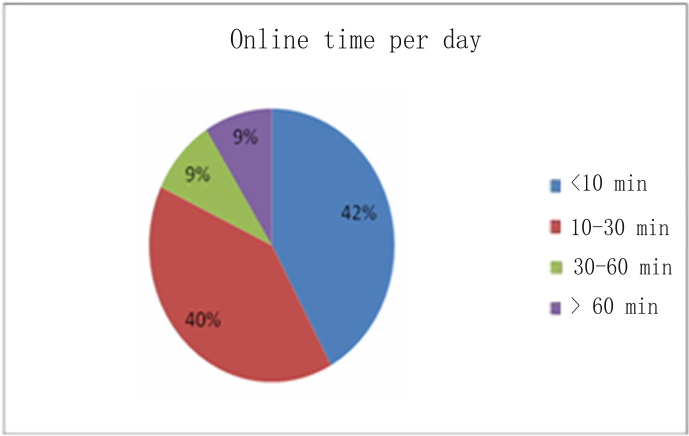
Through an analysis of 60,000 Weibo users and localized surveys of college students, the researchers found two key patterns:
- Uniformity of Habit: Most users in a specific group (like students on a campus) exhibit near-identical usage timing and frequency.
- Heavy-Tailed Data Distribution: As seen in the post-length analysis, the vast majority of social interactions involve tiny bursts of data (10-50 bytes), which has massive implications for signaling overhead in cellular networks.
Impact on QoE: Behavior as the Bottleneck
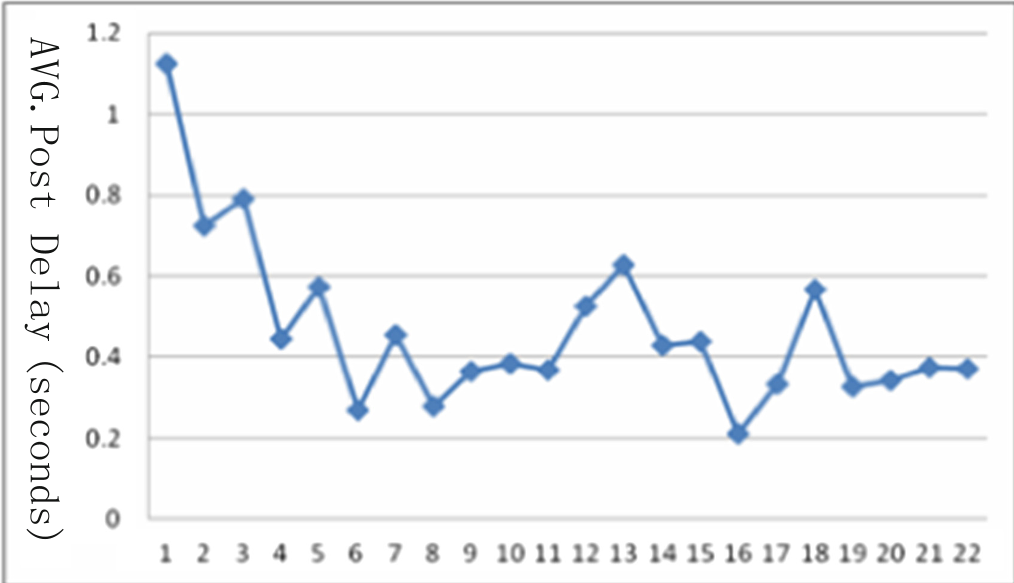
The most striking part of the study is the experiment across different functional zones (offices, restaurants, lounges). Even when the communication capacity and user density were similar, the "average post delay" fluctuated significantly.
This proves that the type of behavior—whether users are passively browsing or actively posting/commenting—triggers different scheduling responses from the network. A delay jitter of >0.1s is perceptible to humans, and the study found behavioral shifts easily crossed this threshold.
Critical Analysis & Future Outlook
Takeaway: This research provides a theoretical bridge between User Behavior (UB) and Quality of Experience (QoE). It suggests that future "Digital Twins" of networks must include behavioral models to be valid.
Limitations: While the paper identifies that behavior causes delay, it doesn't fully deconstruct the specific "intelligent scheduling strategies" used by operators. The study is also highly localized to Chinese SNS (Weibo, QQ).
Future Work: The next frontier is mapping specific action-trigger networks (e.g., the exact flow generated by a "Like" vs. a "Share") to create a modular library of test cases for 6G environments.
Main Reference: Bao, R., Chen, L., & Cui, P. "Analyzing on User Behavior and User Experience of Social Network Services."