
Beyond the Power-Law: Decoding the True Signature of Human Content Generation
Analyzing paerns of user content generation in online social networks
This paper empirically analyzes User Generated Content (UGC) patterns across three major knowledge-sharing Online Social Networks (OSNs): blogs, social bookmarks, and Q&A systems. The authors propose that user posting behavior follows a Stretched Exponential (SE) distribution rather than the commonly assumed power-law, significantly impacting how "core users" are identified.
TL;DR
Is the "90-9-1" rule of social media participation actually accurate? This seminal KDD paper challenges the long-standing academic obsession with power-law distributions in social networks. By analyzing millions of posts across blogs and Q&A sites, the researchers demonstrate that user contributions actually follow a Stretched Exponential (SE) distribution. This discovery fundamentally changes our understanding of "core users" and system scalability.
Background: The Power-Law Obsession
For years, the "Rich-Get-Richer" (Preferential Attachment) model led us to believe that social networks are dominated by a tiny fraction of hyper-prolific users. While this might hold true for links (followers), this paper argues it is a poor fit for content. Posting an article or a high-quality answer requires individual effort that doesn't scale linearly with "social wealth," leading to a distribution that is heavy-tailed but not quite a power law.
The "Stretched Exponential" Insight
The core methodology involves testing three massive datasets (Blog, Bookmark, and Answer systems) against the Stretched Exponential model:
The authors found that the stretch factor () is the "DNA" of a content type. A smaller indicates that content creation requires more effort or results in higher quality (e.g., "Best Answers" in Q&A systems have a smaller than general posts).
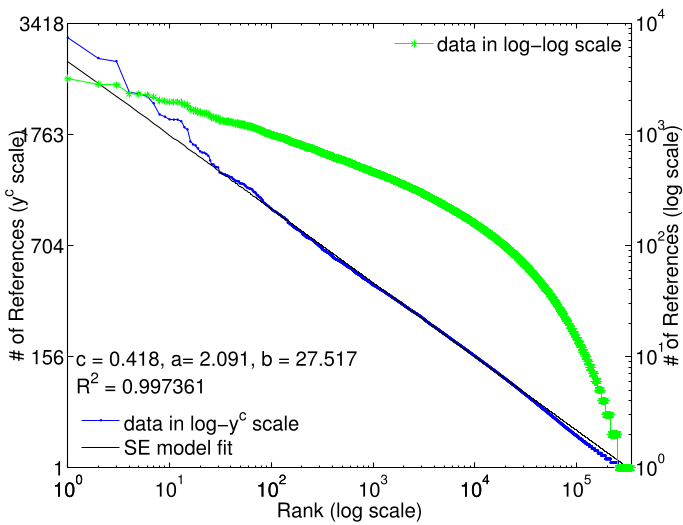 Figure: Various UGC types fitted against the Stretched Exponential scale. Note how the SE scale (left y-axis) turns the curve into a straight line, which a log-log scale (right y-axis) fails to do.
Methodology: Distinguishing Heartbeats from Noise
One of the paper's strengths is its rigorous data cleaning. The authors specifically identified and filtered out:
- "Cut-and-Paste" Bloggers: Users with inhumanly short posting intervals who show no temporal patterns (unlike humans who follow daily/weekly cycles).
- The "King Effect": Top-tier users that occasionally deviate even from the SE model due to exceptional influence.
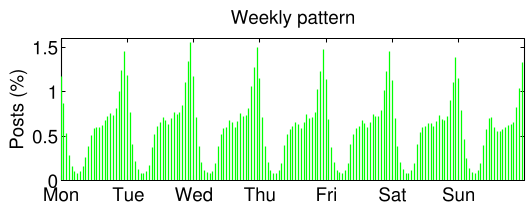 Figure: The rhythmic pulse of human activity. Original content shows clear peaks around 23:00, while automated spam/forwarding lacks this biological signature.
Experiments & The "80-20" Reality Check
While the "80-20 rule" (where 20% of users produce 80% of content) still roughly applies, the SE model shows that the Top 1% are far less dominant than they would be in a Power-Law world.
| Content Type | Stretch Factor () | Effort/Quality Proxy |
|---|---|---|
| Blog Article | 0.418 | Standard Effort |
| Blog Photo | 0.32 | High Effort (Upload/Edit) |
| Best Answers | 0.19 | Hardest (Quality Judged) |
The lower the , the more "skewed" the distribution becomes toward core experts. This provides a mathematical dial to measure how "hard" it is to participate in a given community.
Deep Insights: Why It Matters
- Democratization of Influence: Knowledge-sharing OSNs are more robust than networking OSNs. Because the contribution curve is "flatter" at the top, the departure of a single "super-user" is less likely to collapse the system.
- System Design: Developers should optimize caches and databases for the "Core 15%" rather than just the top 1%.
- The Effort Hypothesis: The paper concludes with a brilliant intuition—that is a physical manifestation of the barrier to entry. As tools like AI make content generation easier, we should expect to increase, making the distribution "flatter."
Conclusion
Guo et al. successfully shifted the focus from who you know to what you do. By proving that content generation follows a Stretched Exponential pattern, they provided a more nuanced, accurate, and human-centric way to model the digital communities we inhabit.
Limitations: The study was conducted in 2009; modern algorithmic feeds (like TikTok's FYP) might introduce new "rich-get-richer" dynamics into content creation that weren't present in the era of chronological blogs.