
Sindbad: Re-Architecting Social Networks with Deep Location Awareness
The anatomy of Sindbad: a location-aware social networking system
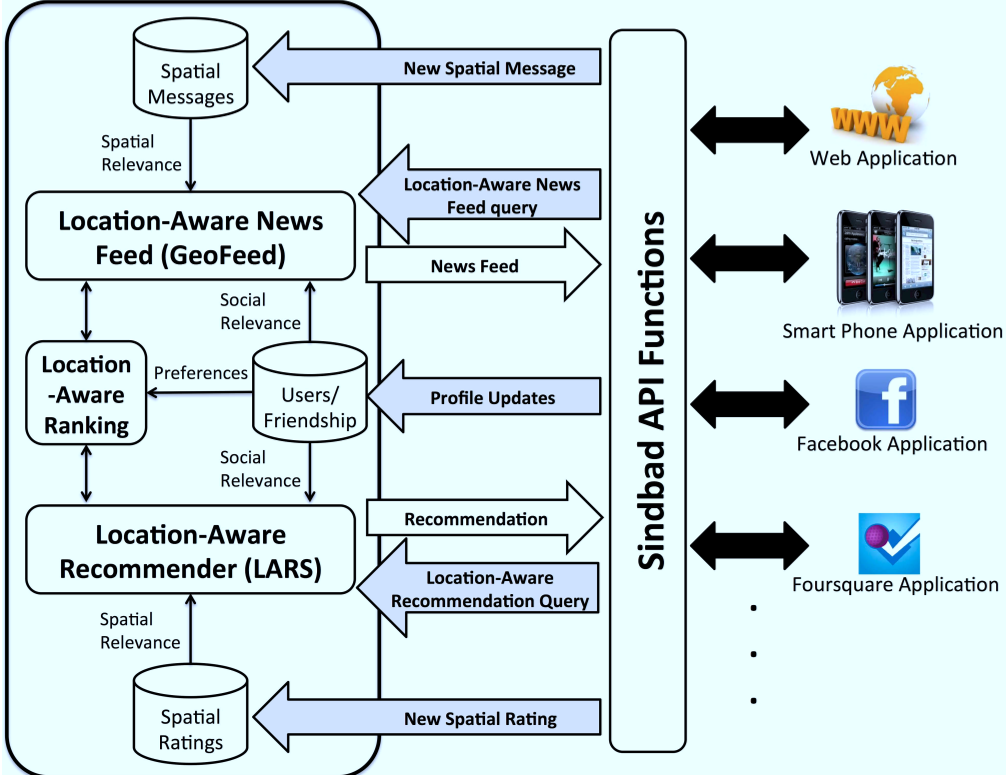
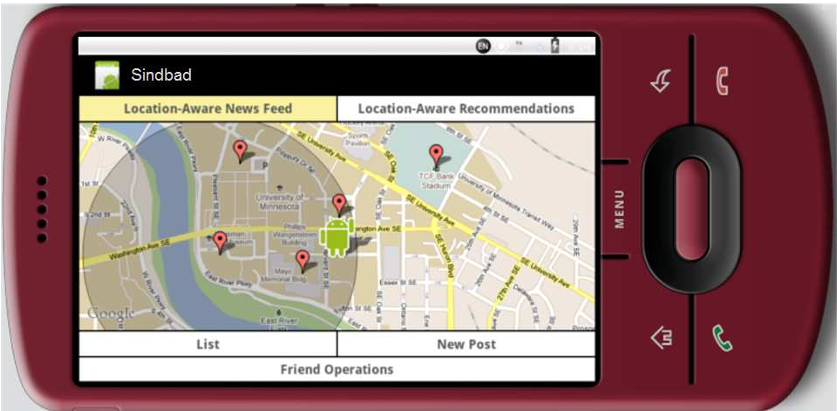
This paper introduces Sindbad, a location-aware social networking system that treats spatial data as a first-class citizen. It integrates three core services—GeoFeed (news feed), LARS (recommender), and GeoRank (ranking)—directly into the PostgreSQL query engine to provide scalable, location-sensitive social interactions.
TL;DR
Sindbad is a pioneering location-based social networking (LBSN) system that moves beyond simple check-ins. By integrating GeoFeed, LARS (Location-Aware Recommender System), and GeoRank directly into the PostgreSQL engine, it delivers news feeds and recommendations that are filtered by spatial proximity and social relevance, all while maintaining the scalability required for millions of users.
Contextual Positioning
In the landscape of 2012, social media was bifurcated: giants like Facebook dominated social graphs but lacked spatial "intelligence," while apps like Foursquare focused on "where" without the "what." Sindbad bridges this gap, establishing a framework where messages have "spatial extents" and recommendations are weighted by travel distance.
Problem & Motivation: The Spatial Blindness of Social Giants
Traditional news feeds (e.g., Twitter) use a purely temporal or social importance model. This leads to information overload where a user might see a review for a restaurant 1,000 miles away just because a friend posted it.
The technical challenges are three-fold:
- Mobility: Users move, changing their "relevance zone" constantly.
- Volume: Trillions of social interactions must be filtered against spatial bounds.
- Scalability: Standard LBSNs often struggle with "heavy" users (those with many friends) or "hot" locations.
Methodology: The Three Pillars of Sindbad
1. GeoFeed: Smart Delivery Modeling
The system doesn't just "query" for news. It uses a GeoFeed decision model to choose between:
- Spatial Push: Pre-computing feeds for high-latency tolerance.
- Spatial Pull: On-demand queries for low-frequency users.
- Shared Push: Materializing results shared across multiple users in the same vicinity.
2. LARS: Adaptive Pyramid Recommendation
To recommend a spatial item (like a restaurant) or a non-spatial item (like a movie) based on location, Sindbad uses an Adaptive Pyramid Structure. This structure partitions the world into cells that grow or shrink.
- Trade-off: The system balances Scalability (merging cells to save storage) vs. Locality (splitting cells to provide more granular, local recommendations).
3. GeoRank: Integrating Preferences
Ranking isn't just about distance. Sindbad calculates a Rank Score using a weighted linear combination:
Rank Score = ω × Spatial Score + (1 − ω) × Temporal Score
This allows users to decide if they care more about "recent" or "near."
Experiments & Results: Performance via Early Pruning
The core insight of the implementation is Early Pruning. By placing the logic inside the DBMS engine, Sindbad can terminate query processing as soon as the top-k items are found, rather than processing all potential friend messages.
The authors demonstrate this efficiency through:
- Reduced Overhead: The decision model for GeoFeed ensures that system resources aren't wasted on heavy pre-computation unless necessary.
- Travel Penalty: LARS uses a "travel penalty" mechanism that avoids calculating exact distances for items that are clearly outside the user's top-k interest range, drastically speeding up recommendation cycles.
Deep Insight & Conclusion
Sindbad represents a shift toward System-Level Awareness. Instead of viewing location as a mere attribute in a table, the researchers treat it as a fundamental constraint for query optimization.
Limitations
- Hardware Constraints of the Era: The 2012 implementation targets PostgreSQL; modern equivalents would likely utilize distributed NoSQL or specialized Vector/Spatial databases.
- Privacy: While the paper focuses on efficiency, the granular tracking of user locations poses significant privacy challenges not fully explored here.
Final Takeaway
For any engineer building "local discovery" features today, Sindbad provides the blueprint: don't filter at the API layer—optimize at the data layer.