
Finding the Needle in the Haystack: Solving Android Malware Detection in Imbalanced Traffic
Finding Android Malware Trace from Highly Imbalanced Network Traffic
The paper introduces a comprehensive Android traffic collection and management system and addresses the challenge of detecting malware in highly imbalanced network datasets. The authors identify that malicious traffic is significantly rarer than benign traffic and demonstrate that a combination of SMOTE (oversampling) and SVM (Support Vector Machine) achieves the best detection performance.
TL;DR
Detecting Android malware via network traffic is hindered by a massive data imbalance: benign traffic overwhelms malicious samples by a factor of nearly 1000:1. This paper presents an automated traffic collection system and proves that standard ML models fail in this context. The authors demonstrate that using SMOTE (Synthetic Minority Over-sampling Technique) coupled with SVM is the most effective way to recover malware traces from the noise.
The Hidden Trap: Why High Accuracy is a Lie
In the world of mobile security, the "In-the-Wild" environment is nothing like a controlled lab. When the authors collected over 1.4 GB of data, they found a startling reality: 1303.37 MB was benign, while a mere 1.69 MB was malicious.
If a classifier simply predicts "Benign" for every single packet, it achieves 99.9% accuracy but detects 0% of the threats. This is the core pain point the authors address. Classic algorithms like Decision Trees or AdaBoost are designed to minimize global error, which leads them to "sacrifice" the minority class (malware) to achieve high overall scores.
Methodology: A Scalable Traffic Factory
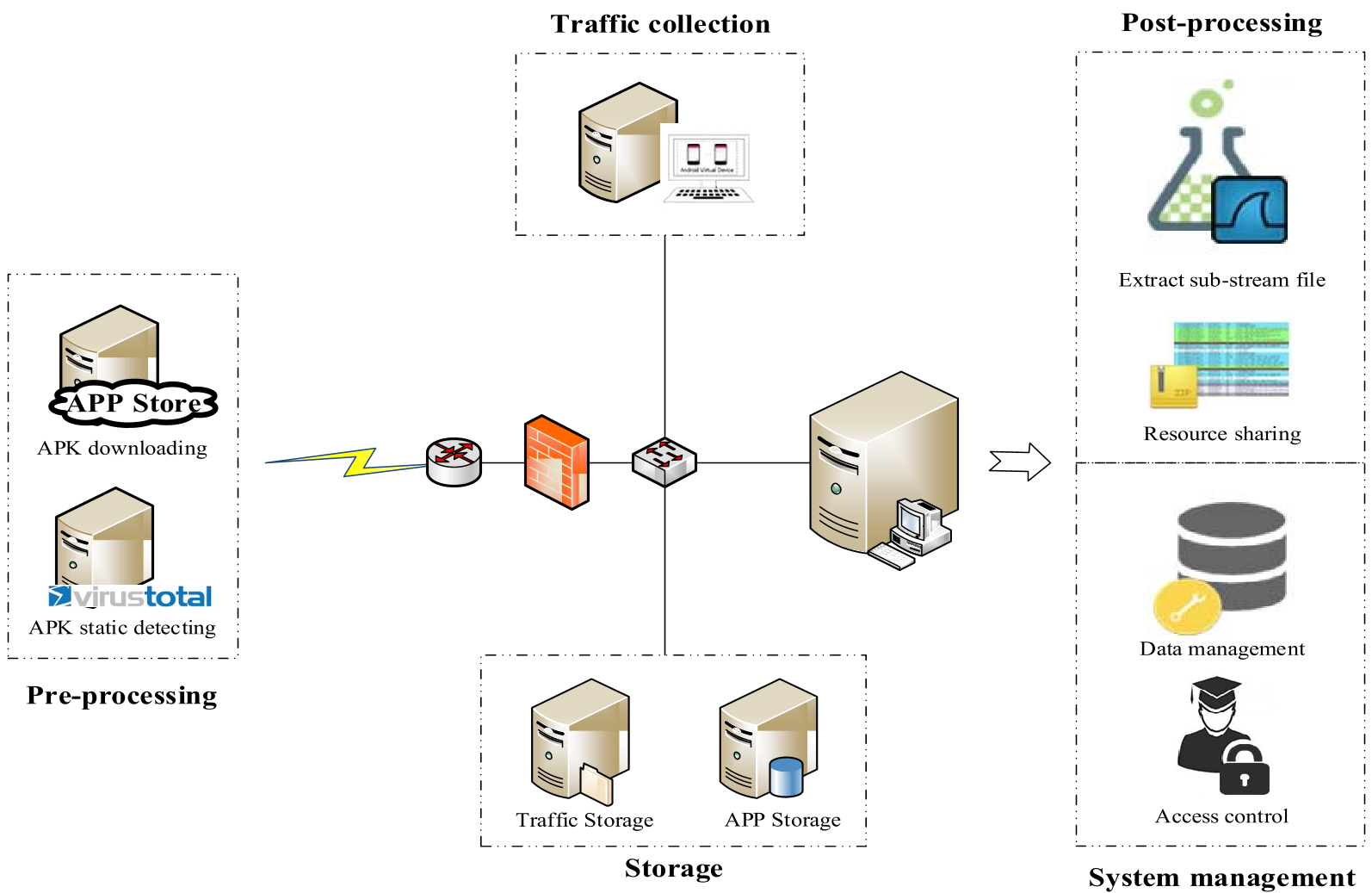
To gather enough data for analysis, the team built a sophisticated control and management system.
1. The Collection Pipeline
The system automates the lifecycle of malware analysis:
- Acquisition: Multi-threaded crawlers download APKs from 11 different App Stores.
- Static Filtering: Integration with the VirusTotal API provides ground-truth labeling.
- Dynamic Execution: A cluster of AVDs (Android Virtual Devices) executes the apps while
tcpdumpcaptures the network headers.
2. Attacking the Imbalance
Because the malicious samples were so sparse (only 33 specific malicious flows), the authors moved beyond standard training. They tested:
- Oversampling (SMOTE/ADASYN): Creating synthetic "malware-like" data points in the feature space.
- Ensemble Undersampling (BalanceCascade/EasyEnsemble): Iteratively training on balanced subsets of the majority class.
Experimental Showdown: Classic vs. Specialized Models
The results confirm a stark contrast. Standard classifiers (KNN, SVM, AdaBoost) showed excellent training metrics but crashed on the test set when tasked with identifying the rare malicious class.
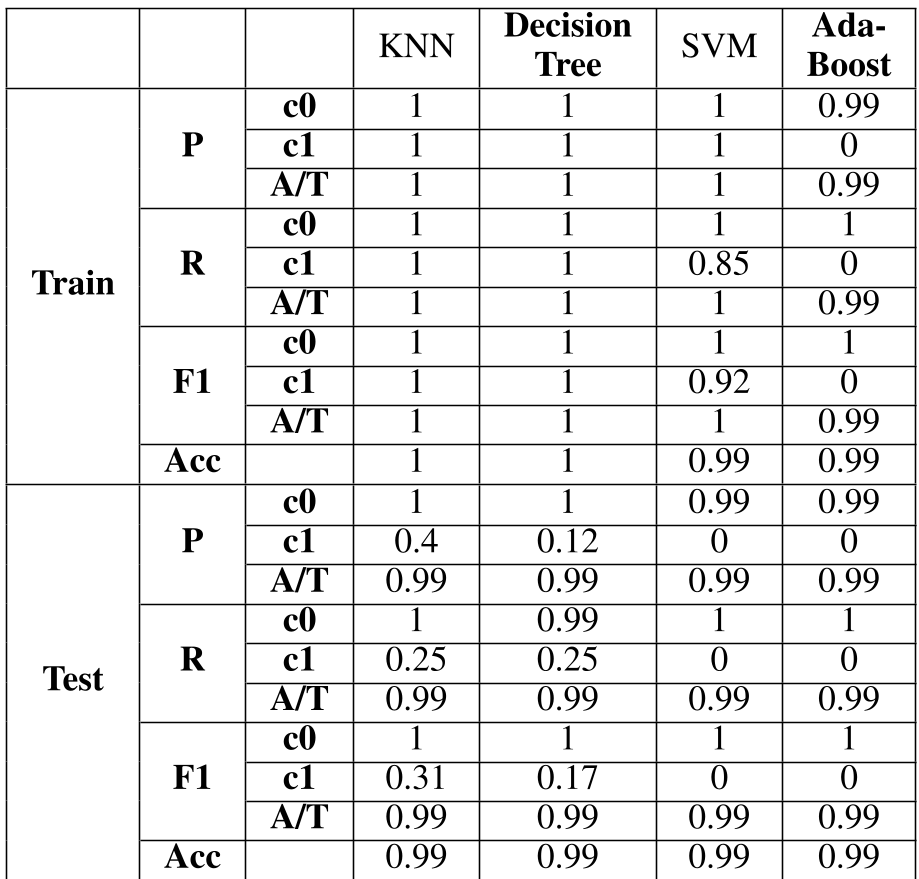
As shown above, the "c1" (Malicious) F1-score for standard SVM was 0, meaning it failed to catch a single malware instance in the test case despite its 99% accuracy.
By introducing SMOTE + SVM, the researchers achieved an AUC of 0.92, significantly outperforming the baseline. SMOTE works by interpolating between existing minority samples, effectively "filling the gaps" in the sparse malware feature manifold, allowing the SVM hyper-plane to better define the boundaries of malicious behavior.
 The AUC results demonstrate that specialized imbalanced methods are non-negotiable for real-world traffic analysis.
Critical Insight & Future Outlook
While the paper successfully highlights the importance of data rebalancing, it also uncovers the "Arms Race" in mobile security.
Limitations:
- Environment Awareness: Sophisticated malware can detect it is running in an emulator and "go dark," resulting in no malicious traffic captured.
- Traffic Encryption: With 91% of the traffic being HTTP, the study relies on statistical features (uplink/downlink volume). As HTTPS/TLS 1.3 becomes the standard, the community must move toward analyzing encrypted handshake metadata rather than just volume.
Conclusion: This work serves as a vital reminder that in cybersecurity, Recall is King. A system that misses 100% of malware while claiming 99.9% accuracy is a liability, not a solution. The transition to imbalanced learning techniques is the only path forward for reliable network-level defense.