
ANFIS-Based Decision Support: Orchestrating Regional Growth through Smart Specialization
6941_Building an ANFIS-Based Decision Support System for Regional Growth The Case of European Regions.
The paper introduces an Adaptive Network Fuzzy Inference System (ANFIS)-based Decision Support System (DSS) designed to assist European policymakers in regional resource allocation. By modeling the relationships between R&D investments, technological development (patents and employment), and regional GDP, the system achieves over 90% forecasting accuracy (Fitness Performance) for 134 EU regions.
Executive Summary
How do you decide where to invest millions of euros in public R&D when the goal is regional prosperity? This paper presents an ANFIS-based Decision Support System (DSS) that moves beyond qualitative "foresight" to provide a rigorous, quantitative framework for European policymakers. By leveraging the Smart Specialization Strategies (RIS3) framework, the authors demonstrate that an Adaptive Network Fuzzy Inference System can predict regional GDP growth with over 96% accuracy, offering a roadmap for prioritizing investments in R&D, patent development, and employment.
The Problem: Navigating the Complexity of Regional Investment
Policymakers face a persistent dilemma: should they focus on a region’s existing strengths (Specialization) or encourage new industries (Diversification)? Most existing tools are either purely qualitative (Delphi methods) or rely on rigid statistical models like ARIMAX, which fail when faced with high volatility and limited data points (small time series).
The core challenge lies in the non-linear relationship between Competitiveness Drivers (CD)—like R&D spending—and the final Outcome of economic growth.
Methodology: The Synergy of Fuzzy Logic and Neural Networks
The authors select ANFIS for its unique ability to thrive in "gray areas." ANFIS acts as a bridge:
- Neural Networks: Extract patterns and trends from historical data through automated learning.
- Fuzzy Logic: Translates these patterns into human-readable "If-Then" rules, allowing policymakers to understand why a set of conditions leads to growth.
Model Architecture
The research processes data through a two-stage ANFIS pipeline:
- Phase 1: Maps R&D inputs (Competitiveness Drivers) to intermediate performance indicators (Patents, Employment, Diversification).
- Phase 2: Uses those predicted intermediate values to forecast the final GDP per capita.
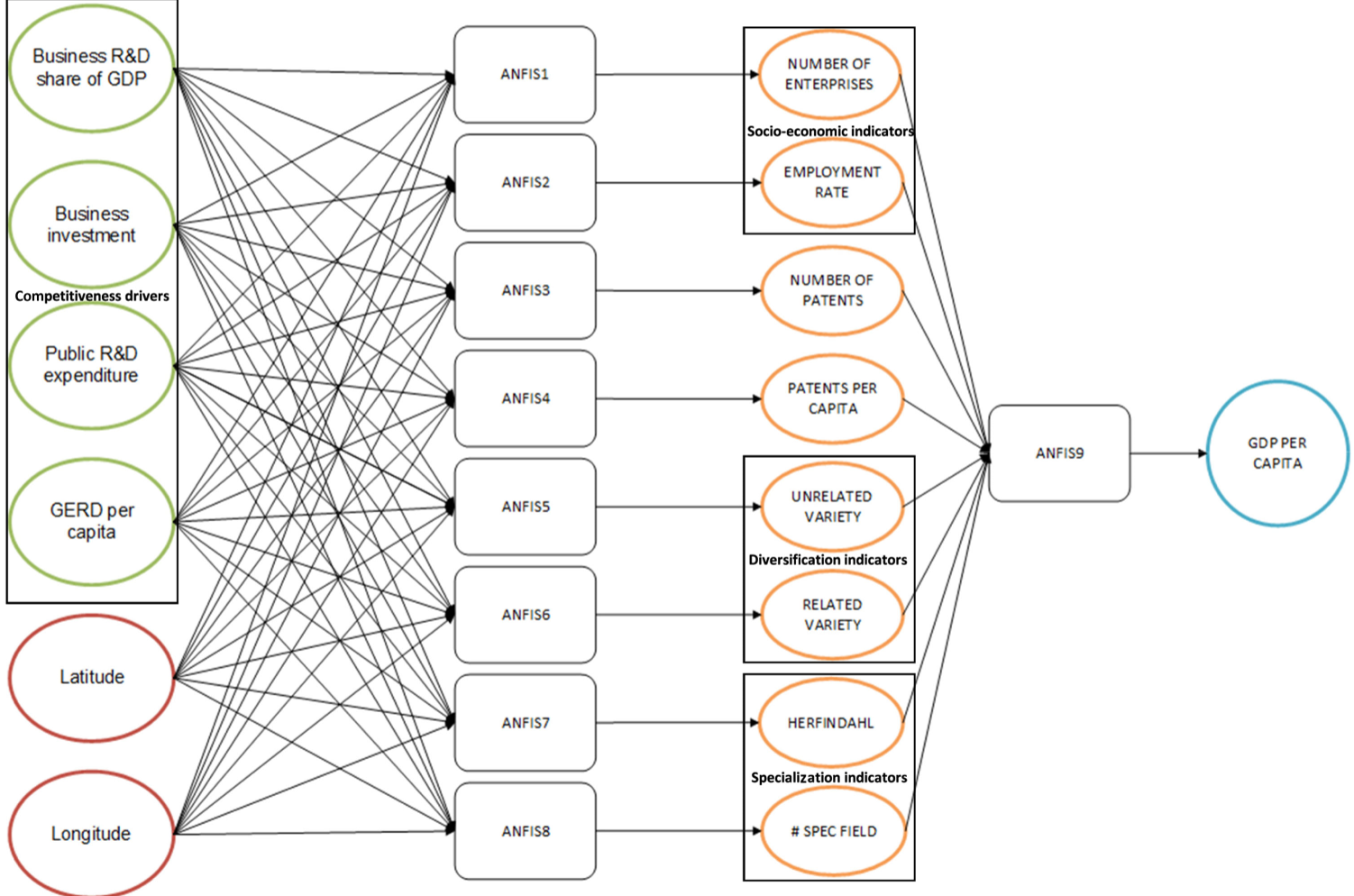
The study utilized several variants, including Model E (Exact values), Model D (Differences/Trends), and Model R (Ratios), further enhanced by spatial data (Latitude/Longitude) to account for cross-border knowledge spillovers.
Key Insights: Diversification vs. Specialization
The results from the ANFIS rules challenge some traditional views on specialization:
- The Power of Related Variety (RV): Growth is most robust when a region diversifies into similar technological domains. This allows for "knowledge spillovers" where expertise in one field fuels success in another.
- The Specialization Trap: High specialization (measured by the Herfindahl index) can actually negatively impact GDP if not accompanied by a high volume of patents per capita.
- The R&D Engine: Business investment and GERD (Gross Domestic Expenditure on R&D) are confirmed as the primary engines for increasing patents and employment.
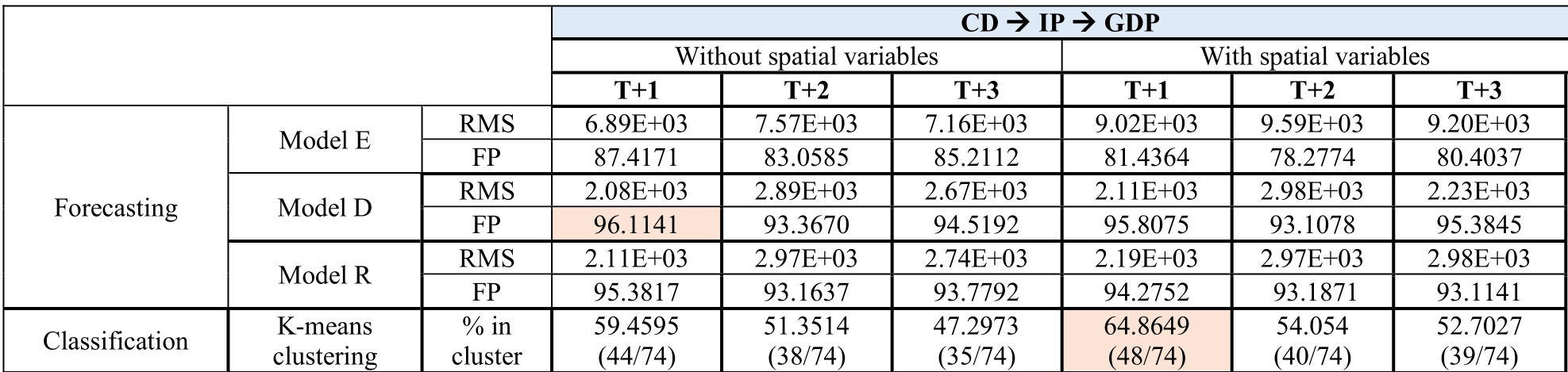
Performance Comparison
The Model D (Difference Model) emerged as the champion, effectively stripping away noise to focus on the change in variables.
Spatial Intelligence: Mapping Europe's Growth Zones
By incorporating spatial coordinates, the ANFIS model identified geographical clusters where specific investment strategies worked best.
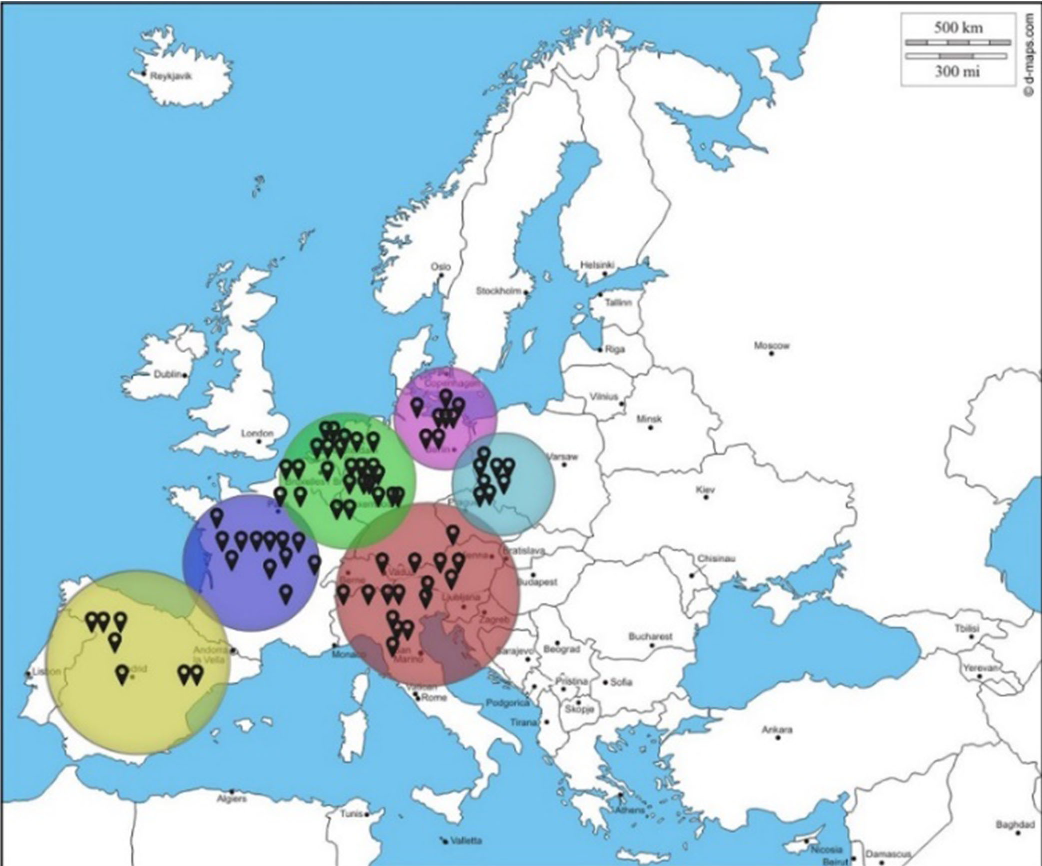 Fig: Clustering of regions (e.g., Zone 1: Mediterranean regions, Zone 3: Central Europe) showed that the impact of R&D can vary significantly based on a region's neighbors.
Conclusion and Future Outlook
This work validates ANFIS as a superior tool for socio-economic forecasting, hitting the "sweet spot" between predictive power and transparency.
The Takeaway for Reform: European regions should shift their focus from narrow specialization toward "Smart Diversification"—investing in sectors that share underlying technological roots with their current strengths.
Limitations: While powerful, the model currently relies on data up to 2011. Future iterations should incorporate more recent data to account for post-pandemic economic shifts and the rise of AI-driven patenting.