
ANFIS-Based Decision Support: Navigating the Complexities of Regional Growth in Europe
6941_Building an ANFIS-Based Decision Support System for Regional Growth The Case of European Regions.
This paper introduces an Adaptive Network Fuzzy Inference System (ANFIS)-based Decision Support System (DSS) designed to assist European policymakers in regional resource allocation. By evaluating the impact of competitiveness drivers on technological development and subsequent economic growth, the model achieves a forecasting fitness performance exceeding 95% in specific configurations.
TL;DR
Strategizing for regional economic growth is often a "wicked problem" for policymakers: should they double down on a region's existing strengths (specialization) or branch out into new fields (diversification)? This paper presents an ANFIS-based Decision Support System (DSS) that models the path from R&D investment to GDP growth. The findings suggest that diversification—specifically Related Variety—linked with a decrease in technological concentration, is the true engine of European regional wealth.
Background & Motivation: The RIS3 Dilemma
The European Union's Smart Specialization Strategies (RIS3) aim to make efficient use of public R&D investment. However, a central tension exists in the literature: does a region grow by concentrating resources (Specialization) or by fostering cross-pollination (Diversification)?
The authors argue that existing forecasting tools are either too black-box (Neural Networks) or too rigid for short-term, volatile data (ARIMAX). They propose ANFIS (Adaptive Network Fuzzy Inference System) as a middle ground: it learns from data like a neural network but outputs human-readable "if-then" rules that policymakers can actually use to justify resource titration.
Methodology: The ANFIS Bridge
The study utilizes data from 134 EU regions (2002–2011), categorizing 15+ variables into a three-stage causal chain:
- Competitiveness Drivers (CD): R&D expenditures (Public/Private).
- Intermediate Performance (IP): Patents, employment rates, and variety indices (Related/Unrelated Variety).
- Outcome: GDP per capita.
Architecture Overview
The ANFIS architecture uses a Takagi–Sugeno fuzzy inference system. By employing grid partitioning and subtractive clustering, the model maps numerical inputs into linguistic membership functions (Low, Medium, High).
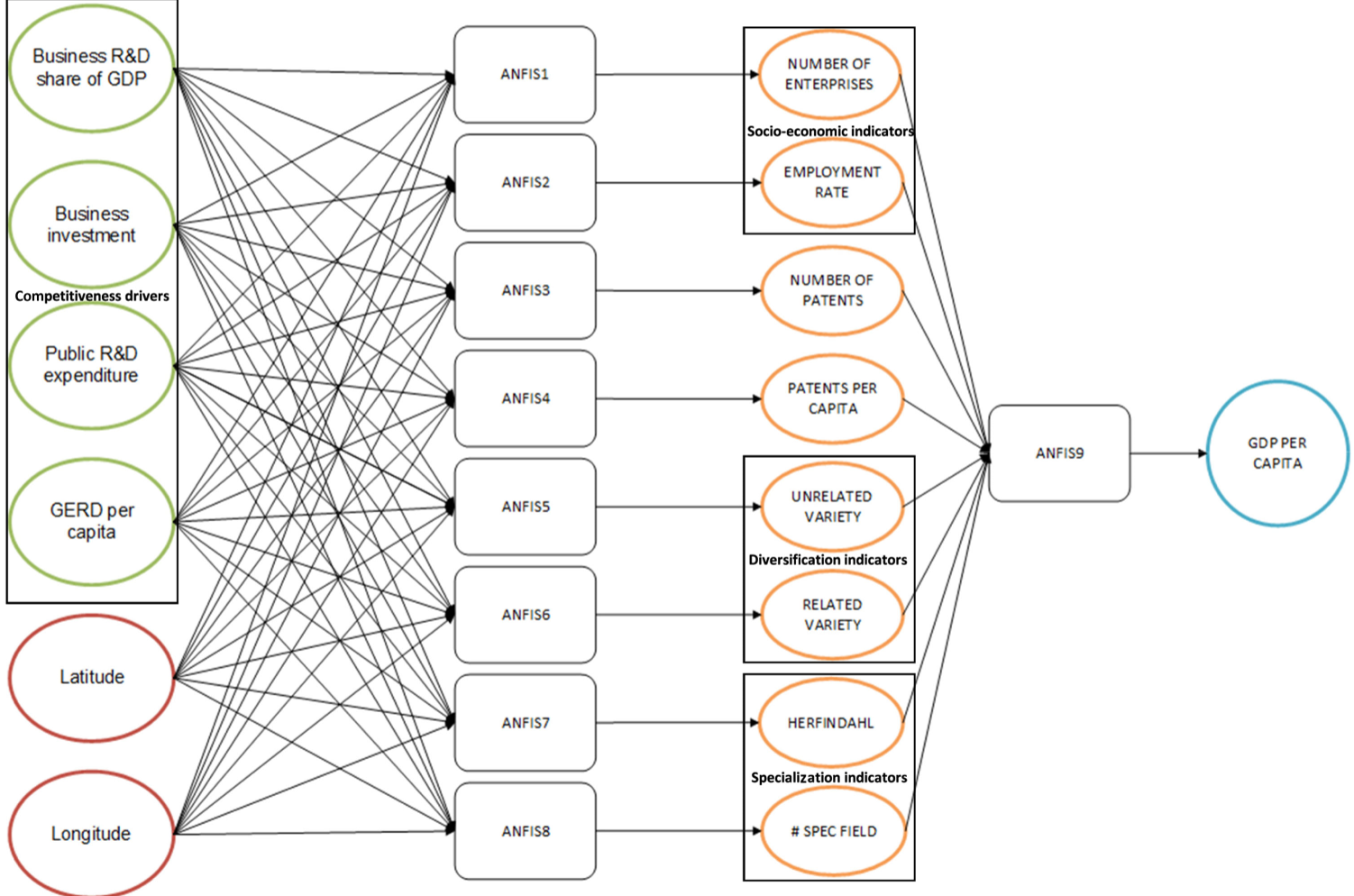 Figure 1: The multi-stage procedure of mapping R&D drivers to Intermediate Performance, and finally to regional GDP.
Key Insights: Why "More Patents" Isn't Always Better
The most striking discovery from the ANFIS rules is the conditional nature of innovation.
- The Specialization Trap: High patenting activity doesn't automatically equate to GDP growth. If the Herfindahl index (a measure of concentration) is high, an increase in patents may actually correlate with a decrease in GDP per capita.
- The Diversification Dividend: Growth is most robust when regions increase their Related Variety (RV). This means innovating in domains that are complementary to existing strengths, rather than just repeating the same technological feats.
- Spatial Significance: Using Latitude and Longitude as inputs improved classification accuracy, confirming that a region's growth is heavily influenced by its geographical "neighbors" and subsequent knowledge spillovers.
Experimental Results
The authors tested different data treatments, including "Exact Values" (Model E), "Differences" (Model D), and "Ratios" (Model R).
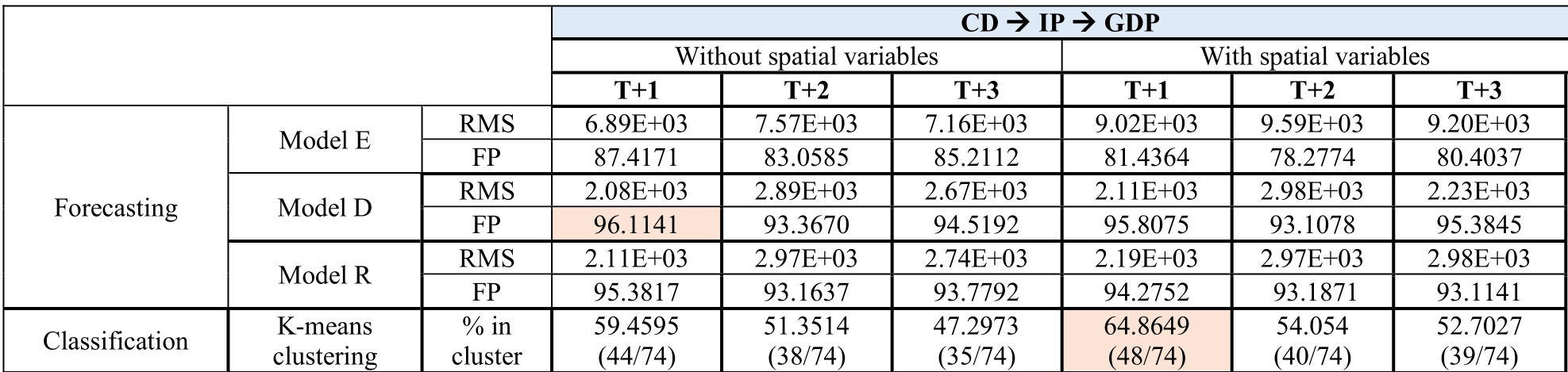 Table 1: The "Model D" configuration (measuring year-on-year change) significantly outperformed others, reaching a 96.11% Fitness Performance.
Critical Analysis & Conclusion
This work moves beyond simple linear regressions to capture the "messy" reality of economic development. While the high accuracy is impressive, it is important to note that the dataset precedes major global shifts like the post-2012 austerity measures or the digital transformation of the 2020s.
The Takeaway for Policy: Policy makers should prioritize Business Investment and GERD (Gross Domestic Expenditure on R&D) but monitor the "variety" of the output. If the regional portfolio becomes too specialized (High Herfindahl), the economic returns on R&D begin to diminish. The goal shouldn't just be more innovation, but smarter, more related innovation.
Future Outlook
While the current model uses NUTS 2 regional data, shifting to a more granular NUTS 3 level could yield even sharper insights into local industrial clusters. Furthermore, integrating "hard-coded" expert knowledge into the ANFIS rules could help the model account for qualitative shifts in policy that numerical data alone might miss.