
The GA-GID1-DELLA Circuit: The Molecular Logic of the "Inhibitor of an Inhibitor"
The angiosperm gibberellin-GID1-DELLA growth regulatory mechanism: how an "inhibitor of an inhibitor" enables flexible response to fluctuating environments.
The paper reviews the molecular mechanism of the Gibberellin (GA)-GID1-DELLA pathway, a pivotal growth regulatory system in angiosperms. It characterizes bioactive GA perception by the GID1 receptor, which triggers the proteasomal degradation of DELLA proteins—constitutive growth inhibitors—thereby enabling plant developmental plasticity in response to environmental fluctuations.
TL;DR
The "Green Revolution" was fueled by wheat and rice varieties that grew shorter and resisted lodging, yet the molecular engine behind this stayed hidden for decades. This review dissects the GA-GID1-DELLA mechanism, a sophisticated biochemical switch where the hormone Gibberellin (GA) acts as a "releaser." By triggering the destruction of DELLA proteins—which otherwise act as molecular brakes—GA allows plants to dynamically scale their growth in response to light, stress, and nutrient availability.
Problem & Motivation: The Genetic Mystery of Dwarfs
In the mid-20th century, geneticists observed "slender" mutants that grew tall regardless of hormone levels and "insensitive dwarfs" that stayed short even when sprayed with GA. This led to the "inhibitor of an inhibitor" hypothesis: plants possess an endogenous growth suppressor, and GA's job is to stop that suppressor.
The problem was identifying the "brake." Why did certain agricultural mutations (like the wheat Rht genes) cause dwarfing? The authors trace how molecular cloning revealed the DELLA proteins as these elusive inhibitors and how their failure to be "switched off" by GA led to the high-yielding crops of the Green Revolution.
Methodology: The Ternary Switch
The core of the GA response is a three-part machinery:
- Bioactive GA: The signal molecule.
- GID1 Receptor: A soluble nuclear protein that "pockets" the GA molecule.
- DELLA Proteins: The nuclear growth repressors.
The "Lid and Lock" Mechanism
When bioactive GA enters the pocket of GID1, it induces an allosteric change: an N-terminal "lid" closes over the GA molecule. This closed lid creates a high-affinity binding surface for the DELLA domain of the inhibitor proteins.
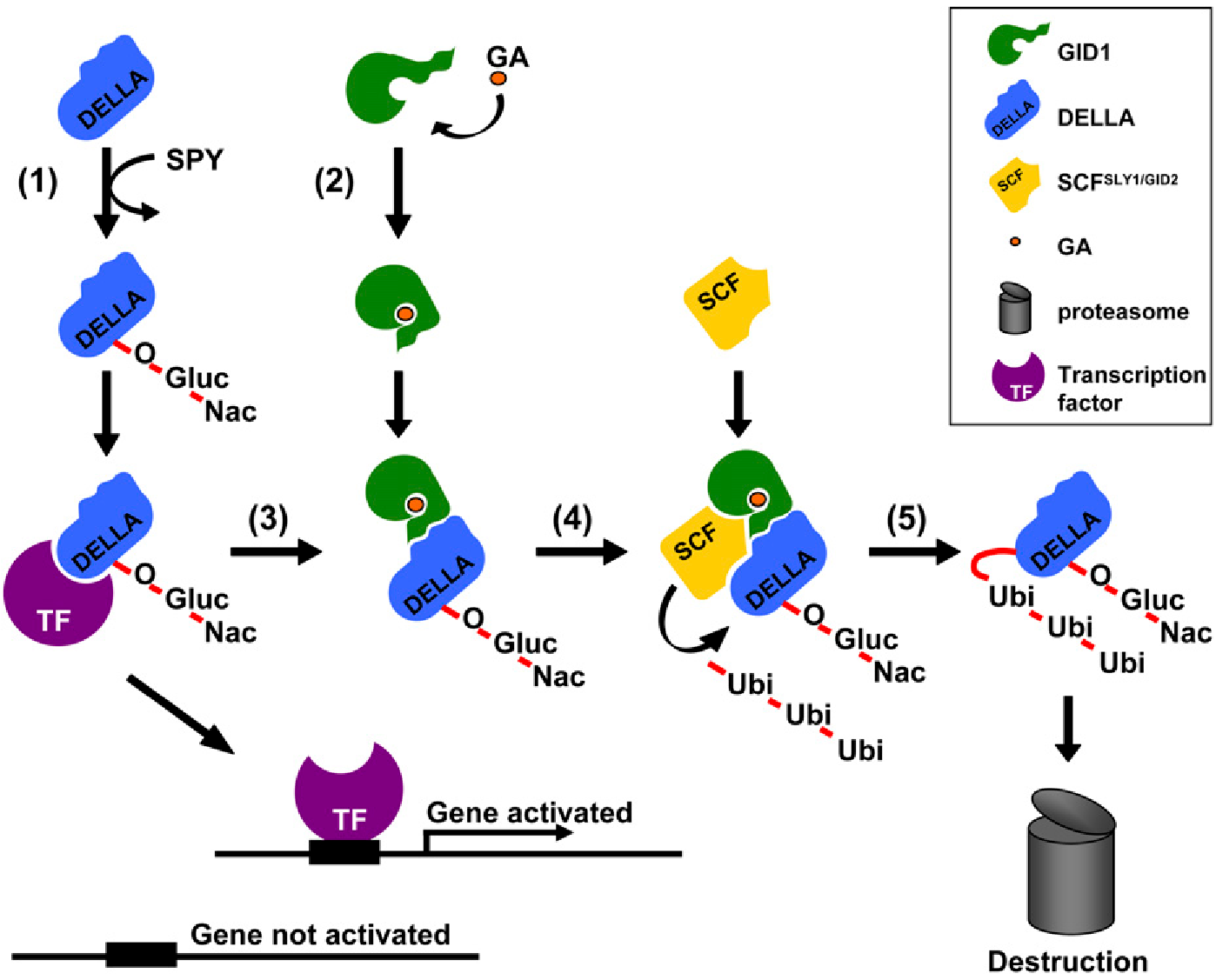
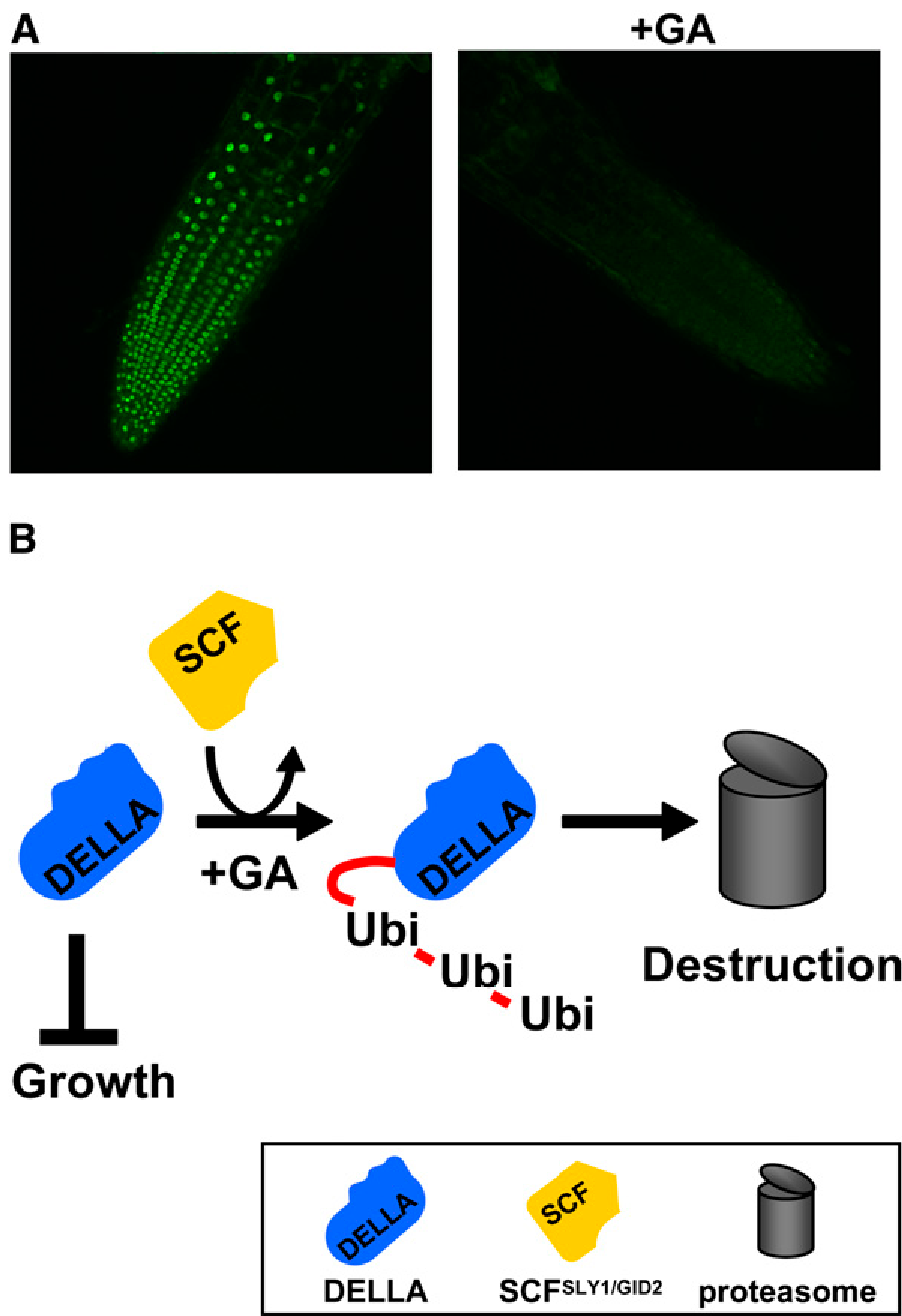
Once the GID1-GA-DELLA complex forms, the DELLA protein is recruited to an SCF E3 ubiquitin ligase (SLY1 in Arabidopsis, GID2 in rice). This leads to the polyubiquitination and subsequent destruction of the DELLA protein by the 26S proteasome. With the "brake" (DELLA) destroyed, growth-promoting transcription factors like PIF3 and PIF4 are free to activate genes for cell elongation.
Experiments & Results: Visualizing the "Disappearing Act"
One of the most striking pieces of evidence for this model comes from fluorescence microscopy. Using GFP-tagged RGA (a DELLA protein), researchers showed that the green signal in root nuclei vanishes within hours of GA treatment, effectively "clearing the path" for growth.
SOTA Comparison & Agricultural Impact:
- Wild Type: Responds to GA by degrading DELLAs; growth increases.
- Green Revolution Mutants (e.g., Rht-B1b): These carry a mutation in the DELLA domain. Because the "lid" of GID1 cannot grab the mutated DELLA, the protein is never degraded. The "brake" stays on permanently, resulting in a stable, high-yielding dwarf phenotype.
- Slender Mutants: These lack DELLA proteins entirely. They grow as if saturated with GA, even if the hormone is chemically inhibited.
Deep Insight: Stress Integration
The review’s most profound contribution is positioning the GA-GID1-DELLA circuit as an Environmental Sensor.
- Salt Stress: Increases GA-deactivating enzymes, causing DELLAs to accumulate and growth to stop, conserving energy for survival.
- Flooding: In rice, the Sub1A gene stabilizes DELLAs to prevent energy-wasting elongation underwater, allowing the plant to "wait out" the flood.
- Pathogen Defense: DELLAs modulate the balance between Salicylic Acid and Jasmonic Acid, suggesting they regulate more than just physical height.
Conclusion
The GA-GID1-DELLA mechanism is not just a growth pathway; it is an evolutionary masterpiece that enables angiosperms to be sessile yet flexible. It translates chemical signals into proteomic destruction, ensuring that a plant only invests in growth when its environment permits.
Future Outlook: The next frontier lies in understanding "non-degradable" DELLA signaling and how the SPY enzyme (O-GlcNAc transferase) modifies DELLA activity independently of hormone levels, potentially offering new ways to engineer climate-resilient crops without sacrificing yield.