
The GA-GID1-DELLA Nexus: Decoding the Molecular "Handbrake" of Plant Growth
The angiosperm gibberellin-GID1-DELLA growth regulatory mechanism: how an "inhibitor of an inhibitor" enables flexible response to fluctuating environments.
The paper reviews the regulatory mechanism of the phytohormone gibberellin (GA), focusing on the GA-GID1-DELLA "inhibitor of an inhibitor" module. It details how GA triggers the degradation of DELLA growth repressors via the GID1 receptor and SCF-type E3 ubiquitin ligases, a system fundamental to angiosperm environmental adaptation and the "Green Revolution."
TL;DR
This review uncovers the elegant molecular machinery that allows flowering plants to "toggle" growth in response to their environment. At its heart is the GA-GID1-DELLA mechanism—a sophisticated "inhibitor of an inhibitor" system. By orchestrating the destruction of DELLA growth-repressing proteins through gibberellin (GA) perception, plants can dynamically adjust their architecture to survive salt, cold, and competition.
Contextual Positioning
Within the coordinate system of plant biology, this work transitions the GA pathway from a classical hormone study to a modern signal integration model. It bridges the gap between historical genetic observations of "slender" mutants and the high-resolution structural biology of the 21st century.
Problem & Motivation: The Invisible Inhibitor
For years, plant biologists observed that certain mutants grew tall regardless of hormone levels—a phenomenon termed "slender." This led to the 1957 hypothesis that growth is naturally inhibited by an endogenous factor, and GA's primary role is simply to remove this "handbrake." The challenge was identifying this brake and understanding how a small diterpenoid like GA could precisely trigger its removal.
Methodology: The Molecular Architecture of Response
The paper details a three-component relay:
- DELLA Proteins: These are the "handbrakes." Found in the nucleus, they don't necessarily bind DNA directly; instead, they act as biochemical sequestrators, grabbing growth-promoting transcription factors like PIFs (Phytochrome Interacting Factors) and preventing them from activating growth genes.
- GID1 Receptor: A soluble nuclear receptor with a deep pocket tailored for bioactive GAs.
- SCF-E3 Ligase: The cellular "disposal" tagger.
The "Inhibitor of an Inhibitor" Mechanism
When bioactive GA enters the GID1 pocket, a flexible "lid" on the receptor closes. This structural change creates a high-affinity surface for the DELLA domain of the repressor.
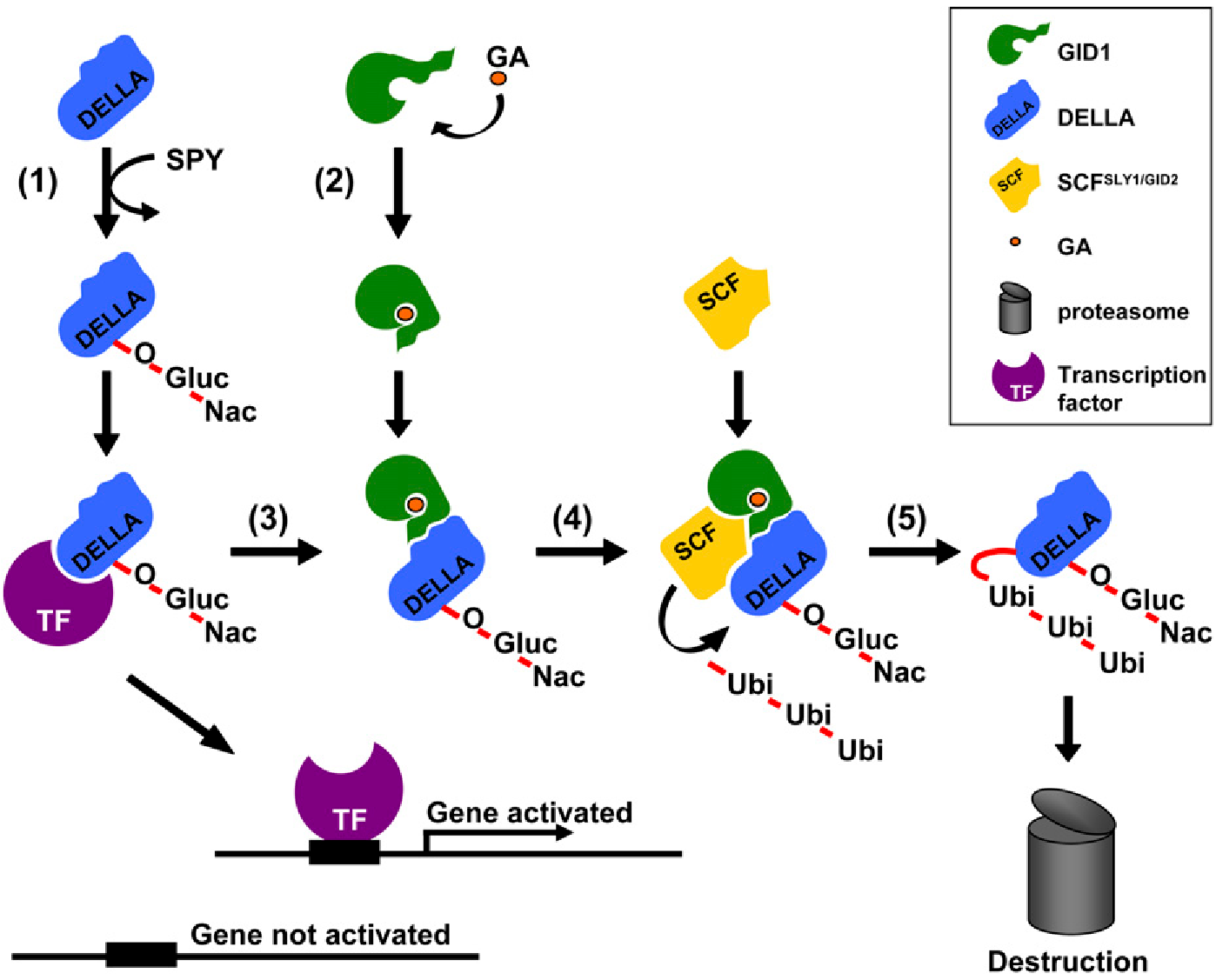 Figure: The GA-GID1-DELLA regulatory circuit. GA binding to GID1 facilitates DELLA recognition, leading to polyubiquitination and degradation via the 26S proteasome.
Experiments & Results: Adaptation through Arrest
The review highlights that this mechanism is not just for elongation; it’s a survival strategy. Under salt stress, plants downregulate GA biosynthesis. This leads to an accumulation of DELLA proteins, which effectively "locks" the plant in a state of growth arrest.
- Abiotic Stress: Salt-stressed plants with high DELLA levels exhibit much higher survival rates than those lacking DELLAs.
- The Green Revolution: The authors emphasize that the high-yield wheat varieties () are essentially "hyper-stable" DELLA mutants. Their growth inhibitors are less sensitive to GA, resulting in shorter, sturdier plants that can support heavier grain loads without lodging.
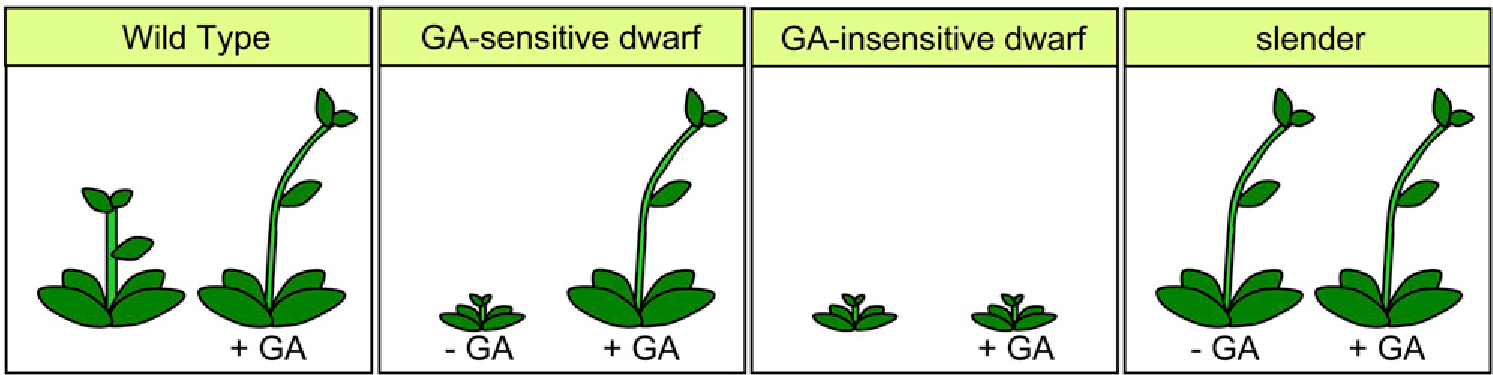 Figure: Phenotypic comparison showing how DELLA mutations dictate plant height and hormone sensitivity.
Critical Analysis & Conclusion
Takeaway
The GA-GID1-DELLA mechanism represents a "nodal" point in plant evolution. It provides a single output channel (growth) for a massive array of input signals (light, ethylene, auxin, and stress).
Limitations & Future Work
While the "degradation" model is well-supported, the authors intriguingly point out that destruction isn't the only way to stop inhibition. The mere formation of the GID1-GA-DELLA complex might be enough to interfere with DELLA's ability to sequester transcription factors, even before the proteasome arrives.
Future research must address:
- The bHLH Spectrum: Do DELLAs interact with a broader range of the basic helix-loop-helix family than currently known?
- Resource Allocation: How exactly are the energy savings from growth arrest diverted into secondary metabolic defense?
By mastering this molecular switch, we gain not just a better understanding of plant development, but the tools to engineer the next generation of climate-resilient crops.