
AnnEvol: Quantifying the Semantic Evolution of Biomedical Ontologies
AnnEvol: An Evolutionary Framework to Description Ontology-Based Annotations
AnnEvol is an evolutionary framework designed to measure the quality and dynamics of ontology-based annotations over time. It utilizes a novel annotation set-wise description approach, leveraging semantic similarity measures and bipartite graph matching to track how groups of annotations evolve across different dataset versions.
TL;DR
AnnEvol is a sophisticated framework designed to address a hidden crisis in bioinformatics: the "apparent" degradation of annotation quality as datasets grow. By shifting the focus from individual annotation terms to semantic sets, the authors provide a quintuple-based metric system to track how knowledge evolves, becomes obsolete, or branches out into new discoveries.
Contextual Positioning
In the landscape of the Semantic Web, the Gene Ontology (GO) and UniProt serve as atlasses for biological functions. However, as our knowledge expands, these maps are redrawn. AnnEvol sits at the intersection of Ontology Evolution and Data Mining, providing a benchmark for the "health" of annotated datasets.
Problem: The "Paradox of Growth"
Traditional metrics often suggest that as we add more annotations to proteins, the correlation with gold-standard similarity measures (like Sequence Similarity) decreases.
The authors identify the culprit: Non-uniform evolution. When one protein gains 50 annotations while its relative gains only 5, traditional 1-to-1 matching protocols fail. We need a way to see "groups" of knowledge rather than just a list of tags.
Methodology: The Quintuple of Change
AnnEvol evaluates the transition between two generations of a dataset using a quintuple :
- Group Evolution (s): Uses the AnnSig measure to find a many-to-many matching between old and new sets.
- Unfit Annotations (n): Terms that vanished without being replaced by something similar.
- New Annotations (w): Fresh knowledge not present or even hinted at in the previous version.
- Obsolete Annotations (o): Terms removed because they are no longer in the ontology.
- Novel Annotations (v): Annotations using brand-new terms added to the ontology version.
Architecture: Bipartite Matching for Semantics
The core of the method is the construction of a bipartite graph between two generations of annotations.
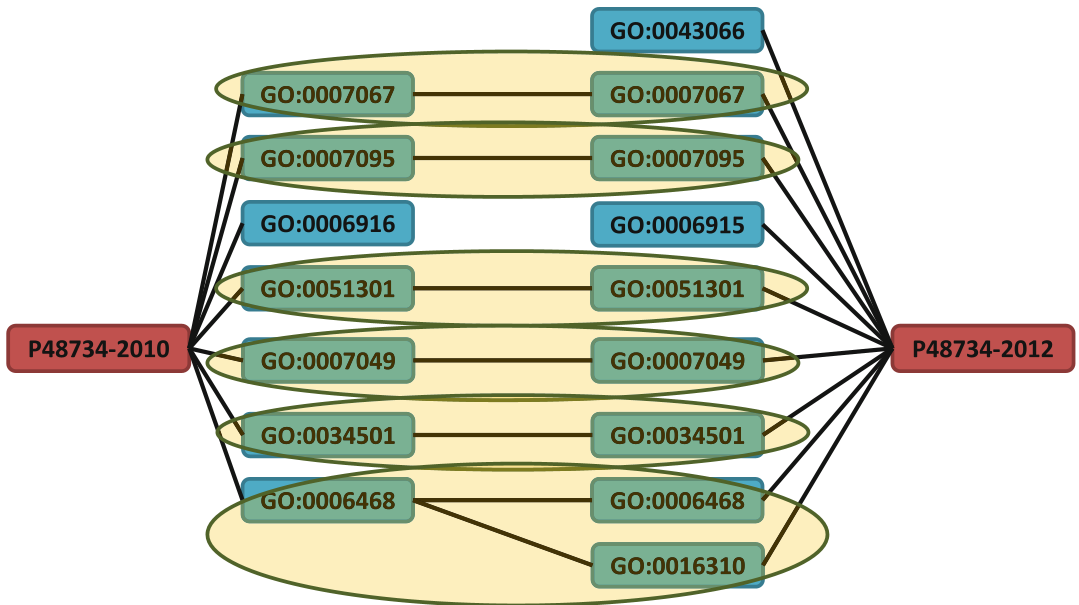 In this graph, clusters (yellow ellipses) represent stable or evolving knowledge. Isolated nodes indicate knowledge retraction or purely new additions.
Experiments and Key Findings
The researchers analyzed UniProt-GOA (automated/electronic) and Swiss-Prot (manually curated) from 2010 to 2014.
Stability vs. Monotonicity
- Swiss-Prot showed higher Stability (0.371), meaning many proteins didn't change at all. However, when they did change, the shifts were "stronger" and more disruptive.
- UniProt-GOA showed higher Monotonicity (0.817), suggesting that while it changes constantly, it rarely "loses" old knowledge; it mostly refines and adds to it.
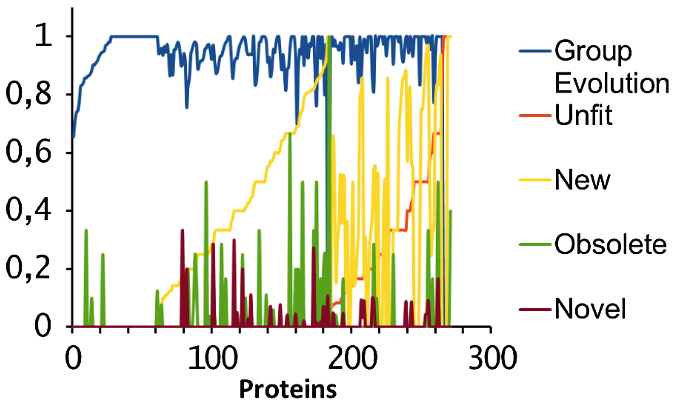 The visual evidence shows UniProt-GOA (left) has more "ordered" evolutionary trends compared to Swiss-Prot, confirming that electronic annotations follow more predictable expansion patterns.
Deep Insight: Why This Matters
The most striking takeaway is the explanation of the Gini Coefficient in annotations. The inequality of how proteins are studied (some are "celebrity" proteins with massive annotation sets, others are "lonely") creates a noise that standard similarity measures can't ignore. AnnEvol’s semantic grouping effectively filters this noise by focusing on "semantic density" rather than raw term counts.
Conclusion and Limitations
AnnEvol is a powerful diagnostic tool for anyone maintaining large-scale curated datasets.
- Value: It differentiates between "deleting knowledge" and "updating knowledge to more specific terms."
- Limitation: The current model relies heavily on the underlying ontology-based similarity measure (). If the taxonomy itself is flawed, the quintuple metrics may inherit that bias.
Future work aims to use these patterns to build recommender systems for annotators, suggesting common term substitutions and detecting when an annotation set has become "stale" relative to its peers.